
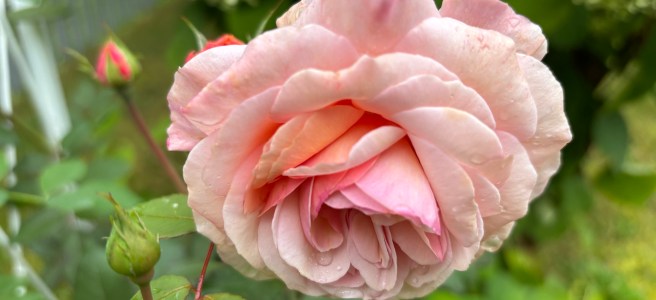
I delayed writing on the topic of gardening and growing roses so many times. It seemed to me that writing about these small everyday issues in a time of polycrisis was an unaffordable luxury (and a guilty pleasure). However, observing sociological and global trends in the countryside garden of the Moscow region, which lies in climate zone five, prompted me to sit down and write my thoughts out.
I am an apprentice gardener who started growing roses several years ago. My first involvement in this activity overlapped with my post-PhD life. By adopting this active hobby, I could not have imagined that growing, and especially growing roses, would captivate me so much. Apart from the emotional involvement, growing drew me into sensing changes in the seasons and experiencing the weather atmosphere in the garden.
Recently, I came across an English translation of a fairy tale, Roses: A Social Hypothesis, written by the German sociologist Georg Simmel. In this short piece, Simmel reflects on the emergence of inequalities in a fictional village, where some residents could cultivate beautiful roses thanks to their efforts and the good quality of soil on their plots, while non-rose owners cultivated envy and resentment towards their luckier neighbours. Robert van Krieken, the translator of this tale, comments on its moral, saying that in such a way Simmel shows the impossibility of getting rid of inequalities, and claims that ‘[t]he pursuit of equality is in many respects a Sisyphean endeavour’.
As a sociologist of inequality, I would debate this interpretation of Simmel’s work and disagree with van Krieken’s comparison of the pursuit of equality with a ‘Sisyphean endeavour’. Nevertheless, Simmel’s reflection on roses evoking feelings in people is of great interest to sociological analysis. I will leave it as an open question whether roses in a neighbour’s garden really evoke envy and resentment, or perhaps admiration and pleasure, while being observed publicly by the village residents. But what is undeniable is that growing and viewing roses is an affective experience.
I was convinced of this when I planted out the first thirteen shrubs of roses with my little relatives back in the spring of 2022. Among them were varieties of roses bred in different countries, including Russia, Germany, France and Britain, which we bought from a local rose nursery. At that time, I was curious about the connections between literature and growing, and little by little my attention was drawn to English roses bred by the gardener David Austin on his farm in Shropshire, in the Midlands, and named after fictional characters and writers.
Thus, a new literary and gardening world of roses opened up to me. That is how Lady of Shalott and A Shropshire Lad joined the community of roses in the garden.
To my surprise, David Austin’s roses proved to be popular among Russian growers, kindly calling them ‘ostinki’, or just English roses (‘angliiskie rosy’). The secret behind this popularity lies in the fact that English roses are unpretentious to cultivate and resilient in low temperatures. They survive the Russian winter well, being grafted onto rose hips to remain frost-resistant. In climate zone five and cooler, gardeners usually cover roses with protective materials or wooden boxes to save them during winter.
However, not all roses winter easily. From my observation, the tender Queen of Sweden, an English rose, wakes up best of all in the spring, while French varieties, such as the charming Emilien Guillot, freeze slightly and need some time to come back to life for a new growing season. I have quickly learnt that roses are sensory creatures, as they react to fluctuations in temperature and weather conditions. When it rains too much, they need additional care and treatment against dampness. When it is hot, they need to be watered well and fed with fertilisers. From time to time, they need to be protected from aphid invasions if ants create anthills nearby.
Returning to literature and roses, I was surprised to read the news about that A Shropshire Lad, the English rose named after the main character from the poem of the same name by Alfred Edward Housman, is no longer sold in the UK because of climate change which has resulted in evolving diseases and pests, and heatwaves on the island. However, it is still possible to find this rose in rose nurseries and garden centres in Russia. The same is true for the William Morris rose, also created by David Austin, which has stopped being sold in the UK but can be found in southern Russian regions, while still being too warm-loving and hard-growing in northern regions.
I have noticed that the experience of growing roses and other plants has widened my senses of perception and helped me think-feel locally and globally at once. Through growing roses, I found that this activity makes people more sensitive not only to atmospheric fluctuations and weather change in local areas but also to the global atmosphere and climate change.
XXXV
On the idle hill of summer,
Sleepy with the flow of streams,
Far I hear the steady drummer
Drumming like a noise in dreams.
Far and near and low and louder
On the roads of earth go by,
Dear to friends and food for powder,
Soldiers marching, all to die.
East and west on fields forgotten
Bleach the bones of comrades slain,
Lovely lads and dead and rotten;
None that go return again.
Far the calling bugles hollo,
High the screaming fife replies,
Gay the files of scarlet follow:
Woman bore me, I will rise.
From the poem A Shropshire Lad by A. E. Housman (1896)

 Alexandrina Vanke