On the poetics of The urban life of workers in post-Soviet Russia

The recent news about the outbreak of the Israel-Palestine war and the ongoing Russia-Ukraine war and the Armenia-Azerbaijan war makes me really sad. This news put me back to the reflection on how social scholars should write in the age of multiplication of conflicts, crises and catastrophes.

I finish The urban life of workers in post-Soviet Russia – to be out just in three months – with the suggestion to invent alternative genres of writing about social reality, society and ordinary people who suffer most from wars, crises and catastrophes. My book ends with a ready-made: ‘Toward the bright future of emergent genres!’ A ready-made is an avant-garde piece of text or art made of already existing objects, images or phrases, etc. which gain new meanings being placed into a new context (read more here).

The final sentence of my book starts with the phrase usually associated with Vladimir Lenin’s slogan ‘Toward the bright future’. On the one hand, it refers to the residualised form of expression, while the residual is always alternative to the dominant, according to Raymond Williams.On the other hand, it performatively calls for novatory action aimed to engage the creativity and imagination of a reader. Thus, it produces the possibility or hope for the emergence of genres different from the dominant ones.

When it is hard to express feelings and thoughts with prose, especially in the ages of wars and catastrophes, people often resort to poetry building on the symbolic, imaginative and rhythmic use of language. At this point, the reader may wonder what poetical can be about the book written in the genre of academic non-fiction.

While writing the book, I integrated some poetic forms in my discursive strategy aimed to represent workers alternatively to their negative, stigmatising representations reproduced in the mainstream academic and media discourses. The avant-garde poetry of the 1920s and the romantic poetry of the late 18th century inspired my academic non-fiction. Below, I shed light on the poetics of The urban life of workers in post-Soviet Russia.

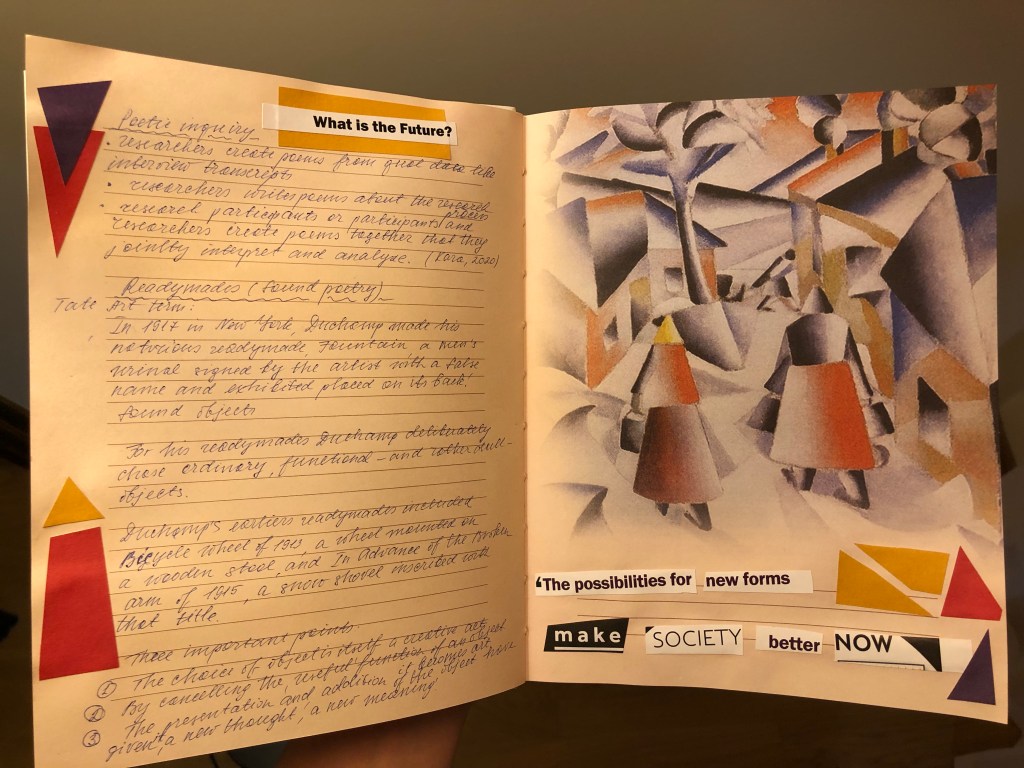
The book opens with my ready-made poem signed with ‘the author’:

What is the Future?

The possibilities for new forms.

Make SOCIETY better NOW!

– A ready-made poem by the author

This poem invites the reader to think about the meaning of the future and calls for action to make society better right now, at least at the level of everyday life. The poem also explains that the future can be viewed as the possibility for new forms of living, creating, writing, etc. The use of three different punctuation marks and upper and lower cases in the three-line poem helps me keep it rhythmic, performative and concise.

My ready-made poem about the future in the visual format © Alexandrina Vanke

I crafted this poem out of booklet and magazine clippings. I cut sentences out first and then glued them on the notepad page already filled with my handwritten notes about ready-made (found) poetry as arts-based research method.

Another example of how I used poetry in academic non-fiction is citing a poem by futurist poet Vladimir Mayakovsky. I included his All hail to subbotniki! in the book to illustrate the meanings of subbotnik, a collective clean of the neighbourhood or the workplace in a day off. (You can read more about this practice here). As far as I did not find an English translation of this poem written in Russian, I translated some of its parts for Chapter 7 covering the theme of the creative forms of everyday resistance.

All hail to subbotniki!

1. Hey, comrades, railway man

and water-transport worker!

2. Remember,

each honest worker

should go to subbotnik! […]

8. All move to subbotnik,

9. and the road will be fixed,

cleaned

and cleared.

Rosta No. 611. November 1920

The poem written in the avant-garde genre one hundred years ago performs several functions in my academic non-fiction about contemporaneity. It provides the reader with the example of the ideological meaning of early-Soviet subbotnik and helps me to show how the meaning of this practice evolved by the 2020s. Apart from this, Mayakovsky’s poem exemplifies performativity calling for action in the avant-garde poetic form which partly inspires (but not pre-determines) my discursive strategy. In this case, the poem by another author illustrates my ethnographic writting about a particular research theme.

The poem All hail to subbotniki! by Maykovsky (on the right-hand side) and his another visual poem (on the left-hand side) taken from the online database of the Russian State Library

The final example which I would like to give is about integration of poetic forms in the skeleton of academic non-fiction. One of the reasons why you may like or not like The urban life of workers in post-Soviet Russia is that the romantic poetry inspired its table of contents and framed its structural composition. The book consists of three parts, Part I: Theoretical sketches, Part Il: Ways of life and Part III: Ways of struggle, which reminiscent of the titles of poetry collections by William Blake, Poetical Sketches (1783) and two parts of his Songs of Innocence and Experience: Songs of Innocence and Songs of Experience (1789–1794).

You may ask: ‘What is William Blake doing in non-fiction about Russia’s workers?’ First of all, I integrated some elements of Blake’s poetry because the romantic poets made a discursive revolution in English literature breaking with the Shakespearian tradition without denying it. One can criticise Blake for being ‘mystic’, the Lake Poets for being ‘arrogant’ and the romantic poetesses for being too focused on their feelings, but their forms of expression helped me figure out my writing strategy about workers aimed not to romanticise them but represent them as they are through the alternative (to the dominant) stylistic means.
If you would like to know more about how these poetic genres allowed me to convey the dominant feelings of the age and creatively tell the story about working-class people, you can pre-order The urbanl life of workers in post-Soviet Russia via your University library or recommend it to your librarian.

On the front cover image of The urban life of workers in post-Soviet Russia

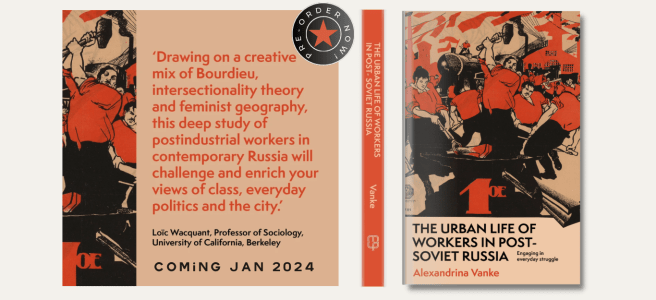
On the background of hot debates about Russia, I got the final version of the front cover of my forthcoming book to be released just in four months, on 16 January 2024. Drawing on multi-sited ethnography, The urban life of workers in post-Soviet Russia: Engaging in everyday struggle creatively explores the lived experiences of working-class and wider deindustrialising communities in the cities of Moscow and Yekaterinburg, and beyond.

In this blog post, I would like to discuss the visual aesthetics of the book mainly focusing on its front cover image. It contains some elements of the poster The 1st of May. The All-Russian subbotnik created by graphic artist Dmitrii Moor (Orlov) in 1920. A brief overview of his life will help to explain better his artistic approach. Moor was born in the family of an engineer in Novocherkassk in 1883. After moving to Moscow in 1989, he got a vocational education and participated in the Revolution of 1905. This experience made him realise that he should present the voice of working-class people through the artistic means (see Kozlov, 1949). Moor did not have a formal art education, but inside the country, he was considered to be a People’s Artist, while his art was called ‘proletarian art’. To the international audience, Moor may be known for his avant-garde posters and political caricatures.

The photo of the poster The 1st of May. The-All Russian subbotnik by Dmitrii Moor (Orlov) taken by Alexandrina Vanke in the Lenin Library

In The 1st of May, Moor depicted working-class people on May Day engaged in building and maintaining not only the industrial urban infrastructure but also the fabric of everyday life. This visual representation of workers as acting aligns with my main argument about workers’ engagement in the creative forms of mundane resistance which, as I explain in the book, falls under the category of everyday struggle.

For the greater effect, Moor used a combination of black, beige and red colours which characterise his graphic art style. The message of his image is clear and concise. The poster realistically shows the urban life of workers and emphasises their class consciousness: the themes my book explores in detail. In the background, one can see the industrial urban landscape with the train, some factories and power lines telling us about industrialisation and electrification in the early-Soviet era. There are two inscriptions on the top reading ‘Russian Socialist Federation of the Soviet Republic’ and ‘Workers Of All Countries Unite!’ (see also). There is the capitalised poster title at the bottom.

In his poster, Moor glorifies subbotnik – the word derived from subbota meaning Saturday – which is a voluntary collective activity of cleaning and maintaining the urban infrastructure or the workplace emerged right after the October Revolution. Subbotniks usually took place on days off around Vladimir Lenin’s birthday on 22 April. Very quickly from a volunteer activity they turned to be free labour of Soviet people. Emerged in the early-Soviet era, subbotnik as a practice survived the dissolution of the USSR and has gained new meanings in contemporary Russia. In Chapter 7, I analyse top-down and grassroots subbotniks organised in one industrial neighbourhood where I did ethnography.

I especially enjoy that Moor’s image shows not only the strength of working-class men but also working-class women. Chapter 3 of my book considers power relations in deindsutrialising communities mediated by the intersections of class, gender, age and ethnicity/race.

Before I started writing the book, I thought that Moor’s image may be good for the front cover. To obtain this image in high resolution, I went to the Lenin Library in Moscow, ordered it from the archive and photographed it. As far as another poster was glued on the backside of The 1st May from the library’s collection, some of the bleedthrough from it are visible in my photo.

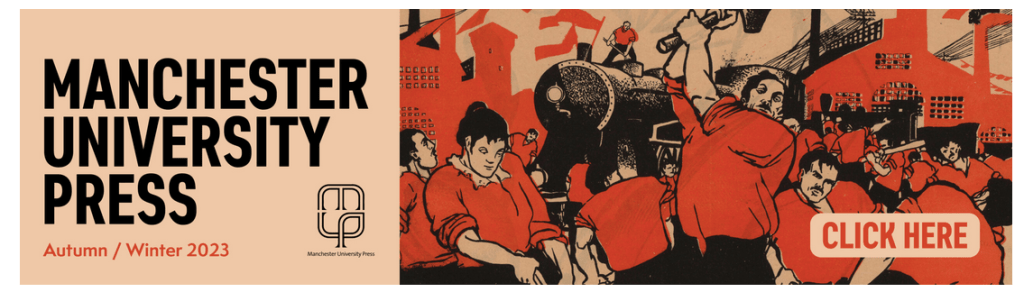
The image by Dmitrii Moor (Orlov) used for Autumn/ Winter 2023 catalogue of Manchester University Press

At the stage of book production, I suggested the publisher to use my photo of Moor’s poster for the front cover. It was so exciting to see that Manchester University Press put this image on the front cover of their Autumn/ Winter 2023 catalogue.

The MUP designer created several front covers for my book differed by the title fonts and colour shades. I am very glad that in its final version, Moor’s avant-garde image from The 1st of May aesthetically resonates with the title font of The urban life of workers in post-Soviet Russia.

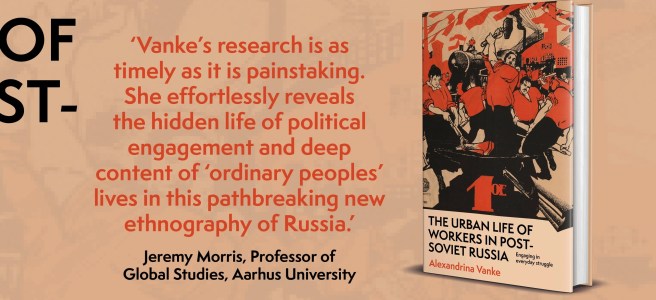
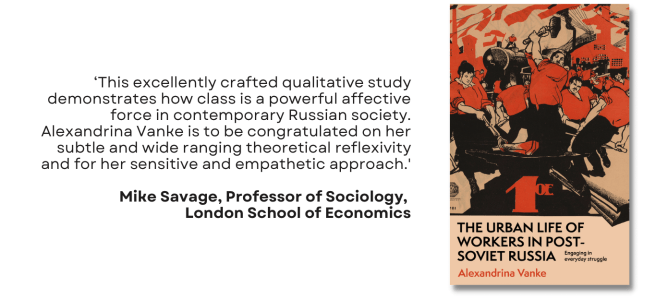
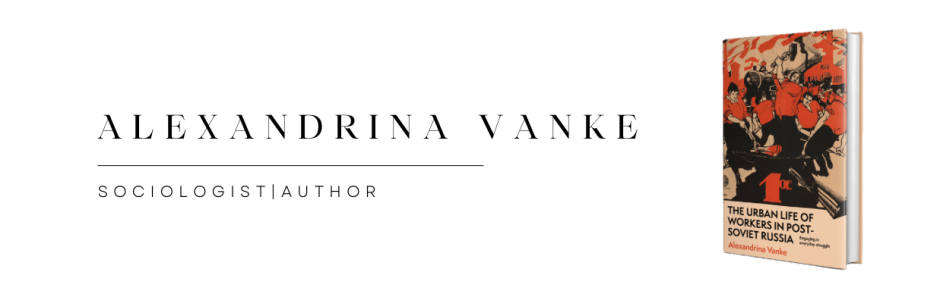
The final front cover of my book

You can find the book details and recommend it to your library on the website of Manchester University Press. The book is also available to pre-order via the following booksellers.

Research article on everyday inequalities and images of society

My new article Researching Lay Perceptions of Inequality through Images of Society: Compliance, Inversion and Subversion of Power Hierarchies has been published in Sociology journal.

Cite: Vanke, A. (2023). Researching Lay Perceptions of Inequality through Images of Society: Compliance, Inversion and Subversion of Power Hierarchies. Sociology, 0(0). https://doi.org/10.1177/00380385231194867

The article enhances our understanding of affective and imaginative power of social class by focusing on ordinary people’s lay perceptions of inequality in the example of Russia. I draw a special attention to the social imaginary by which I mean people’s capacity to evoke images in imagination and produce alternative visions of the future. This understanding follows from the conceptualisations of imaginary by Cornelius Castoriadis, Raymond Williams and Karine Clément. The article also explores the moral and symbolic signifiers of class, as well as a sense of inequality and a sense of social justice being formed within socio-material urban infrastructures.

The article may be of interest of those who apply (or would like to learn how to apply) arts-based methods in qualitative and innovative research. It explains how to utilise the method of ‘drawing of society’ initially introduced by Alexander Bikbov in his cross-national study of pupils’ and students’ perceptions of inequality and social justice. In my research, I develop this arts-based method in a multi-sited ethnography of deindustrialising communities in two major post-industrial cities of Russia.

I integrated the method of a drawing of society in an ethnographic interview. During the interviews, I asked research participants to draw Russian society and then explain what they drew. My database includes 35 drawings of society. I complemented these data with observation in deindustrialising urban areas where my ethnography took place.

The article explains in detail how to analyse drawings of society with other multi-sensory data.

My empirical research has shown that the members of deindustrialising communities, including workers and professionals, tend to imagine Russian society as divided between a small number of the rich and a large number of the poor, and as consisting of morally signified social classes.

I support this argument with three examples of images of society created by my research participants.

First, the image of a pyramid of classes was the most popular in my dataset. These drawings demonstrate a top-down power dynamic in Russian society visualising clear divisions between social classes. They often express ordinary people’s compliance with the established social order.

Second, I analyse the images of society with social portraits of people belonging to different social classes or classed groups. One of them is a drawing of ironically inverted power hierarchy in which the rich appeared to be depicted at the bottom, while the poor at the top. Notably, the middle class is absent in this drawing.

Finally, I analyse the image of a class conflict created by one research participant with the radical imagination. In this drawing, Russian society is divided between the greedy capital holders and ordinary people sub-divided into the active working classes and sleeping ‘vegetables’. This image shows an accumulation of ‘power from below’ aimed to subvert or challenge power hierarchy.

I support this argument with more evidence and examples in one chapter of my forthcoming book The urban life of workers in post-Soviet Russia: Engaging in everyday struggle, which is available to pre-order at the website of Manchester University Press or your preferred bookseller.

Applying creative ethnography in the study of deindustrialising neighbourhoods

I wrote a new blog post on creative ethnography in the study of everyday life in deindustrialising urban settings for SAGE Perspectives. It is based on my recent research article examining structures of feeling in Russia’s industrial neighbourhoods. You can read a full version of this blog here, if you are interested in knowing more about how to apply drawing and visual research methods in multi-sited ethnography .

Deindustrialisation is a global complex process. It leads not only to the closure of factories which would otherwise damage the environment but also negatively affects everyday life and job opportunities of working-class people. Deindustrialisation often goes hand in hand with neoliberal urban development resulting in gentrification and displacement of longstanding residents of former industrial neighbourhoods and council estates.  

Due to the multiple impacts of deindustrialisation on the lived experiences of local communities, it is important to develop multi-sensory approaches and innovative methodologies relevant for researching place attachment, sensual experiences and urban imaginaries of people residing in post-industrial urban areas.

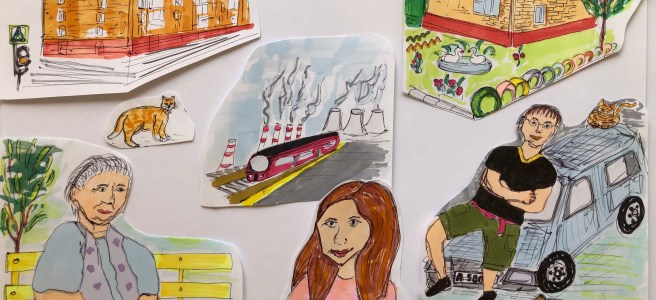
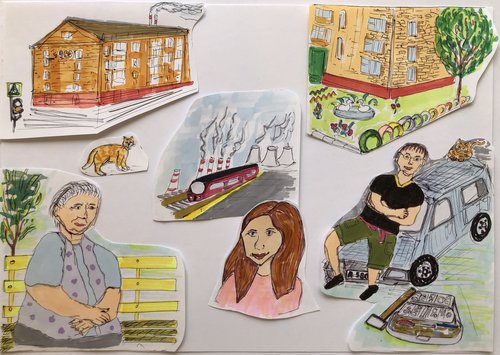
Illustration by Alexandrina Vanke based on ethnographic data from her research

In my study of two industrial neighbourhoods with mixed social compositions in the cities of Moscow and Yekaterinburg, Russia, I drew on the approach of multi-sited ethnography. Its research design built on a combination of the mainstream qualitative methods of interviewing, observation, participation and the creative method of drawing of the neighbourhoods studied made by research participants, also known as a mental mapping technique.

A mental map is a visualisation of the subjective perception of urban space by city dwellers. Kevin Lynch applied mental mapping in his study of the city images in the US. According to Lynch, each image of the city composed by many individual images, which share some similar visual patterns. In my research on Russia’s industrial neighbourhoods, I used mental mapping to explore structures of feeling as affective principles regulating sensual experiences, urban imaginaries and practical activities of local communities. Mental mapping was aimed to elicit how members of those communities sense and imagine their urban areas.

Continue reading in the SAGE Perspectives Blog.

Research article on structure of feeling

My new article Co-existing structures of feeling: Senses and imaginaries of industrial neighbourhoods is out in The Sociological Review. This post summarises its key points. This is a first publication from my doctoral project exploring working-class life and struggle in post-Soviet Russia, which I completed at the University of Manchester in 2021.

tsr-7026773185022708375-71-1-january-2023

In the article, I provide an empirically grounded theorisation of the concept of structure of feeling introduced by sociologist Raymond Williams. Williams defined structure of feeling differently in his works. According to one of his definitions, structure of feeling can be viewed as ‘the spirit of the age’ reflecting the collective cultural feelings of a period or an era. Williams’s another understanding of structure of feeling is related to the lived experiences of working-class communities which have a particular way of life.

While Williams applied structures of feeling mainly in regard to English literature and film, I suggest bringing this concept in sociology of space and place and urban anthropology. In the article, I extend structure of feeling, drawing on my multi-sited ethnography in two industrial neighbourhoods located in the cities of Moscow and Yekaterinburg, Russia.

I conceptualise structure of feeling by focusing on its affective mechanisms regulating senses, imaginaries and practical activities of residents of the two neighbourhoods studied. This ethnographic conceptualisation of structure of feeling allows me to explain better everyday life and local atmospheres in the urban areas undergoing deindustrialisation. The article answers the question of how working-class and longstanding middle-class residents sense and imagine their neighbourhoods.

The article builds on rich multi-sensory data derived from my PhD project: 50 interview transcripts, more than 150 pages of field notes, more than 550 photographs and 43 drawings of the industrial neighbourhoods made by research participants. I show how to apply multi-sited ethnography in the study of the lived experiences of local communities in two locations. I also explain how to use a method of drawing, also known as a mental mapping technique, in research on structures of feeling and deindustrialisation.

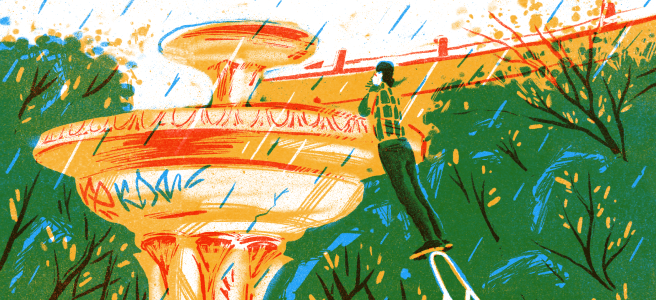
© The image by artist Polina Nikitina based on my ethnographic data

My research has revealed that working-class and longstanding middle-class residents show an affective attachment to place informed by an industrial residual structure of feeling. An industrial structure of feeling comprises values of factory culture, communality and shared space, while an emergent structure of feeling is informed by values of neoliberal development, individual comfort and private space. Both neighbourhoods studied have its particular local atmosphere driven by complicated relationships between socialist/ Soviet / industrial and post-socialist/ post-Soviet/ post-industrial structures of feeling. That is why, I suggest understanding structure of feeling not as a spirit of the time but as a multiple spirit of the time and place.

I develop further this theorisation in my book The urban life of workers in post-Soviet Russia: Engaging in everyday struggle to be published by Manchester University Press. Focusing on the issue of inequality, the book provides a novel account of urban life in post-industrial cities. One of its empirical chapters is partly based on this article.

You can find the article OnlineFirst on the website of The Sociological Review.

If you find the information from this post helpful and decide to use it in your publications, please cite:

Vanke, A. (2023). Co-existing structures of feeling: Senses and imaginaries of industrial neighbourhoods. The Sociological Review, 0(0). https://doi.org/10.1177/00380261221149540

The publications digest

There were no posts in this blog for ten months for some objective reasons. I am currently writing the book The urban life of workers in post-Soviet Russia to be published by Manchester University Press.  

In 2022, I had some publications, which came out but were not covered in the blog. This post presents the digest of those and forthcoming publications.

1. Together with Andrea Lizama and Denisse Sepúlveda, I co-edited a special section on social mobility and inequality issued in Sociological Research Online.

Cite article: Lizama-Loyola, A., Sepúlveda, D., & Vanke, A. (2022). Making Sense of Social Mobility in Unequal Societies. Sociological Research Online, 27(1), 95–100. https://doi.org/10.1177/13607804211066120

The special section takes a global perspective on different aspects of subjective social mobility and inequality. It includes six contributions covering the themes of political debate about social mobility in the UK and collective social mobility of working-class communities in Wales, intersectional inequality experienced by British-born Bengali Muslim women of working-class origin and educational mobility of people from different social backgrounds in Chile, social mobility of rural students in China and Chilean people’s experiences of long-range upward mobility shaped by meritocratic narratives.

Continue reading “The publications digest”

Lakeland and its Poets. Visiting Lodore Falls and the town of Keswick

‘How does the water
Come down at Lodore?’
My little boy asked me
Thus, once on a time;
And moreover he tasked me
To tell him in rhyme.

Robert Southey, The Cataract of Lodore, 1820

Having a genuine interest in English Romantic poetry, one December weekend, I decided to go to the town of Keswick (pronounced as [‘kesik] or [‘kezik]) located in the Lake District, Cumbria. My choice of destination was motivated by the fact that the poets Samuel Coleridge and Robert Southey lived there at the beginning of the 19th century and where their friend William Wordsworth, a famous poet, visited them.

Below, I will reflect on the visual landscape of the area and nature as a public good. Finally, I will consider critically the issue of taste as defined by the Lake Poets[1]. Altogether, this reflection should explain the social, cultural and economic divisions that I found in Keswick and its surroundings.

The visual landscape of Lakeland

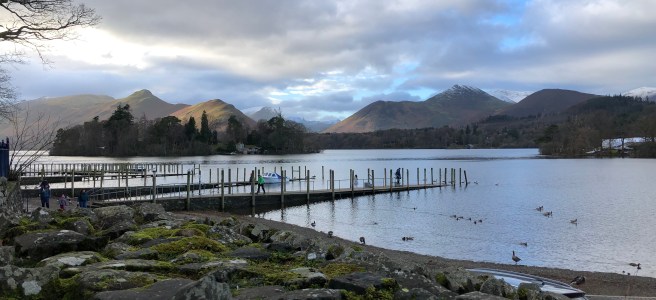
The Lake District, also known as the Lakes and Lakeland, is a national park of North West England. I had a chance to see its northern part with the town of Keswick situated along the northeast shore of Derwentwater lake and surrounded by picturesque hills and mountains, scary caves and magnificent waterfalls.

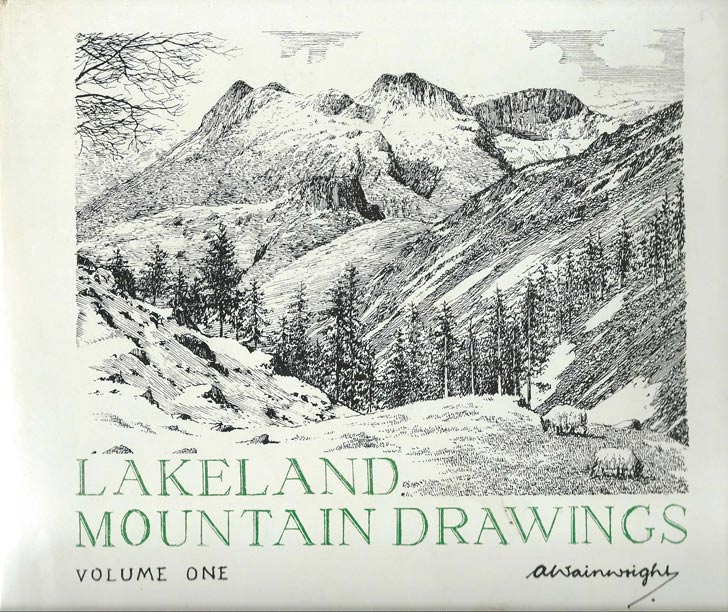
Alfred Wainwright, a British cartographer and illustrator, dedicated 13 years of his life to exploring the landscape of the area and created seven volumes of A Pictorial Guide to the Lakeland Fells published between 1955 and 1966. Through fine detailing, Wainwright’s illustrations and maps depict not only the fells and paths of Lakeland but also the enigma of nature and its magnetism.

The cover of Volume One of Lakeland Mountain Drawings by Alfred Wainwright

My perception of Lakeland was conditioned by the fact that it was my first visit to that area. I was impressed by the beauty of unusual colours of nature which I have not seen anywhere in the UK.  The mountains of orange, green and brown with white snowcaps; the azure sky with lenticular clouds of white and grey shades reflecting in the surface of Derwentwater; black-and-white sheep feeding in the green meadows; trees and shrubs of marsh, sand and black; and pearl-white waterfalls altogether made up the palette of Lakeland in winter.

Continue reading “Lakeland and its Poets. Visiting Lodore Falls and the town of Keswick”

Stick out your tongue at your mother tongue. Or how I visited Shakespeare’s town Stratford-upon-Avon

One December weekend before Christmas, I decided to visit Stratford-upon-Avon, the hometown of English poet and writer William Shakespeare. I went there with the Manchester International Society organising cultural events and bus trips across the UK for students and members of the university community.

Whilst the bus was carrying us from Northern England to Midlands, I had a very nice chat with a female master student from China who came to Manchester to study intercultural communication. We shared a common interest in Lake poetry and experienced similar problems of using English English, as far as we were native speakers of Russian and Chinese languages.

For the first time, I leant that British English should be called English English from my main supervisor who explained to me how to use it in my thesis properly. Not ‘practice’ but ‘practise’, not ‘garbage’ but ‘rubbish’, not ‘while’ but ‘whilst’, etc.

My acquaintance, a master student, told me that there was a hierarchy of English languages. For example, British English and American English take higher positions within the hierarchy of languages compared to Australian and Canadian variants, whilst Asian and Chinese English-es take the lowest positions because of the sounds and pronunciations that are typical for those groups of languages. 

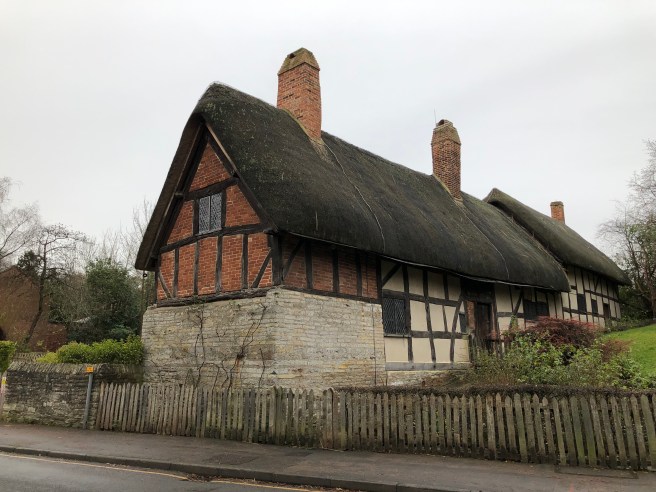
Meanwhile, our bus reached the green fields of Warwickshire and I saw a couple of road signs reading ‘Shakespeare’s town’ and ‘London’. Once the bus dropped us off in Stratford-upon-Avon, we noticed that the car parking was very busy. Crowds of people, including us, were going towards the Victorian Christmas Fayre taking place in the town centre.

The Fayre stalls located along the main streets near the river Avon were full of Christmas gifts, decorations, hand-crafted goods, candles and illuminations. The smell of fried potatoes, mulled wine and other tasty food mixed with the Christmas spirit was in the air. People were waiting in queues to grab something to eat or drink.

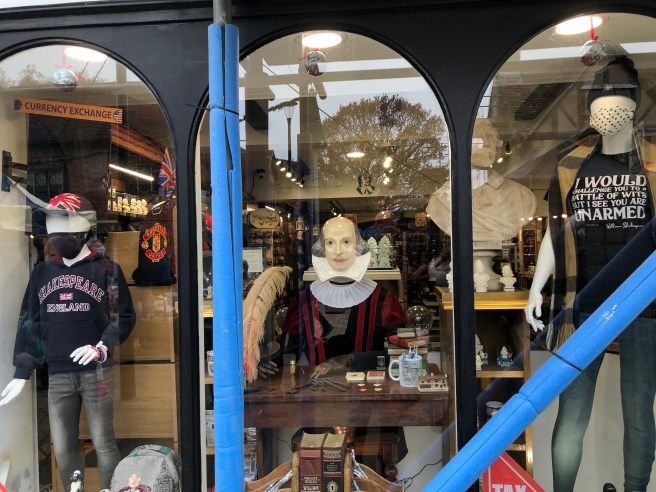
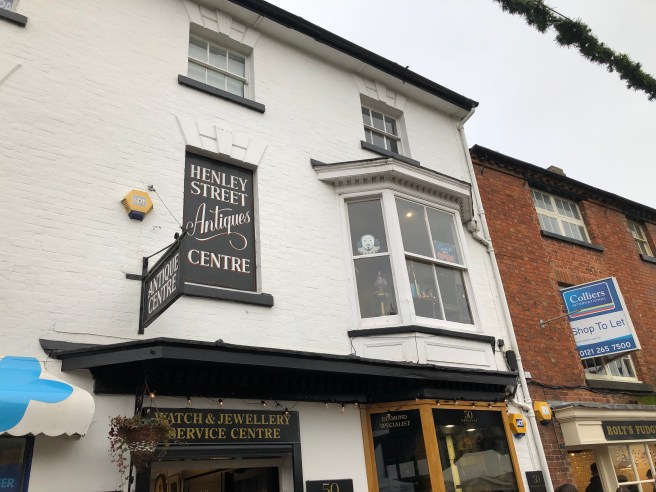
And Shakespeare as a linguistic sign looked at the crowded street from different corners and through the windows of pubs, shops and half-timbered houses. One could see his images on hotel signs, hoodies, mugs, copybooks and souvenirs. We followed Henley Street and came across William Shakespeare’s statue that was surrounded by people visiting the Christmas Fayre.

Continue reading “Stick out your tongue at your mother tongue. Or how I visited Shakespeare’s town Stratford-upon-Avon”

Welsh sketches. From Aberystwyth with love

Aberystwyth is a coastal university town in Ceredigion county of West Wales. If you decide to go there, please do not forget to bring a bit of cultural curiosity and a sense of humour with you. Be ready to meet nice locals there: witches, ghosts, deities, fiends, druids and courageous detectives investigating mysterious crimes. Louie Knight is one of them. He is the best private detective in the town and the main character of the Aberystwyth noir novels by British writer Malcolm Pryce.

In the fifth book of the series, Louie deals with the long-time disappearance of Ninochka, a daughter of Uncle Vanya, a Soviet museum worker from Ukrainian Hughesovka where Ninochka was possessed by the spirit of a dead Welsh girl named Gethsemane Walters. Uncle Vanya, or the man who introduced himself in that way, came to Aberystwyth to ask Louis and his business partner Calamity for help in search of Ninochka. As a fee, uncle Vanya suggested a very valuable sock worn by Yuri Gagarin during his first flight into space.

‘What a story!’ you may say. And you will be right. The Aberystwyth noir novels nicely convey the atmosphere of the town. They can be a good start for learning about its weather, places and legends.

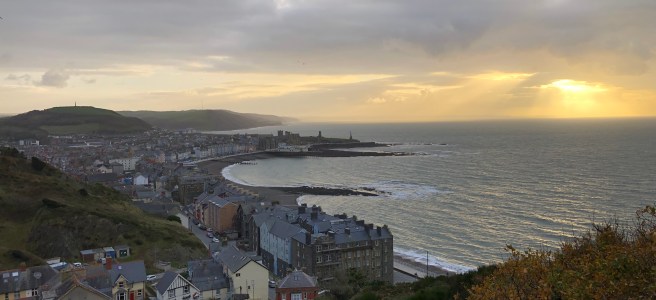
Once you are in the town, go to the Pier from where a beautiful view of the promenade and the Constitution Hill is revealed. The sounds of the blowing wind and crashing waves may combine with the songs of starlings and cries of seagulls there. In evenings, if the weather is clear, wonderful sunsets can be seen from the seafront.

In late November, when I happened to be in Aberystwyth, the weather was mild and changeable. Sometimes it was sunny, sometimes rainy, sometimes cloudy, sometimes windy, but always welcoming.

Rain or shine, people walk along the Prom edged by colourful buildings of the student dorms, hotels, pubs, cafés and small workshops. Once you get to the northern end of the Prom, kick the bar. ‘Kick the Bar’ is a local ritual of kicking the railings performed by students to attract love. However, nowadays not only students but also town dwellers of different ages kick the bar as tradition says.

From the northern end of the Prom, you can easily get to the top of the Constitution Hill either by following a winding path surrounded by small shrubs or by using the Aberystwyth Cliff Railway. Students enjoy going up Consti, as they call the Hill lovingly, and observing picturesque sunsets in evenings and looking at stars shining at nights from the top. One sunny morning after the rain, I was enjoying coffee with the fresh air and the gorgeous view of the bay in the Consti café on the top of the hill. Time stopped and it was nice just to live the moment.

Continue reading “Welsh sketches. From Aberystwyth with love”

An imaginative journey in the pandemic world

I wrote this poem during the third lockdown in the UK. It reflects my experience of staying in one place and not crossing borders between countries for more than a year. The poem has no rhymes but who cares about rhymes nowadays. 
 
An imaginative journey in the pandemic world

I am on my way to St. Michael’s Mount
The train is moving from the North to the South of England
I see green fields and fast-flowing hill streams
But then I cross the English Channel 
(or la Manche as they call it in France)
And I am thinking about people who cross it 
Day by day risking their lives
And where am I going?
To St. Michael’s Mount 
(or le Mont-Saint-Michel as they call it in France)
That welcomes pilgrims with the rise and fall of tides.

Alexandrina Vanke
18th March 2021