
How to craft a video abstract: reflection on making research visible

While all social media are now overflooded with posts about (and by) Generative AI, I have been thinking about how to make high-quality social research visible in the era of Large Language Models and all kinds of AI-based chatbots. Another reason for writing this blogpost is to reflect on my own experience of making video abstracts for the journal articles I published after completing my PhD.

If you are doing social sciences, your goal may be not only to get published but also to share your research outputs with other scholars and broader publics beyond academia. There are many ways in which one can make research publications visible and engage with publics, ranging from writing op-eds and blogposts to making visuals and video abstracts.

Video abstract formats

When I published my first PhD-based article on structures of feeling, I wanted to creatively disseminate it to share the results of my research with wider audiences. I decided to make a video abstract. My quick research into the types of video abstracts for journal articles found three of the most engaging formats.

The most popular one is talking videos, where academics talk about their publications to the camera. This is a less time-consuming video to make, which can be easily recorded with a phone or a laptop camera. However, it requires writing a script or carefully thinking about what you will say. You will probably need to make several takes before you are happy with your video. This option may be uncomfortable for those who do not like talking to the camera.

Another format is recorded video slides with the key findings presented on slides, combining text, images and animation. This may be more familiar to academics, as many were presenting online during (and after) the COVID-19 pandemic. These slides can be made with PowerPoint and recorded with Zoom. This format allows choosing whether to show a face or not, and the focus will be on your slides, not your talking head.

Finally, I came across several animated video abstracts without an author’s face, employing visual storytelling about research outputs. I enjoyed whiteboard animations based on publications, which amazingly combined verbal, textual and visual forms in research presentation. It was not obvious how to make them, but it was obvious that their production is time-consuming, even though they stimulate the creativity and curiosity of both researcher and audience.

Further, I will share my experience of crafting animated and talking video abstracts and conclude with reflections on their role in research visibility.

Animated video abstract

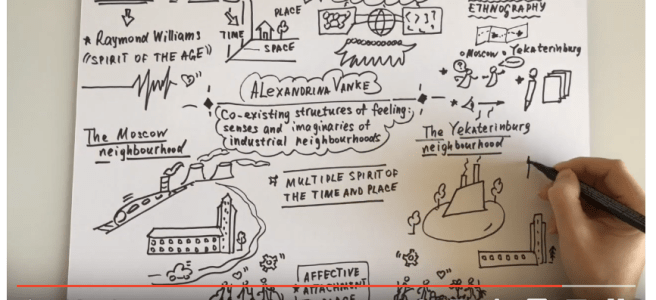
I decided to start with an animated video abstract, as I wanted to draw my article in the video. This prompted me to continue my search and learning. After watching animated videos about research, I found an educational course, From Verbal to Visual. From this online course, I learned how to use icons in sketchnoting, concisely visualise ideas with a black marker and use a video-editing software to combine a video of my graphic drawing, my audio explanation and background music.

It took me several days of creative thinking, learning and making until I crafted my first video abstract. I am sure some will view it as a luxury to spend so much time making an animated video abstract, especially under time pressure in academia. (I was crafting mine during the Christmas holidays). But for me, it was more about curiosity and learning how to make it and how to creatively disseminate research. Of course, when I crafted a second animated video abstract for my journal article on everyday inequalities, it was much easier and quicker. However, it still required time and energy for original thinking and crafting.

Despite all these efforts, I find the result amazing, even though it is far from perfect, but unique, like any handmade object. An animated video abstract reflects the idea of research as craft. This strongly resonates with my vision of doing creative ethnography, which my article on avant-garde methodology develops. This new article explains how to conduct multi-sited ethnography, use drawing and analytical assemblage in research, and creatively write with ethnographic data.

Talking video abstract

My experiences of making video abstracts broadened this year, when Sociology, the journal of the British Sociological Association, invited me to make a talking video about my article on everyday inequalities, which won the Sociology SAGE Prize for Innovation and Excellence 2025. In recent years, more and more academic journals have started suggesting their authors make video abstracts for published articles. In my opinion, Theory, Culture & Society provides really good examples of the talking video format, displayed on their journal website.

As for my experience, recording a talking video abstract for my article published in Sociology journal was split into four stages.

First, making a talking video requires writing and editing an accessible script for a three-minute video. I wrote this script, reread it and tried to tell it. Then I prepared a place and put the minimum equipment I had, a phone with a holder and a laptop camera, in two locations. Later, at the editing stage, I chose to work only with the video recorded with the phone, because it turned out to be better in terms of picture and sound. I decided to use a simple background which would not distract the viewer and put a table lamp on the floor to add cosy light, as it was rainy outside. I made a couple of shoots to check whether my face was in the frame and whether my voice was clearly heard.

At the second stage, ensure that there is no background noise from the window or anywhere else, which will disturb your video recording. Do not forget to put your phone on flight mode. Next, when you are recording a video abstract, it is better to talk about your research article, using a script as a reference and sometimes improvising, rather than reading a script. Natural talking makes a video abstract more engaging. (I know it is hard when you are talking to the camera). I did a couple of takes to choose the best one later.

The third stage includes editing a video abstract with a video-editing app or programme. I used iMovie, but you can use your preferred one, or skip this stage if you do not have time or the skills to use them. But then you need to record an almost perfect video, which does not need to be cut or improved. My talking video appeared to be twice as long as Sociology journal asked for. That is why I cut less important parts to make the video more concise and engaging. I should say that my video-editing skills are very basic. They still allowed me to add my title and name at the beginning and cut less important video frames.

At the final stage, I sent the video abstract and script to the editors of Sociology, who kindly helped me add subtitles. You can find this video abstract on my YouTube channel and it will be available on the Sociology journal website soon.

Is it worth making a video abstract?

Before making a video abstract, one may need to consider carefully whether all the effort and time spent is really worth it. On the one hand, academic journals follow the trend of encouraging authors to make video abstracts. The thing is that online users now consume more video content than textual and visual content. The probability that someone will become interested in your research article increases if they find your video abstract.

On the other hand, I have recently had a chance to discuss this issue with a senior academic who was sceptic about video abstracts and their dissemination on algorithm-based video streaming platforms. According to this position, it is not worth spending time making video abstracts, as they are not supported by algorithms and do not help increase the citation rate. If you are a recognised professor, your publications will be read without creative dissemination. However, early career researchers need to spend time for dissemination if they want their research outputs to rich academic and wider audiences.

It has been two and a half years since I posted a video abstract for my first PhD-based journal article on structures of feeling published behind a paywall. By now, it has reached 850+ views on YouTube, compared with 500+ reads of my blogpost with its summary, 1000+ reads on the journal website, and only eight citations in publications by other academics. This statistic tells us that video abstracts do not directly increase the citation rate, but they increase engagement with your article. For example, I regularly receive emails from people who want to read the article but cannot access it and ask me to share it with them. Some people (most of them students) contact me to say that my article helped them in their research.

As for the article on everyday inequality, also published behind a paywall, its animated video abstract got only 150+ views over the last two years. But the article and my research findings were mentioned in a conversation between three characters in one British film, and it has been cited five times by other academics so far. Again, there is no direct link between a video abstract and scholarly recognition. But what I see from this experience is that my research has become more visible thanks to the video abstracts, which I also posted on my social media accounts.

Are you curious about learning how to craft a video abstract? Are you interested in creative research dissemination? Are you looking for innovative ways of public engagement? If yes, then why not experiment with a video abstract and see what it may bring in terms of making your research visible? At the end of the day, why not give a video abstract a chance among research dissemination channels and public engagement tools?

Paperback release incoming: what critics think about my book and why it matters for the class debate – Part 2

This is the second part of the blogpost with my response to the reviewers who engaged with ‘The urban life of workers in post-Soviet Russia’ to be released in paperback in January 2026. In this part, I would like to discuss some comments on my book by Paupolina Gundarina and Mitja Stefancic.

In her essay ‘“Soviet in post-Soviet” in Alexandrina Vanke’s book The Urban Life of Workers in Post-Soviet Russia: Engaging in Everyday Struggle’, published in Russian on the Syg.ma platform, Paupolina Gundarina provides a very sensitive and careful reading of my book. She views my research as ‘an ambitious and creative ethnographic description of workers’ communities, which opens up new dimensions of (the working) class, creativity, imagination and phenomenology of home’. 

Gundarina finds my methodology, drawing on multi-sited ethnography, innovative and creative. She especially highlights the participatory nature of my study, when I invited research participants to draw their neighbourhood and society, which allowed me to grasp their ‘affective experience[s]’. As the reviewer stresses, this methodology opens up new opportunities for the debate about emotions regarding deindustrialisation and their relationships with the Soviet legacy and ‘the issues of morality, trauma, nostalgia, loss and adaptation’. 

‘[T]his is an ambitious and creative ethnographic description of workers’ communities, which opens up new dimensions of (the working) class, creativity, imagination and phenomenology of home.’ Paupolina Gundarina

Continuing this discussion, I would place my methodology within two developing strands. On the one hand, it is situated within the range of ethnographies paying particular attention to sensory-ness, affect and the imaginary. On the other hand, it develops creative, visual and arts-based methods. In my forthcoming article, I call this approach ‘avant-garde methodology’ which generates alternative interpretations of class experiences.

Gundarina finds my revision of class struggle, which I reconsider within the everyday realm, as an important contribution to the Marxist debate on class and resistance. As she writes, ‘Vanke’s book challenges economic determinism showing that the working class in post-Soviet Russia is defined through everyday practices, spatial belonging and grassroots resistance, not just through employment status’. She correctly reads my argument about the formation of classes in Russia’s major cities as ‘a constant, contradictory process, which is influenced by both the Soviet legacy and neoliberal change’. 

As Gundarina discusses further the ethnographic examples from my book, ordinary people continue to implement Soviet practices in deindustrialising urban spaces. But indeed, in the neoliberal context, these practices gain new meanings, allowing residents of industrial districts to cultivate class feelings and attachment to place, for example, through collective maintenance and decoration of the depleting infrastructure remaining from the Soviet era. According to my approach, these practical activities fall under the category of everyday struggle.  

I especially enjoy that the reviewer included her Russian translation of some research participants’ quotes from the book and provided her example of the controversial local debates around a DIY swan created by a local resident of Barnaul, a Western Siberian city of Russia, and put in a public place.

The book review by Mitja Stefancic, published in the 50th Anniversary Issue of Network, magazine by the British Sociological Association, continues to discuss my book in light of the class debate. As he writes, ‘One of the main achievements of the book lies in its successful attempt to re-discuss the concept of class’. Stefancic stresses the importance of my research as it ‘shows how class in Russia means something different when compared, for example, to Western societies’. This conversation about classes continued in an interview with me by Stefancic published in SerbianEnglish and Italian. I am very grateful for this opportunity to discuss my research outputs beyond academia. 

‘One of the main achievements of the book lies in its successful attempt to re-discuss the concept of class. In fact, on a theoretical level, Vanke effectively shows how class in Russia means something different when compared, for example, to Western societies.’ Mitja Stefancic

Indeed, unlike Western countries with stable social structures, Russia has experienced political upheavals and socio-economic reconfigurations of social groups during the 1990s, which influenced how people perceive classes and inequalities. Since the dissolution of the Soviet Union, a new social structure is being formed in contemporary Russia framed by the neoliberal neo-authoritarian order of power. 

My field research conducted before 2022 revealed polarisation in the social structure with a split between the poor and the rich, as I argue in the book and in my article on lay perceptions of inequality (read its summary on Everyday Society). However, sociologically it is interesting to understand how the Russia-Ukraine war will reconfigure the social structure and redistribute social wealth and capitals between particular segments of Russian society.

Stefancic concludes that my book helps to understand better Russian society itself and will be of interest to those who are focusing on how working classes around the globe overcome life difficulties while being excluded from big politics. In light of the global shift of the political mainstream to the right, as discussed in the August issue of Global Dialogue, my approach to everyday struggle in restrictive conditions has the potential to be transferred to other contexts. 

Paperback release incoming: what critics think about my book and why it matters for the class debate – Part 1

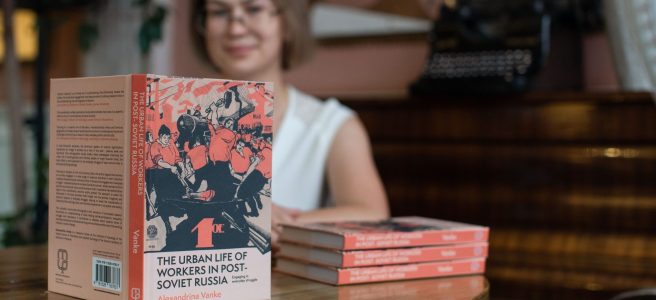
This is photo with the hardback copies of 'The urban life of workers in post-Soviet Russia' by Alexandrina Vanke

I got a wonderful news from Manchester University Press about The urban life of workers in post-Soviet RussiaIt will be out in paperback in January 2026. This means that the book will be available at a more affordable price soon. As recent reviews show, since its first edition in January 2024, the book remains highly relevant, widening discussion about the working classes, deindustrialisation, inequalities and everyday struggles.

In one of the previous blog posts, I replied to the first book reviews by sociologists Claudio Morrison and Christopher Altamura. In this blog post, I would like to continue this conversation about class with other commentators on the book, which appeared in the first half of 2025. I will engage with them in the chronological order in which their reviews were published.

In Challenging Stereotypes of Post-Soviet Russian Workers (CEU Review of Books), Victoria Kobzeva from the University of Birmingham provides critical comments on my theoretical framework, researcher positionality and interpretations of workers’ acts of everyday resistance. On the one hand, Kobzeva writes that the book introduces ‘a dozen concepts’ that are pivotal for my further ethnographic interpretations. On the other hand, she claims that my theoretical contribution to social theory, especially to Pierre Bourdieu’s approach of habitus, ‘feels limited’ despite rich empirical data.

‘Vanke’s book is an example of immersive, prolonged ethnography enriched by creative methodologies and a deep engagement with the lived experiences of Russia’s urban working class.’ Viktoria Kobzeva

When an author meets such criticism, it leads to reflection on what theoretical contribution means and how to increase it in future publications. Below, I would like to address this point of criticism.

The urban life of workers in post-Soviet Russia develops some theoretical concepts further. The book engages with ‘structure of feeling’, introduced by Raymond Williams, which I re-conceptualise as an affective principle regulating senses, imaginaries and practical activities within socio-material infrastructures, drawing on multi-sited ethnography in post-socialist deindustrialising contexts. The book also conceptualises everyday struggle, by which I mean a set of multiple counter-hegemonic acts, micro-practices and activities performed by workers and ordinary people in everyday life. I agree with Kobzeva that everyday struggle needs to be theorised further, as this concept differs from mundane resistance, introduced by James Scott, even though it encompasses resistance. However, I see working with everyday struggle as my contribution to theories of struggle and protest, which mainly focus on overt protests and social movements in Western liberal democracies.

Next, in the book, I map these and other concepts, visualising relationships between them in two theoretical sketches, and synthesise them into a theory of urban life and everyday struggle. I am still thinking about what this theory could be called: multi-sensory, affective or imaginative? The idea of everyday struggle embedded in life leaves room for reconsidering the concept of habitus, through re-viewing it as a set of dispositions of resistance and counter-actions.

The suggested framework adds affective, sensory and imaginative dimensions to the understanding of class and struggle that, as my ethnography shows, goes beyond coping and resistance. This framework opens up an opportunity to think about social change at the micro-level, enacted through enduring dispositions of co-creation and re-shaping. In the book, I also deal with the concept of spatialised gender habitus, or a gendered sense of place. I agree with the reviewer that it needs to be developed further, probably in future publications.

In the book, I do not introduce new concepts. What I do is theorise and synthesise existing concepts based on extensive multi-sited ethnography in Russia’s post-industrial cities. If such a framework contributes to the de-stigmatisation of low-resourced groups in post-socialist settings and can potentially be discussed and adopted (with adjustments) in other ‘local’ contexts, then my goal as an author will have been met.

However, there is still an open question about whether everyday struggle is exclusively working-class, and whether it allows class consciousness, as was asked in the review by Morrison. My continuing ethnography shows that not only working-class people engage in everyday struggle, but that it is still informed by how people sense inequality locally, imagine social justice in society and view the global future.

‘The Urban Life of Workers in Post-Soviet Russia: Engaging in Everyday Struggle (published by Manchester University Press in 2024) by Alexandrina Vanke is an innovative and textured engagement with the world of the working class in the post-industrial cities of Russia.’ Arpita Rachel Abraham

The book review by Arpita Rachel Abraham, an Urban Fellow at the Indian Institute for Human Settlements in Bengaluru, published on the Doing Sociology platform, continues the discussion about class consciousness, urban change, critical sociological theory and ethnography from the perspective of the impact of ‘global political developments’ and ‘Russia’s aggression on Ukraine’ on the working classes and ordinary people. Abraham stresses that my book advances the theory of the everyday, which is often lacking a political dimension. She points out that my research shows that the political is part of everyday life in neoliberal neo-authoritarian contexts. In this sense, my book bridges two separate areas: everyday life studies and social movement studies.

Praising ‘an impressive assemblage of textual, visual and performative elements’ in the book, Abraham raises a critical question about the one-dimensionality and repetitiveness of the argument regarding workers’ active engagement in everyday struggle. I would like to explain that the idea behind writing this book was to make this core argument part of academic storytelling, using it as the key element that would sew all chapters together like a needle. In the next book, I will probably experiment with integrating more authorial ideas and less polished arguments, which I will present not as analytically justified statements but as diverse interpretations, provoking new directions, debates and conversations on the subject matter.

I am grateful to both Victoria Kobzeva and Arpita Rachel Abraham for their interest in my book and for writing reviews that widen the discussion about the issues considered in The urban life of workers in post-Soviet Russia.

In the second part of this blog post, I will reflect on the comments from the reviews of my book by Paupolina Gundarin and Mitja Stefancic.

To be continued…

Sociological Debate on Inequalities in Russia and Beyond

My review Sociological Debate on Inequalities in Russia and Beyond has been published in the Russian Sociological Review.

The review considers the 5th All-Russian Sociological Congress held at the Ural Federal University in Yekaterinburg in October, 2016. The event, entitled “Sociology and Society: Social Inequality and Social Justice,” attracted more than 1000 delegates from Russia and abroad. The Congress took place against a background of increasing social inequality in Russia, following the economic crisis of 2015. The program included 17 sessions, 37 panels, and 35 round tables which covered burning topics such as the unequal distribution of resources in Russian regions, the reduction of social welfare, the low living standards of vulnerable social groups, the growth of ethnic tension, and others. One of the plenary talks was given by the president of the International Sociological Association, Margaret Abraham, who spoke on the humanistic mission of Sociology, and called to coalesce in the struggle against social injustice in the world. The discussions at the Congress have shown that sociologists in Russia follow the global trends in examining urgent social problems, as well as in reflecting methodological issues, e.g., the application of new approaches in inequality studies. The debate on the restriction of academic freedoms in Russia at the closing plenary session made it obvious that the solution to this problem can be found in professional solidarity and is the responsibility of everyone who belongs to the sociological community.

Read more: here.

How can I tell what social class I belong in?

My post on social class for TheQuestion UK.


The answer this question depends on several parameters. Firstly, it depends on the way you define classes or social groups. Secondly, it depends on the social structure of the society you are a part of. Thirdly, it depends on your class consciousness or your subjective class self-identification. I’ll outline four main sociological approaches to social classes here.

1) In Marxist theory, classes are understood as large groups of people differing in their positions regarding the ownership of the means of production and social division of labour. In other words, a class position is determined by the role of an individual in the public organization of labour. Marx divides the capitalist society of the 18th century into three classes:

  • Bourgeoisie, which is a dominant class owning the means of production and feeding on the exploitation of wage-workers;
  • Petite bourgeoisie, which is a class of small owners living on their personal (mostly family) labour (e.g. craftsmen, substantial peasants, etc.);
  • Workers who make up a class of employees without the means of production, who sell their labour power, producing surplus value and being exploited by bourgeoisie in the process.

In Marxism, class position forms class consciousness. But since the 18th century, the concept of class has changed significantly and new social classifications have been invented.

2) In the latter half of the 20th century, French sociologist Pierre Bourdieu built on the Marxist concepts of class and capital. According to Bourdieu, social class should be understood as a collective position in the multi-dimensional space of social distinctions, which is a configuration of various volumes of capitals:

  • Economic capital (money, valuable material objects),
  • Cultural capital (level of education, specific knowledge, diplomas),
  • Social capital (connections, social networks),
  • Symbolic capital (recognition).

In Bourdieu’s approach, social classes look like clusters of points. It means that individuals with the same social characteristics and the same volumes of capitals cluster together in social space and have similar “class habituses.” “Class habitus” refers to an incorporated history and a set of social practices (manners, styles of behavior, etc.) that are determined by both the general of society and the biography of the individual.

To understand Bourdieu’s vision of classes, you can the graph from his book “Distinction: A Social Critique of the Judgment of Taste”:

3) British sociologist John Goldthorpe suggested yet another class model centered on employment status. He distinguishes three main classes differing by type of labour contract:

  • Employers who buy labour forces and control workers;
  • Employees who sell their labour power to employers;
  • Self-employed who are relatively independent and work for themselves (e.g., businessmen, freelancers, etc.).

With R. Erikson and L. Portocarrero, Goldthorpe has elaborated an eleven-class scheme (EGP) containing several service classes, working classes and transitory classes. (See more about EGP here). Today, the EGP class scheme is widely used by sociologists in research on social stratification, social mobility, and social inequality.

4) In recent research on social structure in British society, a group of enthusiastic sociologists under the leadership of Mike Savage constructed a new classification of classes, building on Bourdieu’s approach of capitals. On the basis of vast empirical data Savage and colleagues have defined seven classes in contemporary British society, each involving specific social traits:

  • Elite: very high economic capital (especially savings), high social capital, very high highbrow cultural capital;
  • Established middle class: high economic capital, high status of mean contacts, high highbrow and emerging cultural capital;
  • Technical middle class: high economic capital, very high mean social contacts, but relatively few contacts reported, moderate cultural capital;
  • New affluent workers: moderately good economic capital, moderately poor mean score of social contacts, though high range, moderate highbrow but good emerging cultural capital;
  • Traditional working class: moderately poor economic capital, though with reasonable house price, few social contacts, low highbrow and emerging cultural capital;
  • Emergent service workers: moderately poor economic capital, though with reasonable household income, moderate social contacts, high emerging (but low highbrow) cultural capital;
  • Precariat: poor economic capital, and the lowest scores on every other criterion.

If you would like to know which class you belong in according to the classification developed by Mike Savage and his team, just take the test “The Great British class calculator: What class are you?”

But beware! Do not forget that this test is designed for respondents from Great Britain. Other societies might have other class structures, or the social classes in those societies might involve a different set of social traits 🙂

Альманах-30

В минувшую пятницу 27 мая в книжном магазине «Циолковский» состоялась первая презентация Альманаха-30 – краудфандингового проекта, доведенного командой энергичных ребят и девушек – Сергеем Простаковым, Сергеем Карповым, Антоном Секисовым, Аленой Салмановой и Оксаной Зинченко – до формата толстого кирпича из текста. Под чёрной обложкой Альманаха собрались поэты, писатели, публицисты, социальные ученые и журналисты, родившиеся после 1985 года и пишущие на русском языке. Задача Альманаха-30 состояла в том, чтобы дать слово представителям поколения тридцатилетних, которые уже заметны в российском публичном пространстве и в каком-то смысле начинают формировать его интеллектуальный ландшафт.

IMG_6684

С предложением написать текст хорошего качества на любую тему по своей дисциплине ко мне обратились идейные вдохновители проекта. В силу того, что сейчас мои интересы так или иначе сосредоточены вокруг новых исследований рабочего класса, то мой текст посвящен фабричным рабочим, проживающим в малом российском городе. Однако, далее я буду говорить о текстах своих соседей со страниц Альманаха.

Надо сказать, что Альманах-30 – коллективный портрет моего поколения – вызвал противоречивые впечатления и натолкнул на мысль о том, что мы (авторы) очень разные и в большинстве своем не вписываемся или с трудом вписываемся в прежние рамки, а это значит, что изменения неизбежны. Тем не менее, это, пожалуй, единственное, что нас объединяет.

Листая Альманах-30, я стала думать, кто мне близок из авторов. Надо сказать, что писатели и поэты сразу вызвали недоумение, за исключением левых поэтов, с творчеством которых я знакома по Альманаху «Транслит». Признаться, имена остальных авторов из разряда #fiction я видела впервые. Особенно позабавил поэт, который, видимо, думает, что он Пушкин, или, может быть, это стёб такой (стр. 90):

Мне часто грезится, что я велик,
Что памятник мне лепят где-то выше,
Где я сижу и головой поник,
Раздумывая о смысле нашей жизни.

На этом моменте отложу в сторону тексты из раздела #fiction и поговорю о том, в чем я хорошо разбираюсь, а именно о текстах авторов из раздела #non-fiction, который мне представляется более однородным, хотя и разным по качеству. Тут у меня возникло вполне понятное чувство родства с авторами из Европейского Университета в Санкт-Петербурге (стр. 95 и 169). У этих текстов есть знак качества.

От текста про политику последнего советского поколения (стр. 215), которое унесло ураганом, я ожидала большего, а в конечном итоге получился обзор исследований молодежи со ссылками на работы других социальных ученых. С него я перепрыгнула к тексту про гнев и скорбь постсоветских людей, написанный в русле нового для России интеллектуального направления death studies (стр. 415). Им я зачиталась настолько, что проехала свою остановку, возвращаясь после пятничной презентации Альманаха. Никогда не думала, что про смерть можно писать так увлекательно и с чувством юмора.

Дальше мой выбор пал на текст про демократию, автор которого задается вопросом о кризисе этого политического жанра (стр. 337). Текст поразил своей глубиной, а его автор вдумчивостью и письмом в стиле французской политической философии.

Большой интерес вызвали статьи авторов из журналистского цеха. Например, размышления о том, как новые поколения молодых воспринимают сегодня текст (стр. 321), или о судьбе малых медиа в эпоху упрощения (стр. 29). К слову, в формате small media сделан и Альманах-30, задача которого на сегодня, как мне видится, состоит в налаживании междисциплинарных и межжанровых коммуникаций между молодыми интеллектуалами, которые пишут разными стилями, но в одинаковой тональности. В этом смысле, создатели Альманаха-30 выступили в чрезвычайно важной для сегодняшней России роли культурных посредников, сшивающих поколение тридцатилетних и порождающих дискуссии. Куда приведут нас эти дискуссии, покажет время, а закончить хочется стихами поэта Романа Осьминкина, отражающими суть настоящего (стр. 84):

***

Из мюзикла про Современное искусство

левые художники унылое говно
правые художники засохшее говно
либеральные художники вонючее говно
зато аполитичные художники самое оно
самое свежайшее
самое прекрасное
самое гармоничное
самое эстетичное
самое нетелеологически целесообразное
самое формально безупречное
самое осмысленное
самое автономное
самое говорящее само за себя
самое поэтичное
самое миметичное
самое аполлоничное
самое неинструментализируемое
самое ауратичное
самое пресамое говно

Медиа-репрезентации рабочих: видеозапись дискуссии

21 мая в книжном магазине “Порядок слов” состоялась презентация результатов проекта “Рабочий дискурс в российских средствах массовой информации”, который мы проводили вместе с Максимом Кулаевым в течение двух последних лет.

Какие представления о рабочих есть у журналистов из крупных печатных изданий? Какая логика лежит в основе медийных текстов о рабочих? Как следует писать о рабочих? Каковы перспективы сотрудничества между социологами, журналистами, профсоюзами и рабочими? Ответы на эти вопросы содержатся в видеозаписи дискуссии.

© Видео Анатолия Трофимова

Политические эмоции: российские митинги 2011-2013 годов

Моя статья “Политические эмоции: российские митинги 2011-2013 годов“, посвященная сопоставлению коллективных эмоций на протестных митингах и митингах в поддержку власти, опубликована в пятом номере журнала “Неприкосновенный запас. Дебаты о политике и культуре” за 2014 год.

Эмоциональный накал в сегодняшнем российском обществе в связи с политическим кризисом в Украине делает все более актуальным изучение политизированных эмоций и эмоциональных режимов, которые управляют коллективными чувствами людей, находящихся «по разные стороны баррикад». Для понимания процессов, происходящих в российском обществе сегодня, необходимо вернуться на три года назад, к выборам в Государственную Думу 4 декабря 2011 года, за которыми, как утверждают исследователи, последовал «эмоциональный взрыв», ставший результатом сбоя так называемой «управляемой демократии», создаваемой на протяжении 2000-х годов в России. Читать далее…