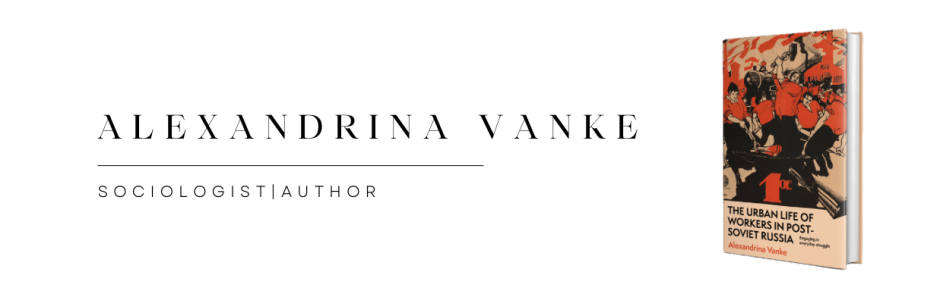

The urban life of workers in post-Soviet Russia is now released in paperback! I am really happy about this, as the paperback edition makes the book more accessible to students, less privileged academics and non-academic communities, who were in my mind while writing. As an author, I am committed to the values of responsible production of knowledge and its dissemination among diverse communities of readers.
Two years have passed since the publication of the hardback edition, and the interest in the book is not waning. So far, the book has received eight reviews in academic journals and online platforms, developing the debates about the agency and everyday engagement of working-class communities. Two recent reviews came out in the second half of 2025. One positive review by Anna Shadrina was published in Sociology, the journal of the British Sociological Association, while another critical one by Irina Tartakovskaya appeared in the newly-launched Russian-language journal Sociology of Care. I would like to thank both reviewers for reading my book and joining the debate about the working classes.
In her review, Anna Shadrina stresses the importance of the contribution to the sociology of class in authoritarian contexts, which the book makes, drawing on my rich theoretical and empirical work. At the same time, she points out that my author’s position towards struggles taking place in Russia should have been articulated more explicitly. Commenting on the issue of author’s positionality, I should say that I wanted to avoid writing about my own feelings and instead preferred focusing on what ethnography allowed me to document, as my argument of everyday struggles from below is already alternative to the mainstream representations of workers, and especially Russia’s workers. But I do not exclude that my next books will draw more on my own experiences and comprise more reflection on my author’s feelings triggered by the global polycrisis.
In turn, Irina Tartakovskaya criticises the book for not sufficiently unpacking the theme of moral economy and my overestimation of workers’ negative representations in the media and academic publications, as they are not disregarded to that extent. She agrees with the relevance of the concept of everyday struggle, which I develop in the book, but notes that not only Russia’s working classes but also its middle classes, including those who emigrated from Russia during the war in Ukraine, take part in everyday struggle, and I almost do not take them into consideration.
To address this criticism, I need to contextualise my key argument and explain within which debates it emerged. First of all, the argument of Russia’s workers’ engagement in everyday struggles in urban life has been situated within the international debates about working-class communities, which have been presented as Brexiters in the UK, and as supporters of conservatives in the US and the right populist rhetoric in some other countries. In the anglophone world, workers are marginalised and stereotyped, not only in media discourses but also in English academic literature, which is evidenced by critical research by Jayne Raisborough and Matt Adams (Raisborough and Adams, 2017), and by Charlie Walker, Steven Roberts and Karla Elliot (Walker and Roberts, 2018; Roberts and Elliot, 2020). Indeed, in the Soviet Union, the working class was respected but still used as an ideological construct for regulation of the societal structure and economy, a strategy partly inherited by Russia and other post-socialist countries.
In contrast to this, my ethnographically-grounded argument of workers as shaping their everyday realities from below, alternative to the mainstream representations, contributes to the international debates about the agency of the subordinate. The Russian case can work here as an analytical example of how it is possible to study working-class communities and talk about workers in academic debates. My argument of the everyday struggle of Russia’s workers resonates with the argument by Denis Gorbach (2024) of Ukraine’s workers’ participation in everyday politics. Both concepts – struggles and politics in everyday life – are part of the theories of moral economy as they were introduced by Edward P. Thompson and James Scott, and further developed by their followers and critics.
On the 28th of January 2026, The Sociological Review journal organised a public event ‘Where are we now? A sociological take on the past year’ with Yasmin Gunaratham, Gholam Khiabany, Aaron Winter and Kirsteen Paton talking about hope and resistance in the time of wars, genocide, catastrophic violence, systemic injustices, extreme inequalities and normalisation of the far-right discourses. The speakers concluded that expression of solidarity for struggles and responding to particular situations create alternative ways of living and organising lives, as suggested by Raymond Williams, that give hope in the hard times of despair. The urban life of workers in post-Soviet Russia, which ethnographically develops the concept of everyday struggle beyond surviving and coping, contributes to this debates by showing, how hope is co-created through grassroots involvement in the mundane practical activities of ordinary people, anticipating sustainable change now and then.



 Аннотация. Углубление социального неравенства, которое автор связывает с глобальным распространением неолиберализма, усложняет систему властных отношений между мужскими телами и сексуальностями и ведет к дифференциации типов маскулинности. На материале 43 биографических интервью переосмысляются властные отношения внутри двух социально-профессиональных сред — так называемых синих и белых воротничков. Автор приходит к выводу, что через регулирование телесности сфера труда управляет эмоциональными отношениями и, как следствие, сексуальной жизнью мужчин из обеих групп. Наряду с этим режимы производственного и офисного труда генерируют разные логики управления мужской телесностью, которые воспроизводятся в приватной сфере и используются для создания мужской субъективности.
 Аннотация. В статье рассматриваются территориальные идентичности, сформировавшиеся вокруг советских предприятий: завода имени И. А. Лихачева (ЗИЛ) в Москве и Уральского завода тяжелого машиностроения (Уралмаш) в Екатеринбурге. На примере двух кейсов авторы отвечают на вопрос о том, как создается территориальная идентичность индустриальных районов в постсоветской России. Авторы анализируют культурные практики в двух индустриальных районах и показывают, какой вклад в изменение их территориальных идентичностей вносят культурные акторы: представители творческих профессий и культурной среды, то есть научные работники, художники, архитекторы, фотографы, преподаватели высших учебных заведений, работники музеев, культурные и городские активисты. Исследование обнаруживает увеличение социального неравенства между резидентами индустриальных районов: рабочими и представителями других социальных групп. На фоне неолиберальной политики новые социальные акторы приходят в индустриальные районы, изменяя конфигурацию их социального состава. Оба кейса – территории вокруг завода имени И. А. Лихачёва и Уралмашзавода – демонстрируют наслоение разных типов идентичности и ассоциирующихся с ними культур рабочего и среднего классов. Так, в случае индустриальных районов мы можем говорить о множественной территориальной идентичности, которая выражается в том, что коренные жители и новые культурные акторы применяют классово дифференцированные «советские» и «постсоветские» культурные практики, воспроизводят «старые» и «новые» стили жизни.




 Alexandrina Vanke