How to craft a video abstract: reflection on making research visible

While all social media are now overflooded with posts about (and by) Generative AI, I have been thinking about how to make high-quality social research visible in the era of Large Language Models and all kinds of AI-based chatbots. Another reason for writing this blogpost is to reflect on my own experience of making video abstracts for the journal articles I published after completing my PhD.

If you are doing social sciences, your goal may be not only to get published but also to share your research outputs with other scholars and broader publics beyond academia. There are many ways in which one can make research publications visible and engage with publics, ranging from writing op-eds and blogposts to making visuals and video abstracts.

Video abstract formats

When I published my first PhD-based article on structures of feeling, I wanted to creatively disseminate it to share the results of my research with wider audiences. I decided to make a video abstract. My quick research into the types of video abstracts for journal articles found three of the most engaging formats.

The most popular one is talking videos, where academics talk about their publications to the camera. This is a less time-consuming video to make, which can be easily recorded with a phone or a laptop camera. However, it requires writing a script or carefully thinking about what you will say. You will probably need to make several takes before you are happy with your video. This option may be uncomfortable for those who do not like talking to the camera.

Another format is recorded video slides with the key findings presented on slides, combining text, images and animation. This may be more familiar to academics, as many were presenting online during (and after) the COVID-19 pandemic. These slides can be made with PowerPoint and recorded with Zoom. This format allows choosing whether to show a face or not, and the focus will be on your slides, not your talking head.

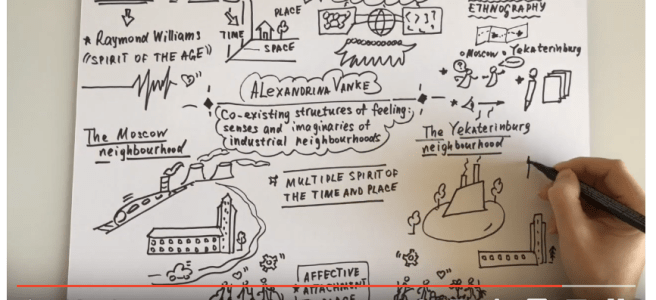
Finally, I came across several animated video abstracts without an author’s face, employing visual storytelling about research outputs. I enjoyed whiteboard animations based on publications, which amazingly combined verbal, textual and visual forms in research presentation. It was not obvious how to make them, but it was obvious that their production is time-consuming, even though they stimulate the creativity and curiosity of both researcher and audience.

Further, I will share my experience of crafting animated and talking video abstracts and conclude with reflections on their role in research visibility.

Animated video abstract

I decided to start with an animated video abstract, as I wanted to draw my article in the video. This prompted me to continue my search and learning. After watching animated videos about research, I found an educational course, From Verbal to Visual. From this online course, I learned how to use icons in sketchnoting, concisely visualise ideas with a black marker and use a video-editing software to combine a video of my graphic drawing, my audio explanation and background music.

It took me several days of creative thinking, learning and making until I crafted my first video abstract. I am sure some will view it as a luxury to spend so much time making an animated video abstract, especially under time pressure in academia. (I was crafting mine during the Christmas holidays). But for me, it was more about curiosity and learning how to make it and how to creatively disseminate research. Of course, when I crafted a second animated video abstract for my journal article on everyday inequalities, it was much easier and quicker. However, it still required time and energy for original thinking and crafting.

Despite all these efforts, I find the result amazing, even though it is far from perfect, but unique, like any handmade object. An animated video abstract reflects the idea of research as craft. This strongly resonates with my vision of doing creative ethnography, which my article on avant-garde methodology develops. This new article explains how to conduct multi-sited ethnography, use drawing and analytical assemblage in research, and creatively write with ethnographic data.

Talking video abstract

My experiences of making video abstracts broadened this year, when Sociology, the journal of the British Sociological Association, invited me to make a talking video about my article on everyday inequalities, which won the Sociology SAGE Prize for Innovation and Excellence 2025. In recent years, more and more academic journals have started suggesting their authors make video abstracts for published articles. In my opinion, Theory, Culture & Society provides really good examples of the talking video format, displayed on their journal website.

As for my experience, recording a talking video abstract for my article published in Sociology journal was split into four stages.

First, making a talking video requires writing and editing an accessible script for a three-minute video. I wrote this script, reread it and tried to tell it. Then I prepared a place and put the minimum equipment I had, a phone with a holder and a laptop camera, in two locations. Later, at the editing stage, I chose to work only with the video recorded with the phone, because it turned out to be better in terms of picture and sound. I decided to use a simple background which would not distract the viewer and put a table lamp on the floor to add cosy light, as it was rainy outside. I made a couple of shoots to check whether my face was in the frame and whether my voice was clearly heard.

At the second stage, ensure that there is no background noise from the window or anywhere else, which will disturb your video recording. Do not forget to put your phone on flight mode. Next, when you are recording a video abstract, it is better to talk about your research article, using a script as a reference and sometimes improvising, rather than reading a script. Natural talking makes a video abstract more engaging. (I know it is hard when you are talking to the camera). I did a couple of takes to choose the best one later.

The third stage includes editing a video abstract with a video-editing app or programme. I used iMovie, but you can use your preferred one, or skip this stage if you do not have time or the skills to use them. But then you need to record an almost perfect video, which does not need to be cut or improved. My talking video appeared to be twice as long as Sociology journal asked for. That is why I cut less important parts to make the video more concise and engaging. I should say that my video-editing skills are very basic. They still allowed me to add my title and name at the beginning and cut less important video frames.

At the final stage, I sent the video abstract and script to the editors of Sociology, who kindly helped me add subtitles. You can find this video abstract on my YouTube channel and it will be available on the Sociology journal website soon.

Is it worth making a video abstract?

Before making a video abstract, one may need to consider carefully whether all the effort and time spent is really worth it. On the one hand, academic journals follow the trend of encouraging authors to make video abstracts. The thing is that online users now consume more video content than textual and visual content. The probability that someone will become interested in your research article increases if they find your video abstract.

On the other hand, I have recently had a chance to discuss this issue with a senior academic who was sceptic about video abstracts and their dissemination on algorithm-based video streaming platforms. According to this position, it is not worth spending time making video abstracts, as they are not supported by algorithms and do not help increase the citation rate. If you are a recognised professor, your publications will be read without creative dissemination. However, early career researchers need to spend time for dissemination if they want their research outputs to rich academic and wider audiences.

It has been two and a half years since I posted a video abstract for my first PhD-based journal article on structures of feeling published behind a paywall. By now, it has reached 850+ views on YouTube, compared with 500+ reads of my blogpost with its summary, 1000+ reads on the journal website, and only eight citations in publications by other academics. This statistic tells us that video abstracts do not directly increase the citation rate, but they increase engagement with your article. For example, I regularly receive emails from people who want to read the article but cannot access it and ask me to share it with them. Some people (most of them students) contact me to say that my article helped them in their research.

As for the article on everyday inequality, also published behind a paywall, its animated video abstract got only 150+ views over the last two years. But the article and my research findings were mentioned in a conversation between three characters in one British film, and it has been cited five times by other academics so far. Again, there is no direct link between a video abstract and scholarly recognition. But what I see from this experience is that my research has become more visible thanks to the video abstracts, which I also posted on my social media accounts.

Are you curious about learning how to craft a video abstract? Are you interested in creative research dissemination? Are you looking for innovative ways of public engagement? If yes, then why not experiment with a video abstract and see what it may bring in terms of making your research visible? At the end of the day, why not give a video abstract a chance among research dissemination channels and public engagement tools?
Seeing between the lines: how drawing opens up new horizons in social research 

The recent requests from academic journals to peer-review submissions on drawing as a method and an invitation to give a guest talk on drawing in social research have made me reflect on my experience of using drawing in sensory ethnography and, more broadly, in the social sciences. Looking back at my published research and evaluating my unpublished work in progress have provided me with several insights on applying drawing as a research tool of data collection, which I share below.

I should say that I am not an artist. I am a professional sociologist who is mainly doing ethnography and qualitative research. For these methodological traditions, interviewing and observation in all their variations are the main methods of data collection. But how can we make these classical methods more vivid, imaginative and (multi-)sensory? I suggest that integrating drawing in interviewing and observation in different ways, genres and formats can help with this.

Preparing my slides for the guest talk within the course ‘Research in Pictures’ led by the contemporary artist Victoria Lomasko at Humboldt University, I realised that I tend to use line and graphic drawing in research in two ways.

First, I apply drawing as a creative task for research participants while interviewing them. In this case, a researcher invites interviewees to draw something with a pen, a black liner or felt pens. And then participants are asked to explain their drawings, as this verbal information will be important for further interpretations at the stage of data analysis. As a sociologist, I believe that it does not make sense to ask participants to draw anything without their additional explanations. Otherwise, a researcher would not interpret the drawings correctly. But this is also an issue for the methodological discussion.

A research participant drawing her volunteer experience of cleaning the Black Sea from the fuel oil split. Photo by Alexandrina Vanke ©

Sometimes this leads to the situation when participants draw and talk simultaneously, sharing their emotions, senses, feelings and thoughts about the topic of drawing. Sometimes they draw in silence and then provide a reflection on the drawing made or the topic discussed. Thus, drawing becomes a helpful means for talking in a deeper, emotional way and from another angle about the research topic compared to directly answering questions from the interview guide.

My recent articles on felt-sensed imaginaries of industrial neighbourhoods and on everyday perceptions of inequalities explain how to ask people to draw their neighbourhoods and society in one interview. Throughout my research practice, I learnt that requests for participants to draw something should be short and clear, and relevant to the research questions or themes. Then drawing will enrich an inquiry with visual information, which is different from verbal narratives but extends and supports them.

Second, I experiment with sketching and graphic drawing in ethnographic observation. In social research, observation typically requires writing field notes. There is a rule saying that without field notes it does not make sense to do observation. I am sure some social scholars will disagree with that. They will probably be right because one can make graphic field notes, although they still require inscriptions. But what if we apply sketching as one more way of documenting events, life situations or slow changes in space? Why not combine observational drawings with written field notes or keep them as either additional or substantive visual data, similar to photos but not equal to photos?

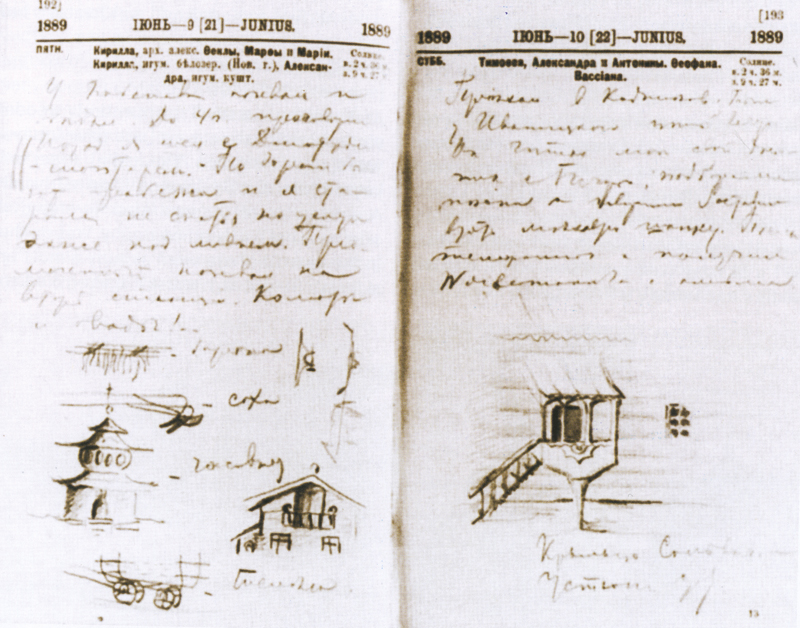
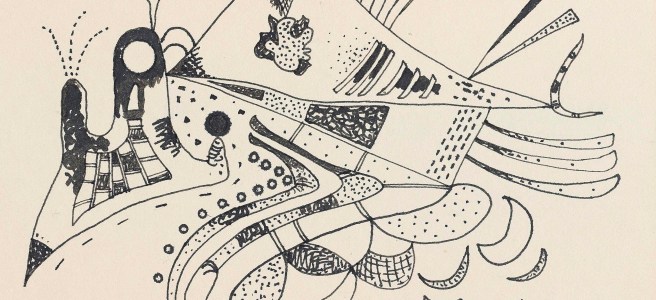
My favourite example is the black-and-white drawings from the expedition diary by the artist Wassily Kandinsky, who studied the culture of the people living in the Russian North. Kandinsky’s field notes combine written words and quick sketches of folk architecture, costumes and rituals.

Sketches in the expedition diary by Wassily Kandinsky. Source: https://ourreg.ru/2018/01/29/ja-polozhitelno-vljublen-zyrjan/

To be sincere, I am still struggling with sketching people, and especially moving ones. But sometimes I manage to grasp their motion and movements with curvy lines and fuzzy shapes. Indeed, it is much easier to draw people resting or sitting, for example, in a café or on a bench.

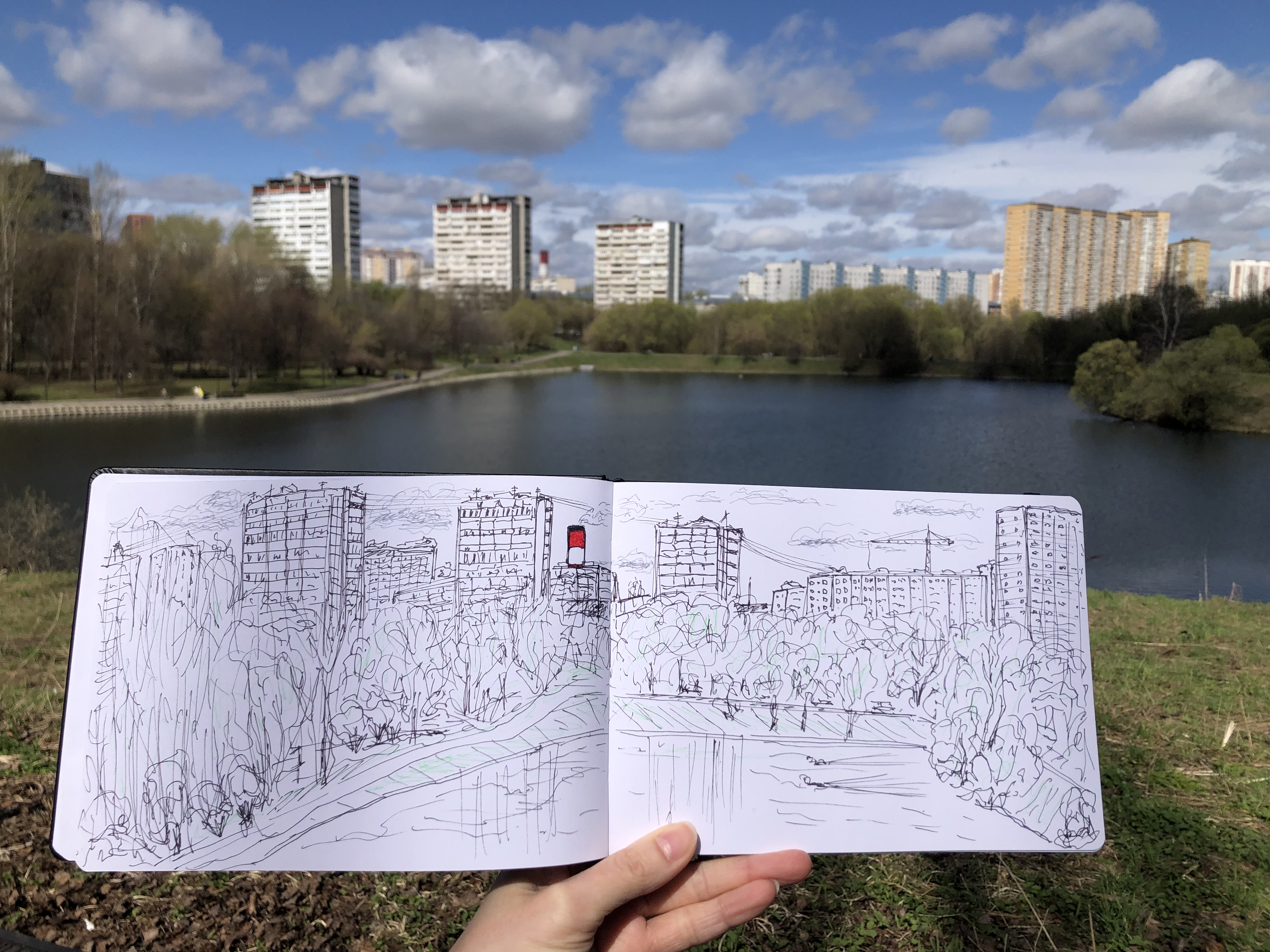
However, the easiest way to start sketching for research purposes is to depict the landscape or an architectural building through simple and familiar shapes, like triangles, squares and rectangles. After that, one can add some eye-catching details to these geometrical objects and connect them with lines. Making a straight horizontal line dividing the field and the sky on a paper sheet does not require specific artistic skills. But this exercise will help to feel a drawing tool and a drawing surface and to connect yourself with the drawn subject.

Graphic drawing of the deindustrialising landscape of Moscow by Alexandrina Vanke ©

I write more about these and other issues, such as how to analyse drawings by participants and make observational drawings and theoretical sketches in my article ‘Multi-sited ethnography: developing avant-garde methodology for creative research into everyday lives’ forthcoming in Sociological Research Online. Stay tuned for more updates!

For learning more examples of using line and graphic drawing in social research, check out the following publications:

On crafting illustrations for The urban life of workers in post-Soviet Russia

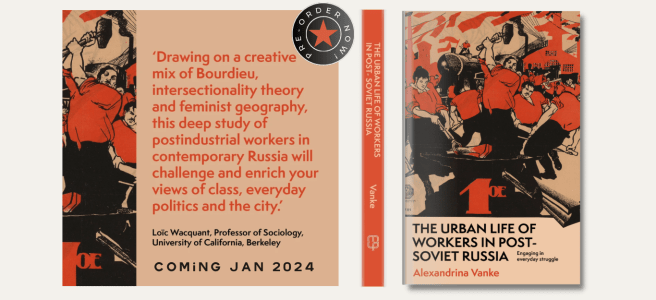
This is the third blogpost in the series about The urban life of workers in post-Soviet Russia. The book will be out in two months in January 2024. I am very excited about this and looking forward to receiving comments from the readers and reviewers.

From its short description, you may learn that the book draws on the ethnographic study with elements of arts-based research. Earlier I wrote about how I integrated poetry in academic writing (read here). In this post, I would like to explain how I used illustrations to support the textual narrative and my overarching argument.

The urban life of workers in post-Soviet Russia includes about 30 black and white illustrations of three types.

First, I illustrate one of my arguments about the complexity of socio-spatial imaginaries with drawings of the industrial neighbourhoods and Russian society made by research participants with a black pen. I obtained these drawings with verbal explanations during interviews with workers and professionals. Drawings with explanations are multi-sensory data created by participants. That is why I view my participants as co-creators of unique data for this ethnographic study. These drawings are as important as interview narratives and other data. They visualise the feelings of residents of the industrial neighbourhoods to their places of residence and their subjective perceptions of inequality and whole Russian society.   

Second, I use some ethnographic photographs taken during fieldwork in Moscow and Yekaterinburg cities. The photographs help to provide the reader with a sense of atmosphere in two locations studied. Some of them show the urban settings and infrastructure of the industrial neighbourhoods. Some others focus on practical activities of ordinary people, such as collective maintenance of deindustrialising areas and cultivating mini-gardens near social housing blocks. For illustrations, I selected those photographs that did not show particiapants’ faces to align with the ethical principles of anonymity. I also use a photograph of a massive May Day Demo in St. Petersburg by Pyotr Prinyov from the mid-2010s to explain better the restrictions for open protests in today’s Russia.

Finally, I crafted several graphic illustrations with the help of drawing skills that I learnt from artist Victoria Lomasko within our course ‘Avant-garde and arts-based methods in qualitative research’. With a black marker, I drew the portraits of some research participants, as well as workers of different ages, genders and ethnicities who I met in a post-industrial city. Moreover, I entitled the first part of the book ‘Theoretical sketches’ not only because ‘Poetical Sketches’ by William Blake inspired my writing. Synthesising a novel theory of urban life, this first part includes my graphic sketches visually explaining the conceptualisation of structure of feeling and everyday struggle.

In the book, I combine the textual register with the visual one to tell the story about the urban life of workers vividly and vibrantly. The idea of such a creative approach to academic writing is not (only) to entertain the reader but not to leave them indifferent.

If you are interested in writing a book review, you can request a free copy of The urban life of workers in post-Soviet Russia on the website of Manchester University Press (click here). If you can, please purchase the book via your University or local library to make it available to a wider community of readers (click here).

On the poetics of The urban life of workers in post-Soviet Russia

The recent news about the outbreak of the Israel-Palestine war and the ongoing Russia-Ukraine war and the Armenia-Azerbaijan war makes me really sad. This news put me back to the reflection on how social scholars should write in the age of multiplication of conflicts, crises and catastrophes.

I finish The urban life of workers in post-Soviet Russia – to be out just in three months – with the suggestion to invent alternative genres of writing about social reality, society and ordinary people who suffer most from wars, crises and catastrophes. My book ends with a ready-made: ‘Toward the bright future of emergent genres!’ A ready-made is an avant-garde piece of text or art made of already existing objects, images or phrases, etc. which gain new meanings being placed into a new context (read more here).

The final sentence of my book starts with the phrase usually associated with Vladimir Lenin’s slogan ‘Toward the bright future’. On the one hand, it refers to the residualised form of expression, while the residual is always alternative to the dominant, according to Raymond Williams.On the other hand, it performatively calls for novatory action aimed to engage the creativity and imagination of a reader. Thus, it produces the possibility or hope for the emergence of genres different from the dominant ones.

When it is hard to express feelings and thoughts with prose, especially in the ages of wars and catastrophes, people often resort to poetry building on the symbolic, imaginative and rhythmic use of language. At this point, the reader may wonder what poetical can be about the book written in the genre of academic non-fiction.

While writing the book, I integrated some poetic forms in my discursive strategy aimed to represent workers alternatively to their negative, stigmatising representations reproduced in the mainstream academic and media discourses. The avant-garde poetry of the 1920s and the romantic poetry of the late 18th century inspired my academic non-fiction. Below, I shed light on the poetics of The urban life of workers in post-Soviet Russia.

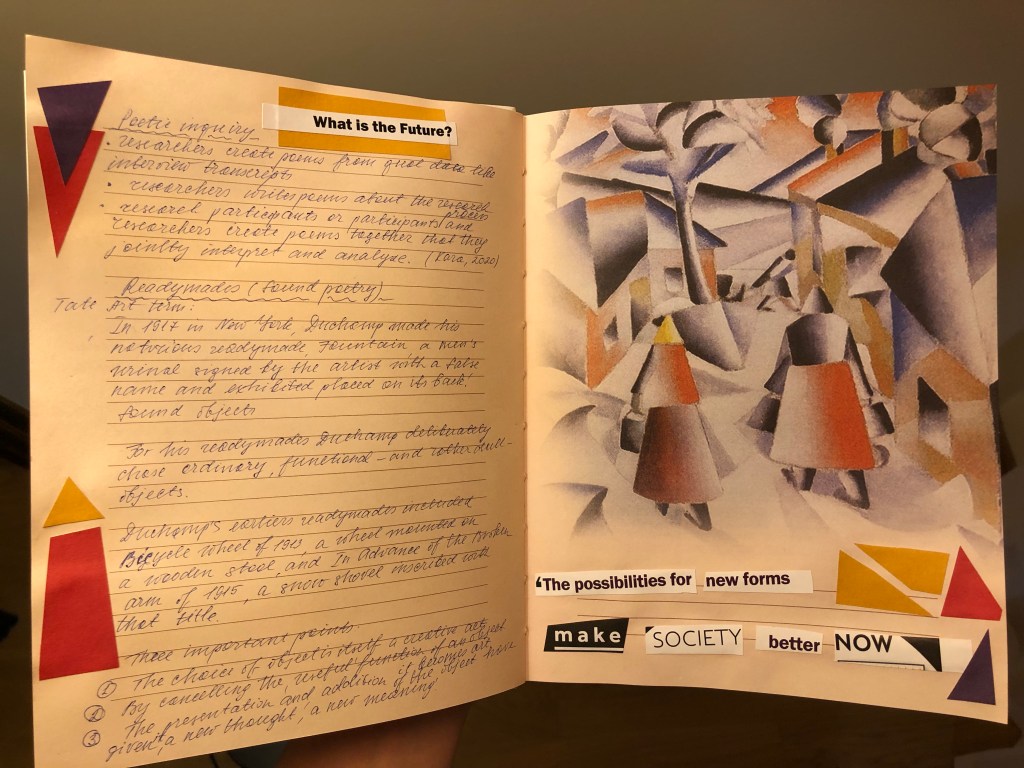
The book opens with my ready-made poem signed with ‘the author’:

What is the Future?

The possibilities for new forms.

Make SOCIETY better NOW!

– A ready-made poem by the author

This poem invites the reader to think about the meaning of the future and calls for action to make society better right now, at least at the level of everyday life. The poem also explains that the future can be viewed as the possibility for new forms of living, creating, writing, etc. The use of three different punctuation marks and upper and lower cases in the three-line poem helps me keep it rhythmic, performative and concise.

My ready-made poem about the future in the visual format © Alexandrina Vanke

I crafted this poem out of booklet and magazine clippings. I cut sentences out first and then glued them on the notepad page already filled with my handwritten notes about ready-made (found) poetry as arts-based research method.

Another example of how I used poetry in academic non-fiction is citing a poem by futurist poet Vladimir Mayakovsky. I included his All hail to subbotniki! in the book to illustrate the meanings of subbotnik, a collective clean of the neighbourhood or the workplace in a day off. (You can read more about this practice here). As far as I did not find an English translation of this poem written in Russian, I translated some of its parts for Chapter 7 covering the theme of the creative forms of everyday resistance.

All hail to subbotniki!

1. Hey, comrades, railway man

and water-transport worker!

2. Remember,

each honest worker

should go to subbotnik! […]

8. All move to subbotnik,

9. and the road will be fixed,

cleaned

and cleared.

Rosta No. 611. November 1920

The poem written in the avant-garde genre one hundred years ago performs several functions in my academic non-fiction about contemporaneity. It provides the reader with the example of the ideological meaning of early-Soviet subbotnik and helps me to show how the meaning of this practice evolved by the 2020s. Apart from this, Mayakovsky’s poem exemplifies performativity calling for action in the avant-garde poetic form which partly inspires (but not pre-determines) my discursive strategy. In this case, the poem by another author illustrates my ethnographic writting about a particular research theme.

The poem All hail to subbotniki! by Maykovsky (on the right-hand side) and his another visual poem (on the left-hand side) taken from the online database of the Russian State Library

The final example which I would like to give is about integration of poetic forms in the skeleton of academic non-fiction. One of the reasons why you may like or not like The urban life of workers in post-Soviet Russia is that the romantic poetry inspired its table of contents and framed its structural composition. The book consists of three parts, Part I: Theoretical sketches, Part Il: Ways of life and Part III: Ways of struggle, which reminiscent of the titles of poetry collections by William Blake, Poetical Sketches (1783) and two parts of his Songs of Innocence and Experience: Songs of Innocence and Songs of Experience (1789–1794).

You may ask: ‘What is William Blake doing in non-fiction about Russia’s workers?’ First of all, I integrated some elements of Blake’s poetry because the romantic poets made a discursive revolution in English literature breaking with the Shakespearian tradition without denying it. One can criticise Blake for being ‘mystic’, the Lake Poets for being ‘arrogant’ and the romantic poetesses for being too focused on their feelings, but their forms of expression helped me figure out my writing strategy about workers aimed not to romanticise them but represent them as they are through the alternative (to the dominant) stylistic means.

If you would like to know more about how these poetic genres allowed me to convey the dominant feelings of the age and creatively tell the story about working-class people, you can pre-order The urbanl life of workers in post-Soviet Russia via your University library or recommend it to your librarian.

Research article on everyday inequalities and images of society

My new article Researching Lay Perceptions of Inequality through Images of Society: Compliance, Inversion and Subversion of Power Hierarchies has been published in Sociology journal.

Cite: Vanke, A. (2023). Researching Lay Perceptions of Inequality through Images of Society: Compliance, Inversion and Subversion of Power Hierarchies. Sociology, 0(0). https://doi.org/10.1177/00380385231194867

The article enhances our understanding of affective and imaginative power of social class by focusing on ordinary people’s lay perceptions of inequality in the example of Russia. I draw a special attention to the social imaginary by which I mean people’s capacity to evoke images in imagination and produce alternative visions of the future. This understanding follows from the conceptualisations of imaginary by Cornelius Castoriadis, Raymond Williams and Karine Clément. The article also explores the moral and symbolic signifiers of class, as well as a sense of inequality and a sense of social justice being formed within socio-material urban infrastructures.

The article may be of interest of those who apply (or would like to learn how to apply) arts-based methods in qualitative and innovative research. It explains how to utilise the method of ‘drawing of society’ initially introduced by Alexander Bikbov in his cross-national study of pupils’ and students’ perceptions of inequality and social justice. In my research, I develop this arts-based method in a multi-sited ethnography of deindustrialising communities in two major post-industrial cities of Russia.

I integrated the method of a drawing of society in an ethnographic interview. During the interviews, I asked research participants to draw Russian society and then explain what they drew. My database includes 35 drawings of society. I complemented these data with observation in deindustrialising urban areas where my ethnography took place.

The article explains in detail how to analyse drawings of society with other multi-sensory data.

My empirical research has shown that the members of deindustrialising communities, including workers and professionals, tend to imagine Russian society as divided between a small number of the rich and a large number of the poor, and as consisting of morally signified social classes.

I support this argument with three examples of images of society created by my research participants.

First, the image of a pyramid of classes was the most popular in my dataset. These drawings demonstrate a top-down power dynamic in Russian society visualising clear divisions between social classes. They often express ordinary people’s compliance with the established social order.

Second, I analyse the images of society with social portraits of people belonging to different social classes or classed groups. One of them is a drawing of ironically inverted power hierarchy in which the rich appeared to be depicted at the bottom, while the poor at the top. Notably, the middle class is absent in this drawing.

Finally, I analyse the image of a class conflict created by one research participant with the radical imagination. In this drawing, Russian society is divided between the greedy capital holders and ordinary people sub-divided into the active working classes and sleeping ‘vegetables’. This image shows an accumulation of ‘power from below’ aimed to subvert or challenge power hierarchy.

I support this argument with more evidence and examples in one chapter of my forthcoming book The urban life of workers in post-Soviet Russia: Engaging in everyday struggle, which is available to pre-order at the website of Manchester University Press or your preferred bookseller.

Applying creative ethnography in the study of deindustrialising neighbourhoods

I wrote a new blog post on creative ethnography in the study of everyday life in deindustrialising urban settings for SAGE Perspectives. It is based on my recent research article examining structures of feeling in Russia’s industrial neighbourhoods. You can read a full version of this blog here, if you are interested in knowing more about how to apply drawing and visual research methods in multi-sited ethnography .

Deindustrialisation is a global complex process. It leads not only to the closure of factories which would otherwise damage the environment but also negatively affects everyday life and job opportunities of working-class people. Deindustrialisation often goes hand in hand with neoliberal urban development resulting in gentrification and displacement of longstanding residents of former industrial neighbourhoods and council estates.  

Due to the multiple impacts of deindustrialisation on the lived experiences of local communities, it is important to develop multi-sensory approaches and innovative methodologies relevant for researching place attachment, sensual experiences and urban imaginaries of people residing in post-industrial urban areas.

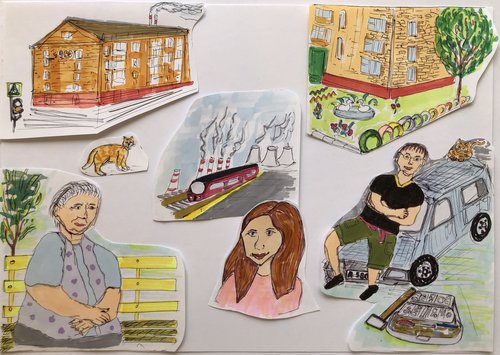
Illustration by Alexandrina Vanke based on ethnographic data from her research

In my study of two industrial neighbourhoods with mixed social compositions in the cities of Moscow and Yekaterinburg, Russia, I drew on the approach of multi-sited ethnography. Its research design built on a combination of the mainstream qualitative methods of interviewing, observation, participation and the creative method of drawing of the neighbourhoods studied made by research participants, also known as a mental mapping technique.

A mental map is a visualisation of the subjective perception of urban space by city dwellers. Kevin Lynch applied mental mapping in his study of the city images in the US. According to Lynch, each image of the city composed by many individual images, which share some similar visual patterns. In my research on Russia’s industrial neighbourhoods, I used mental mapping to explore structures of feeling as affective principles regulating sensual experiences, urban imaginaries and practical activities of local communities. Mental mapping was aimed to elicit how members of those communities sense and imagine their urban areas.

Continue reading in the SAGE Perspectives Blog.