Paperback release incoming: what critics think about my book and why it matters for the class debate – Part 2

This is the second part of the blogpost with my response to the reviewers who engaged with ‘The urban life of workers in post-Soviet Russia’ to be released in paperback in January 2026. In this part, I would like to discuss some comments on my book by Paupolina Gundarina and Mitja Stefancic.

In her essay ‘“Soviet in post-Soviet” in Alexandrina Vanke’s book The Urban Life of Workers in Post-Soviet Russia: Engaging in Everyday Struggle’, published in Russian on the Syg.ma platform, Paupolina Gundarina provides a very sensitive and careful reading of my book. She views my research as ‘an ambitious and creative ethnographic description of workers’ communities, which opens up new dimensions of (the working) class, creativity, imagination and phenomenology of home’. 

Gundarina finds my methodology, drawing on multi-sited ethnography, innovative and creative. She especially highlights the participatory nature of my study, when I invited research participants to draw their neighbourhood and society, which allowed me to grasp their ‘affective experience[s]’. As the reviewer stresses, this methodology opens up new opportunities for the debate about emotions regarding deindustrialisation and their relationships with the Soviet legacy and ‘the issues of morality, trauma, nostalgia, loss and adaptation’. 

‘[T]his is an ambitious and creative ethnographic description of workers’ communities, which opens up new dimensions of (the working) class, creativity, imagination and phenomenology of home.’ Paupolina Gundarina

Continuing this discussion, I would place my methodology within two developing strands. On the one hand, it is situated within the range of ethnographies paying particular attention to sensory-ness, affect and the imaginary. On the other hand, it develops creative, visual and arts-based methods. In my forthcoming article, I call this approach ‘avant-garde methodology’ which generates alternative interpretations of class experiences.

Gundarina finds my revision of class struggle, which I reconsider within the everyday realm, as an important contribution to the Marxist debate on class and resistance. As she writes, ‘Vanke’s book challenges economic determinism showing that the working class in post-Soviet Russia is defined through everyday practices, spatial belonging and grassroots resistance, not just through employment status’. She correctly reads my argument about the formation of classes in Russia’s major cities as ‘a constant, contradictory process, which is influenced by both the Soviet legacy and neoliberal change’. 

As Gundarina discusses further the ethnographic examples from my book, ordinary people continue to implement Soviet practices in deindustrialising urban spaces. But indeed, in the neoliberal context, these practices gain new meanings, allowing residents of industrial districts to cultivate class feelings and attachment to place, for example, through collective maintenance and decoration of the depleting infrastructure remaining from the Soviet era. According to my approach, these practical activities fall under the category of everyday struggle.  

I especially enjoy that the reviewer included her Russian translation of some research participants’ quotes from the book and provided her example of the controversial local debates around a DIY swan created by a local resident of Barnaul, a Western Siberian city of Russia, and put in a public place.

The book review by Mitja Stefancic, published in the 50th Anniversary Issue of Network, magazine by the British Sociological Association, continues to discuss my book in light of the class debate. As he writes, ‘One of the main achievements of the book lies in its successful attempt to re-discuss the concept of class’. Stefancic stresses the importance of my research as it ‘shows how class in Russia means something different when compared, for example, to Western societies’. This conversation about classes continued in an interview with me by Stefancic published in SerbianEnglish and Italian. I am very grateful for this opportunity to discuss my research outputs beyond academia. 

‘One of the main achievements of the book lies in its successful attempt to re-discuss the concept of class. In fact, on a theoretical level, Vanke effectively shows how class in Russia means something different when compared, for example, to Western societies.’ Mitja Stefancic

Indeed, unlike Western countries with stable social structures, Russia has experienced political upheavals and socio-economic reconfigurations of social groups during the 1990s, which influenced how people perceive classes and inequalities. Since the dissolution of the Soviet Union, a new social structure is being formed in contemporary Russia framed by the neoliberal neo-authoritarian order of power. 

My field research conducted before 2022 revealed polarisation in the social structure with a split between the poor and the rich, as I argue in the book and in my article on lay perceptions of inequality (read its summary on Everyday Society). However, sociologically it is interesting to understand how the Russia-Ukraine war will reconfigure the social structure and redistribute social wealth and capitals between particular segments of Russian society.

Stefancic concludes that my book helps to understand better Russian society itself and will be of interest to those who are focusing on how working classes around the globe overcome life difficulties while being excluded from big politics. In light of the global shift of the political mainstream to the right, as discussed in the August issue of Global Dialogue, my approach to everyday struggle in restrictive conditions has the potential to be transferred to other contexts. 
Paperback release incoming: what critics think about my book and why it matters for the class debate – Part 1

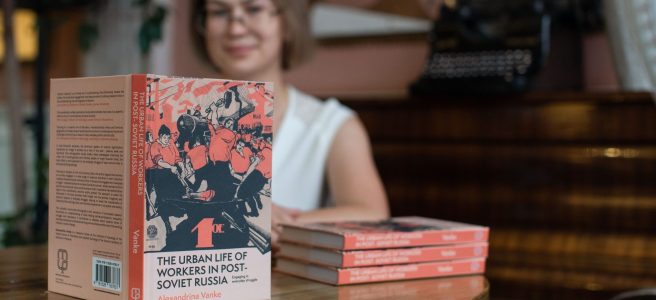
This is photo with the hardback copies of 'The urban life of workers in post-Soviet Russia' by Alexandrina Vanke

I got a wonderful news from Manchester University Press about The urban life of workers in post-Soviet RussiaIt will be out in paperback in January 2026. This means that the book will be available at a more affordable price soon. As recent reviews show, since its first edition in January 2024, the book remains highly relevant, widening discussion about the working classes, deindustrialisation, inequalities and everyday struggles.

In one of the previous blog posts, I replied to the first book reviews by sociologists Claudio Morrison and Christopher Altamura. In this blog post, I would like to continue this conversation about class with other commentators on the book, which appeared in the first half of 2025. I will engage with them in the chronological order in which their reviews were published.

In Challenging Stereotypes of Post-Soviet Russian Workers (CEU Review of Books), Victoria Kobzeva from the University of Birmingham provides critical comments on my theoretical framework, researcher positionality and interpretations of workers’ acts of everyday resistance. On the one hand, Kobzeva writes that the book introduces ‘a dozen concepts’ that are pivotal for my further ethnographic interpretations. On the other hand, she claims that my theoretical contribution to social theory, especially to Pierre Bourdieu’s approach of habitus, ‘feels limited’ despite rich empirical data.

‘Vanke’s book is an example of immersive, prolonged ethnography enriched by creative methodologies and a deep engagement with the lived experiences of Russia’s urban working class.’ Viktoria Kobzeva

When an author meets such criticism, it leads to reflection on what theoretical contribution means and how to increase it in future publications. Below, I would like to address this point of criticism.

The urban life of workers in post-Soviet Russia develops some theoretical concepts further. The book engages with ‘structure of feeling’, introduced by Raymond Williams, which I re-conceptualise as an affective principle regulating senses, imaginaries and practical activities within socio-material infrastructures, drawing on multi-sited ethnography in post-socialist deindustrialising contexts. The book also conceptualises everyday struggle, by which I mean a set of multiple counter-hegemonic acts, micro-practices and activities performed by workers and ordinary people in everyday life. I agree with Kobzeva that everyday struggle needs to be theorised further, as this concept differs from mundane resistance, introduced by James Scott, even though it encompasses resistance. However, I see working with everyday struggle as my contribution to theories of struggle and protest, which mainly focus on overt protests and social movements in Western liberal democracies.

Next, in the book, I map these and other concepts, visualising relationships between them in two theoretical sketches, and synthesise them into a theory of urban life and everyday struggle. I am still thinking about what this theory could be called: multi-sensory, affective or imaginative? The idea of everyday struggle embedded in life leaves room for reconsidering the concept of habitus, through re-viewing it as a set of dispositions of resistance and counter-actions.

The suggested framework adds affective, sensory and imaginative dimensions to the understanding of class and struggle that, as my ethnography shows, goes beyond coping and resistance. This framework opens up an opportunity to think about social change at the micro-level, enacted through enduring dispositions of co-creation and re-shaping. In the book, I also deal with the concept of spatialised gender habitus, or a gendered sense of place. I agree with the reviewer that it needs to be developed further, probably in future publications.

In the book, I do not introduce new concepts. What I do is theorise and synthesise existing concepts based on extensive multi-sited ethnography in Russia’s post-industrial cities. If such a framework contributes to the de-stigmatisation of low-resourced groups in post-socialist settings and can potentially be discussed and adopted (with adjustments) in other ‘local’ contexts, then my goal as an author will have been met.

However, there is still an open question about whether everyday struggle is exclusively working-class, and whether it allows class consciousness, as was asked in the review by Morrison. My continuing ethnography shows that not only working-class people engage in everyday struggle, but that it is still informed by how people sense inequality locally, imagine social justice in society and view the global future.

‘The Urban Life of Workers in Post-Soviet Russia: Engaging in Everyday Struggle (published by Manchester University Press in 2024) by Alexandrina Vanke is an innovative and textured engagement with the world of the working class in the post-industrial cities of Russia.’ Arpita Rachel Abraham

The book review by Arpita Rachel Abraham, an Urban Fellow at the Indian Institute for Human Settlements in Bengaluru, published on the Doing Sociology platform, continues the discussion about class consciousness, urban change, critical sociological theory and ethnography from the perspective of the impact of ‘global political developments’ and ‘Russia’s aggression on Ukraine’ on the working classes and ordinary people. Abraham stresses that my book advances the theory of the everyday, which is often lacking a political dimension. She points out that my research shows that the political is part of everyday life in neoliberal neo-authoritarian contexts. In this sense, my book bridges two separate areas: everyday life studies and social movement studies.

Praising ‘an impressive assemblage of textual, visual and performative elements’ in the book, Abraham raises a critical question about the one-dimensionality and repetitiveness of the argument regarding workers’ active engagement in everyday struggle. I would like to explain that the idea behind writing this book was to make this core argument part of academic storytelling, using it as the key element that would sew all chapters together like a needle. In the next book, I will probably experiment with integrating more authorial ideas and less polished arguments, which I will present not as analytically justified statements but as diverse interpretations, provoking new directions, debates and conversations on the subject matter.

I am grateful to both Victoria Kobzeva and Arpita Rachel Abraham for their interest in my book and for writing reviews that widen the discussion about the issues considered in The urban life of workers in post-Soviet Russia.

In the second part of this blog post, I will reflect on the comments from the reviews of my book by Paupolina Gundarin and Mitja Stefancic.

To be continued…