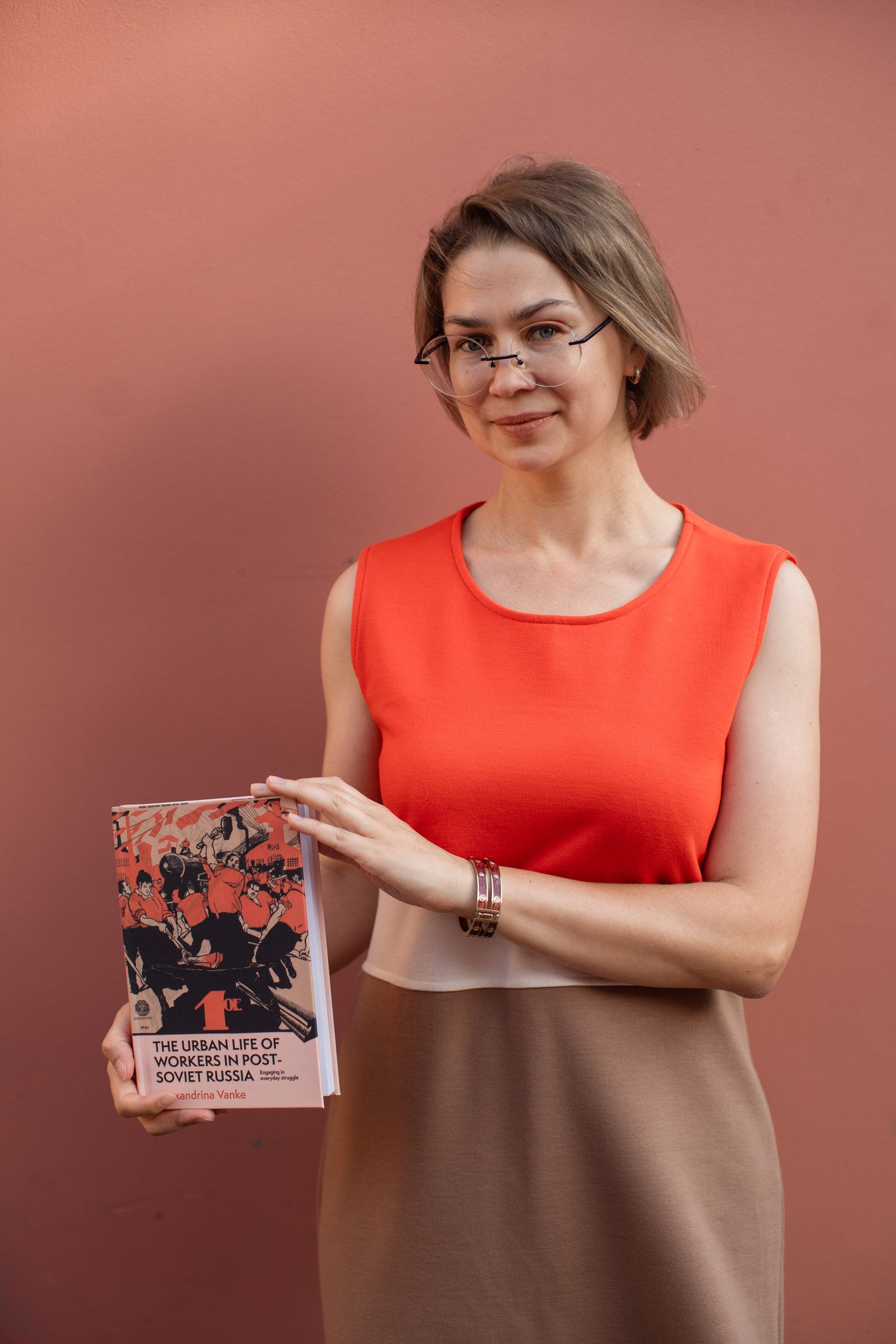

Paperback release incoming: what critics think about my book and why it matters for the class debate – Part 2

This is the second part of the blogpost with my response to the reviewers who engaged with ‘The urban life of workers in post-Soviet Russia’ to be released in paperback in January 2026. In this part, I would like to discuss some comments on my book by Paupolina Gundarina and Mitja Stefancic.

In her essay ‘“Soviet in post-Soviet” in Alexandrina Vanke’s book The Urban Life of Workers in Post-Soviet Russia: Engaging in Everyday Struggle’, published in Russian on the Syg.ma platform, Paupolina Gundarina provides a very sensitive and careful reading of my book. She views my research as ‘an ambitious and creative ethnographic description of workers’ communities, which opens up new dimensions of (the working) class, creativity, imagination and phenomenology of home’. 

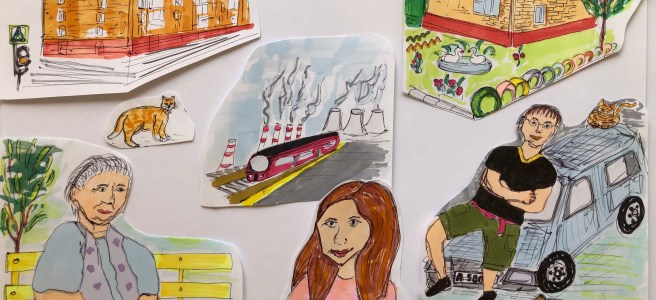
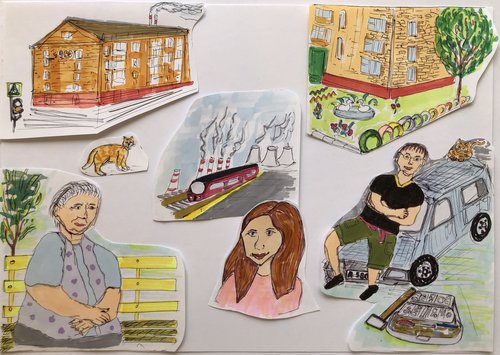
Gundarina finds my methodology, drawing on multi-sited ethnography, innovative and creative. She especially highlights the participatory nature of my study, when I invited research participants to draw their neighbourhood and society, which allowed me to grasp their ‘affective experience[s]’. As the reviewer stresses, this methodology opens up new opportunities for the debate about emotions regarding deindustrialisation and their relationships with the Soviet legacy and ‘the issues of morality, trauma, nostalgia, loss and adaptation’. 

‘[T]his is an ambitious and creative ethnographic description of workers’ communities, which opens up new dimensions of (the working) class, creativity, imagination and phenomenology of home.’ Paupolina Gundarina

Continuing this discussion, I would place my methodology within two developing strands. On the one hand, it is situated within the range of ethnographies paying particular attention to sensory-ness, affect and the imaginary. On the other hand, it develops creative, visual and arts-based methods. In my forthcoming article, I call this approach ‘avant-garde methodology’ which generates alternative interpretations of class experiences.

Gundarina finds my revision of class struggle, which I reconsider within the everyday realm, as an important contribution to the Marxist debate on class and resistance. As she writes, ‘Vanke’s book challenges economic determinism showing that the working class in post-Soviet Russia is defined through everyday practices, spatial belonging and grassroots resistance, not just through employment status’. She correctly reads my argument about the formation of classes in Russia’s major cities as ‘a constant, contradictory process, which is influenced by both the Soviet legacy and neoliberal change’. 

As Gundarina discusses further the ethnographic examples from my book, ordinary people continue to implement Soviet practices in deindustrialising urban spaces. But indeed, in the neoliberal context, these practices gain new meanings, allowing residents of industrial districts to cultivate class feelings and attachment to place, for example, through collective maintenance and decoration of the depleting infrastructure remaining from the Soviet era. According to my approach, these practical activities fall under the category of everyday struggle.  

I especially enjoy that the reviewer included her Russian translation of some research participants’ quotes from the book and provided her example of the controversial local debates around a DIY swan created by a local resident of Barnaul, a Western Siberian city of Russia, and put in a public place.

The book review by Mitja Stefancic, published in the 50th Anniversary Issue of Network, magazine by the British Sociological Association, continues to discuss my book in light of the class debate. As he writes, ‘One of the main achievements of the book lies in its successful attempt to re-discuss the concept of class’. Stefancic stresses the importance of my research as it ‘shows how class in Russia means something different when compared, for example, to Western societies’. This conversation about classes continued in an interview with me by Stefancic published in SerbianEnglish and Italian. I am very grateful for this opportunity to discuss my research outputs beyond academia. 

‘One of the main achievements of the book lies in its successful attempt to re-discuss the concept of class. In fact, on a theoretical level, Vanke effectively shows how class in Russia means something different when compared, for example, to Western societies.’ Mitja Stefancic

Indeed, unlike Western countries with stable social structures, Russia has experienced political upheavals and socio-economic reconfigurations of social groups during the 1990s, which influenced how people perceive classes and inequalities. Since the dissolution of the Soviet Union, a new social structure is being formed in contemporary Russia framed by the neoliberal neo-authoritarian order of power. 

My field research conducted before 2022 revealed polarisation in the social structure with a split between the poor and the rich, as I argue in the book and in my article on lay perceptions of inequality (read its summary on Everyday Society). However, sociologically it is interesting to understand how the Russia-Ukraine war will reconfigure the social structure and redistribute social wealth and capitals between particular segments of Russian society.

Stefancic concludes that my book helps to understand better Russian society itself and will be of interest to those who are focusing on how working classes around the globe overcome life difficulties while being excluded from big politics. In light of the global shift of the political mainstream to the right, as discussed in the August issue of Global Dialogue, my approach to everyday struggle in restrictive conditions has the potential to be transferred to other contexts. 

The urban life of workers in post-Soviet Russia: dissemination and reception

Unbelievable, ‘The urban life of workers in post-Soviet Russia’ is now six month old! At its six-month mark, I would like to reflect on its dissemination and initial reception. 

This is an academic book. So it is not surprising that the first feedback and comments I received were from my colleagues in universities around the world. What surprised me, however, was that historians, including the historians of Russia and labour movements in other countries, appeared to be so grateful readers! 

Some of them wrote to me to say that they were interested in reading the book and found it valuable. At the same time, some of them pointed out that such title should cost less and that the high price prevents a wider audience from reading it. I absolutely agree! But the publisher sets the price. If enough copies are sold, Manchester University Press will reprint the book in softcover. So thinking about dissemination is important here.

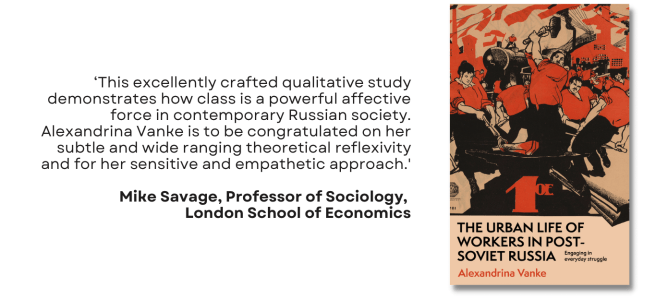
I have also received messages from friends and colleagues with congratulations saying that they liked the book cover. Needless to say, I like it too. I chose the image for the front cover deliberately. I was lucky that my publisher provided me with a designer who came up with a really great cover. I am glad that the readers find it cool and hot at once.

‘The urban life of workers in post-Soviet Russia’ tells the story of workers living in specific geographical locations, in post-industrial cities. So it seemed to be of interest to human geographers and urban scholars. Sociologist Anna Zhelnina invited me to talk about my book on one episode of the New Books Network. It was a very pleasant conversation, which helped me to talk about the book from different angles. We discussed the local atmosphere in Russia’s deindustrialising neighbourhoods, the involvement of residents in grassroots activities, social and labour movements, and, among other things, my research methodology, alternative approach to writing and theoretical contribution.

I really enjoy research blogging. So I have written a number of guest posts about the book. First, Manchester University Press republished my blog about subbotnik, proletarian art and the urban life of workers. Then, I wrote about how working-class communities experience deindustrialisation in Russia for the blog of the international project ‘Deindustrialization and the Politics of Our Time’ (DéPOT at Concordia University). Finally, I contributed to the blog of the Raymond Williams Society with a post on structure of feeling as a conceptual tool in the study of everyday life and struggle.

I am grateful to my colleagues for inviting me to present the book at the regular seminar of the Bourdieu, Work and Inequality research network and at the seminar for history students at Sorbonne Université. 

I also presented some chapters of the book at the British Sociological Association annual conference 2024 ‘Crisis, Continuity and Change’ and at the DéPOT project annual conference ‘Gender, Family and Deindustrialization’. 

These dissemination efforts has resulted in ‘The urban life of workers in post-Soviet Russia’ being included in the book review lists of the following journals, magazines and blogs (that I am aware of): 

·      The BSA Network Magazine

·      LSE Review of Books

·      Europe-Asia Studies

·      Eurasian Geography and Economics

·      Key Words: A Journal of Cultural Materialism 

·      Laboratorium: Russia Review of Social Research 

If you would like to get a free copy, please contact one of the issues listed above to write a review. 

Last but not least. I would like to thank all the people who ordered my book for their libraries! ‘The urban life of workers in post-Soviet Russia’ is now available in the library catalogues of the following universities:

·      University of Helsinki

·      University College London

·      University of Sussex

·      Aarhus University

·      Sorbonne University

·      Manchester Metropolitan University

·      University of Cambridge 

I guess this list is longer. 

What next? I see the interest in my book in French-speaking countries, especially in France and Canada. It would be great to have it translated into French and other languages. If anyone from a non-English publisher reads this post and is interested in translating my book into another language, please contact Manchester University Press. 

And for me, it’s time to think about how else I can tell the stories of workers’ urban lives. 

Stay tuned!

The release day of The urban life of workers in post-Soviet Russia

It’s release day! I am delighted to announce that The urban life of workers in post-Soviet Russia is out now!

Many thanks to all people whose support made this book possible. I am grateful to Manchester University Press for their professionalism and high quality book production. The process of crafting this book was inspiring for me, despite the dark times throughout which I was writing it.

The book is centered on the stories of urban workers in Russian society. But I hope that an international reader gets something useful about how ‘ordinary people’ overcome life difficulties with meagre resources they possess. This practical knowledge may be especially valuable in the era of crises and conflicts we live now as humankind.

In this final blog post in the series about The urban life of workers in post-Soviet Russia, I would like to discuss briefly its contents.

As I wrote earlier, the book consists of three parts. The first one Theoretical sketches presents my ethnographically grounded synthesis of the concepts allowing a critical reflection on the challenges that workers and other city dwellers face in deindustrialising urban areas. Chapter 1 develops a novel theory of urban life and everyday struggle building the network of revised concepts, including structure of feeling, senses, imaginaries, order of power, everyday struggle, consciousness and habitus.

The second part Ways of life tells the story about everyday life in Russia’s major post-industrial cities and Russian society as a whole.

Chapter 2 provides the setting of the story discussing the local atmospheres, sensual experiences and spatial imaginaries in the two industrial neighbourhoods located in the cities of Moscow and Yekaterinburg. Chapter 3 considers spatialised gendered senses of working-class people and intersectional inequalities in the industrial neighbourhoods studied.

Chapter 4 analyses the symbolic and moral meanings of social groups in Russia, including the working class and the middle class, mentioned by research participants from both cities. This chapter pays special attention to moral judgement and blaming working and poor people by wealthier classes intensified in the context of the Russia-Ukraine war. Chapter 5 examines research participants’ subjective perceptions of the whole Russian society by looking at their social imaginaries and everyday inequalities they experience daily.

The third part Ways of struggle explores different forms of struggle and particular consciousness emerging from engagement in them.

Chapter 6 focuses on open protests, including trade union strikes and social movements, leading to the formation of dispositions of protest and political consciousness. It shows how the objective restrictions for massive collective actions were steadily increasing in Russia throughout the 2010s and dropped to minimum in 2022.

Chapter 7 explains how workers and other residents of deindustrialising areas are actively engaged in the everyday forms of resistance to multiple challenges caused by neoliberalism and neo-authoritarianism. This long-standing engagement in everyday struggle leads to the formation of habituated resistance and practical consciousness of creative nature.

If you want to help The urban life of workers in post-Soviet Russia become visible, please consider taking the following action:

  • order the book for your library or recommend it to your librarian;
  • request a free copy from Manchester University Press to write a review;
  • include it in your syllabus or reading list.

By signing up to the MUP newsletter, you will get 30% discount on this title.

Enjoy the book!

On building a discursive strategy for The urban life of workers in post-Soviet Russia

I have great news! The release day of The urban life of workers in post-Soviet Russia was rescheduled for the 9th January 2024. It will be available earlier than expected. Christmas is coming and my book is coming too!

The urban life of workers in post-Soviet Russia became possible thanks to support of communities. Before writing this post, I launched a short survey asking my friends what they would like to know else about it. Most of them replied that they were interested in knowing how I built a discursive strategy for the book. This topic followed by the role of epigraphs in book chapters. And several friends were curious about what books influenced my writing style.

This monthly post discusses these issues.

What is a discursive strategy?

I would like to start with the definition. By discursive strategies, linguists Ruth Wodak and Martin Reisigl mean ‘a more or less accurate and more or less intentional plan of practices (including discursive practices) adopted to achieve a certain aim’ (2015: 585). Applying this to academic non-fiction, I rather view discursive strategies as sets of semantic, stylistic and representational decisions that authors make reflexively and situationally in the process of writing texts to achieve particular aims related to knowledge production, articulation and dissemination.

For me, building a discursive strategy about ‘ordinary people’ (in Russia and elsewhere) implies a creation of an alternative overarching frame for writing about them, as well as choosing consciously what words, phrases and expressions to use and not use when I represent research participants. This implies reflection on how turn separate stories into a coherent grand narrative about ordinary lives and struggles in contemporary societies.

The urban life of workers in post-Soviet Russia criticises negative and stereotypical representations of working-class people typical for dominant media and academic discourses, and especially blaming and shaming discourses about Russia’s poor that became widespread in the context of the Russia-Ukraine war. In contrast to this, my book focuses on ordinary people’s everyday struggle suggesting an alternative genre of writing about them. According to the book description, this genre of writing is influenced by the avant-garde documentary tradition and working-class literature.

Why and how to use epigraphs

Using epigraphs, i.e. short quotations or sayings, in the beginning of a book, chapter or even section, can be part of the discursive strategy. With the help of epigraphs an author can not only introduce the main idea of their text to a reader, but also build the relationships with other texts from particular literary or intellectual traditions.

In Domination and the Arts of Resistance, anthropologist James Scott uses proverbs and quotations from texts written in different genres in the beginning of his book, chapters and some sections. For epigraphs, Scott prefers the extracts from plays by Euripides, Jean Genet and Václav Havel; novels by George Eliot, Onore de Balzak, George Orwell and Milan Kundera; philosophical works by Blaise Pascal, Immanuel Kant and Alexander Herzen; and academic non-fiction by Paul Willis, Michel de Certeau and other authors. This set of references shows that Scott is anchoring his writing in the European intellectual tradition. However, most of these authors were white men, apart from George Eliot who was a white woman.

While I was selecting epigraphs for The urban life of workers in post-Soviet Russia, I tried to quote people who were white and black, men and women. Most of them were writing between the 19th and 20th centuries. But similarly to Scott I start one chapter on open protests with the quotation from The Suppliant Women by Euripides: ‘All our life is struggle’ – because one research participant, a trade union activist, paraphrased it in the interview.

For epigraphs in other chapters, I quoted literary theorists Valentin Vološinov and Viktor Shklovsky and writers Maxim Gorky and Victor Serge to show the inter-textual connections of my writing with the early Soviet avant-garde literary tradition. This literary tradition is characterised by experimentation and alternative representation of workers. Sociologists Raymond Williams and Stuart Hall – whose quotations I also used for epigraphs – analysed and developed avant-garde approaches.

To contextualise my writing within the feminist intellectual tradition, which my book develops further, I quoted in epigraphs such writers and public figures, as Clara Zetkin, Alexandra Kolontai, Angela Davis and Kimberlé Crénshaw. They all contributed to the struggle of the oppressed for social justice and provided us with valuable writing strategies.

Books and authors that influenced my writing

I started thinking more seriously of how I was writing about workers during my PhD at Manchester, the city with a long tradition of working-class literature. To enhance my writing skills, I started reading British fiction about social classes. Novels Second Generation and Border Country by Raymond Williams influenced not only my way of thinking about writing, but also inspired me for building my discursive strategy.

Everyday Post-Socialism: Working-Class Communities in the Russian Margins, academic non-fiction by sociologist and anthropologist Jeremy Morris appeared to be important for my reflection on how I can write about Russia’s workers and Russian society as a whole. Apart from inheriting critical ethnography, Morris’s writing style is situated at the intersection of British and Soviet working-class literatures.

Moreover, in Manchester, whether you want it or not, you will learn about historian E.P. Thompson, the author of The Making of the English Working Class, and writer Elizabeth Gaskell who worked with the genre of the industrial novel. I cannot help but mention Marx and Engels whose explorations of working-class people in Manchester formed the ground for their books.

At the same time, I was reading contemporary working-class writers and scholars, including a collection of essays Common People, academic books by Doreen Massey and other authors. Last but not least, I really enjoy reading Jonathan Coe, novelist from Midlands writing political satire, whose fictional characters ranging from working-class people to the elites live on the pages of his books.

The urban life of workers in post-Soviet Russia explains in detail the novel genre of writing that I suggest social scholars trying in their writing process.

On crafting illustrations for The urban life of workers in post-Soviet Russia

This is the third blogpost in the series about The urban life of workers in post-Soviet Russia. The book will be out in two months in January 2024. I am very excited about this and looking forward to receiving comments from the readers and reviewers.

From its short description, you may learn that the book draws on the ethnographic study with elements of arts-based research. Earlier I wrote about how I integrated poetry in academic writing (read here). In this post, I would like to explain how I used illustrations to support the textual narrative and my overarching argument.

The urban life of workers in post-Soviet Russia includes about 30 black and white illustrations of three types.

First, I illustrate one of my arguments about the complexity of socio-spatial imaginaries with drawings of the industrial neighbourhoods and Russian society made by research participants with a black pen. I obtained these drawings with verbal explanations during interviews with workers and professionals. Drawings with explanations are multi-sensory data created by participants. That is why I view my participants as co-creators of unique data for this ethnographic study. These drawings are as important as interview narratives and other data. They visualise the feelings of residents of the industrial neighbourhoods to their places of residence and their subjective perceptions of inequality and whole Russian society.   

Second, I use some ethnographic photographs taken during fieldwork in Moscow and Yekaterinburg cities. The photographs help to provide the reader with a sense of atmosphere in two locations studied. Some of them show the urban settings and infrastructure of the industrial neighbourhoods. Some others focus on practical activities of ordinary people, such as collective maintenance of deindustrialising areas and cultivating mini-gardens near social housing blocks. For illustrations, I selected those photographs that did not show particiapants’ faces to align with the ethical principles of anonymity. I also use a photograph of a massive May Day Demo in St. Petersburg by Pyotr Prinyov from the mid-2010s to explain better the restrictions for open protests in today’s Russia.

Finally, I crafted several graphic illustrations with the help of drawing skills that I learnt from artist Victoria Lomasko within our course ‘Avant-garde and arts-based methods in qualitative research’. With a black marker, I drew the portraits of some research participants, as well as workers of different ages, genders and ethnicities who I met in a post-industrial city. Moreover, I entitled the first part of the book ‘Theoretical sketches’ not only because ‘Poetical Sketches’ by William Blake inspired my writing. Synthesising a novel theory of urban life, this first part includes my graphic sketches visually explaining the conceptualisation of structure of feeling and everyday struggle.

In the book, I combine the textual register with the visual one to tell the story about the urban life of workers vividly and vibrantly. The idea of such a creative approach to academic writing is not (only) to entertain the reader but not to leave them indifferent.

If you are interested in writing a book review, you can request a free copy of The urban life of workers in post-Soviet Russia on the website of Manchester University Press (click here). If you can, please purchase the book via your University or local library to make it available to a wider community of readers (click here).

On the poetics of The urban life of workers in post-Soviet Russia

The recent news about the outbreak of the Israel-Palestine war and the ongoing Russia-Ukraine war and the Armenia-Azerbaijan war makes me really sad. This news put me back to the reflection on how social scholars should write in the age of multiplication of conflicts, crises and catastrophes.

I finish The urban life of workers in post-Soviet Russia – to be out just in three months – with the suggestion to invent alternative genres of writing about social reality, society and ordinary people who suffer most from wars, crises and catastrophes. My book ends with a ready-made: ‘Toward the bright future of emergent genres!’ A ready-made is an avant-garde piece of text or art made of already existing objects, images or phrases, etc. which gain new meanings being placed into a new context (read more here).

The final sentence of my book starts with the phrase usually associated with Vladimir Lenin’s slogan ‘Toward the bright future’. On the one hand, it refers to the residualised form of expression, while the residual is always alternative to the dominant, according to Raymond Williams.On the other hand, it performatively calls for novatory action aimed to engage the creativity and imagination of a reader. Thus, it produces the possibility or hope for the emergence of genres different from the dominant ones.

When it is hard to express feelings and thoughts with prose, especially in the ages of wars and catastrophes, people often resort to poetry building on the symbolic, imaginative and rhythmic use of language. At this point, the reader may wonder what poetical can be about the book written in the genre of academic non-fiction.

While writing the book, I integrated some poetic forms in my discursive strategy aimed to represent workers alternatively to their negative, stigmatising representations reproduced in the mainstream academic and media discourses. The avant-garde poetry of the 1920s and the romantic poetry of the late 18th century inspired my academic non-fiction. Below, I shed light on the poetics of The urban life of workers in post-Soviet Russia.

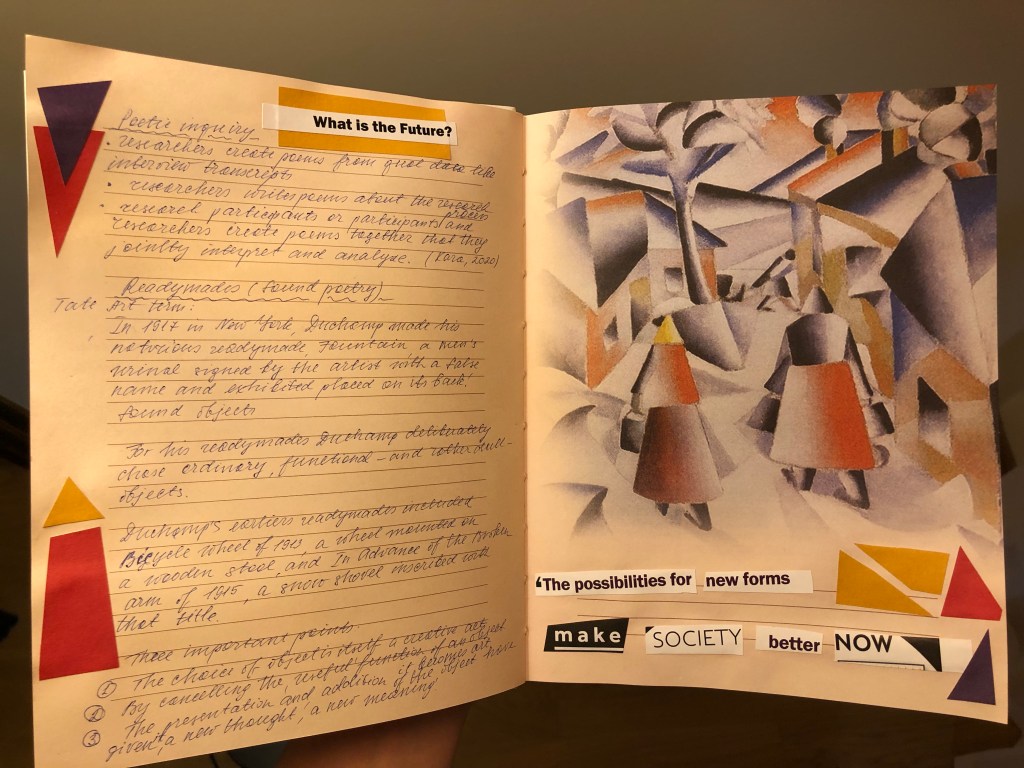
The book opens with my ready-made poem signed with ‘the author’:

What is the Future?

The possibilities for new forms.

Make SOCIETY better NOW!

– A ready-made poem by the author

This poem invites the reader to think about the meaning of the future and calls for action to make society better right now, at least at the level of everyday life. The poem also explains that the future can be viewed as the possibility for new forms of living, creating, writing, etc. The use of three different punctuation marks and upper and lower cases in the three-line poem helps me keep it rhythmic, performative and concise.

My ready-made poem about the future in the visual format © Alexandrina Vanke

I crafted this poem out of booklet and magazine clippings. I cut sentences out first and then glued them on the notepad page already filled with my handwritten notes about ready-made (found) poetry as arts-based research method.

Another example of how I used poetry in academic non-fiction is citing a poem by futurist poet Vladimir Mayakovsky. I included his All hail to subbotniki! in the book to illustrate the meanings of subbotnik, a collective clean of the neighbourhood or the workplace in a day off. (You can read more about this practice here). As far as I did not find an English translation of this poem written in Russian, I translated some of its parts for Chapter 7 covering the theme of the creative forms of everyday resistance.

All hail to subbotniki!

1. Hey, comrades, railway man

and water-transport worker!

2. Remember,

each honest worker

should go to subbotnik! […]

8. All move to subbotnik,

9. and the road will be fixed,

cleaned

and cleared.

Rosta No. 611. November 1920

The poem written in the avant-garde genre one hundred years ago performs several functions in my academic non-fiction about contemporaneity. It provides the reader with the example of the ideological meaning of early-Soviet subbotnik and helps me to show how the meaning of this practice evolved by the 2020s. Apart from this, Mayakovsky’s poem exemplifies performativity calling for action in the avant-garde poetic form which partly inspires (but not pre-determines) my discursive strategy. In this case, the poem by another author illustrates my ethnographic writting about a particular research theme.

The poem All hail to subbotniki! by Maykovsky (on the right-hand side) and his another visual poem (on the left-hand side) taken from the online database of the Russian State Library

The final example which I would like to give is about integration of poetic forms in the skeleton of academic non-fiction. One of the reasons why you may like or not like The urban life of workers in post-Soviet Russia is that the romantic poetry inspired its table of contents and framed its structural composition. The book consists of three parts, Part I: Theoretical sketches, Part Il: Ways of life and Part III: Ways of struggle, which reminiscent of the titles of poetry collections by William Blake, Poetical Sketches (1783) and two parts of his Songs of Innocence and Experience: Songs of Innocence and Songs of Experience (1789–1794).

You may ask: ‘What is William Blake doing in non-fiction about Russia’s workers?’ First of all, I integrated some elements of Blake’s poetry because the romantic poets made a discursive revolution in English literature breaking with the Shakespearian tradition without denying it. One can criticise Blake for being ‘mystic’, the Lake Poets for being ‘arrogant’ and the romantic poetesses for being too focused on their feelings, but their forms of expression helped me figure out my writing strategy about workers aimed not to romanticise them but represent them as they are through the alternative (to the dominant) stylistic means.

If you would like to know more about how these poetic genres allowed me to convey the dominant feelings of the age and creatively tell the story about working-class people, you can pre-order The urbanl life of workers in post-Soviet Russia via your University library or recommend it to your librarian.

On the front cover image of The urban life of workers in post-Soviet Russia

On the background of hot debates about Russia, I got the final version of the front cover of my forthcoming book to be released just in four months, on 16 January 2024. Drawing on multi-sited ethnography, The urban life of workers in post-Soviet Russia: Engaging in everyday struggle creatively explores the lived experiences of working-class and wider deindustrialising communities in the cities of Moscow and Yekaterinburg, and beyond.

In this blog post, I would like to discuss the visual aesthetics of the book mainly focusing on its front cover image. It contains some elements of the poster The 1st of May. The All-Russian subbotnik created by graphic artist Dmitrii Moor (Orlov) in 1920. A brief overview of his life will help to explain better his artistic approach. Moor was born in the family of an engineer in Novocherkassk in 1883. After moving to Moscow in 1989, he got a vocational education and participated in the Revolution of 1905. This experience made him realise that he should present the voice of working-class people through the artistic means (see Kozlov, 1949). Moor did not have a formal art education, but inside the country, he was considered to be a People’s Artist, while his art was called ‘proletarian art’. To the international audience, Moor may be known for his avant-garde posters and political caricatures.

The photo of the poster The 1st of May. The-All Russian subbotnik by Dmitrii Moor (Orlov) taken by Alexandrina Vanke in the Lenin Library

In The 1st of May, Moor depicted working-class people on May Day engaged in building and maintaining not only the industrial urban infrastructure but also the fabric of everyday life. This visual representation of workers as acting aligns with my main argument about workers’ engagement in the creative forms of mundane resistance which, as I explain in the book, falls under the category of everyday struggle.

For the greater effect, Moor used a combination of black, beige and red colours which characterise his graphic art style. The message of his image is clear and concise. The poster realistically shows the urban life of workers and emphasises their class consciousness: the themes my book explores in detail. In the background, one can see the industrial urban landscape with the train, some factories and power lines telling us about industrialisation and electrification in the early-Soviet era. There are two inscriptions on the top reading ‘Russian Socialist Federation of the Soviet Republic’ and ‘Workers Of All Countries Unite!’ (see also). There is the capitalised poster title at the bottom.

In his poster, Moor glorifies subbotnik – the word derived from subbota meaning Saturday – which is a voluntary collective activity of cleaning and maintaining the urban infrastructure or the workplace emerged right after the October Revolution. Subbotniks usually took place on days off around Vladimir Lenin’s birthday on 22 April. Very quickly from a volunteer activity they turned to be free labour of Soviet people. Emerged in the early-Soviet era, subbotnik as a practice survived the dissolution of the USSR and has gained new meanings in contemporary Russia. In Chapter 7, I analyse top-down and grassroots subbotniks organised in one industrial neighbourhood where I did ethnography.

I especially enjoy that Moor’s image shows not only the strength of working-class men but also working-class women. Chapter 3 of my book considers power relations in deindsutrialising communities mediated by the intersections of class, gender, age and ethnicity/race.

Before I started writing the book, I thought that Moor’s image may be good for the front cover. To obtain this image in high resolution, I went to the Lenin Library in Moscow, ordered it from the archive and photographed it. As far as another poster was glued on the backside of The 1st May from the library’s collection, some of the bleedthrough from it are visible in my photo.

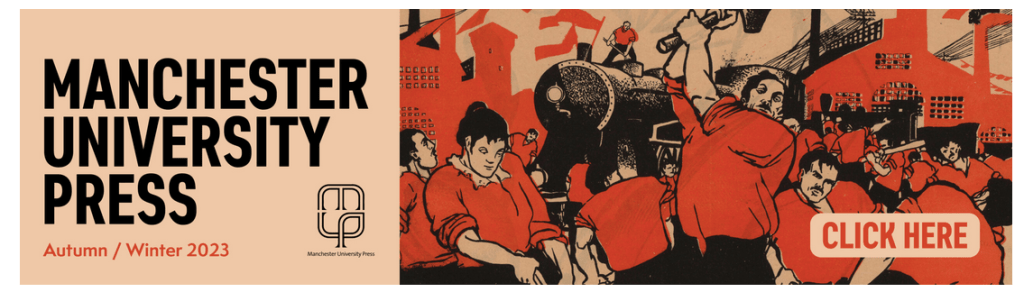
The image by Dmitrii Moor (Orlov) used for Autumn/ Winter 2023 catalogue of Manchester University Press

At the stage of book production, I suggested the publisher to use my photo of Moor’s poster for the front cover. It was so exciting to see that Manchester University Press put this image on the front cover of their Autumn/ Winter 2023 catalogue.

The MUP designer created several front covers for my book differed by the title fonts and colour shades. I am very glad that in its final version, Moor’s avant-garde image from The 1st of May aesthetically resonates with the title font of The urban life of workers in post-Soviet Russia.

The final front cover of my book

You can find the book details and recommend it to your library on the website of Manchester University Press. The book is also available to pre-order via the following booksellers.

Applying creative ethnography in the study of deindustrialising neighbourhoods

I wrote a new blog post on creative ethnography in the study of everyday life in deindustrialising urban settings for SAGE Perspectives. It is based on my recent research article examining structures of feeling in Russia’s industrial neighbourhoods. You can read a full version of this blog here, if you are interested in knowing more about how to apply drawing and visual research methods in multi-sited ethnography .

Deindustrialisation is a global complex process. It leads not only to the closure of factories which would otherwise damage the environment but also negatively affects everyday life and job opportunities of working-class people. Deindustrialisation often goes hand in hand with neoliberal urban development resulting in gentrification and displacement of longstanding residents of former industrial neighbourhoods and council estates.  

Due to the multiple impacts of deindustrialisation on the lived experiences of local communities, it is important to develop multi-sensory approaches and innovative methodologies relevant for researching place attachment, sensual experiences and urban imaginaries of people residing in post-industrial urban areas.

Illustration by Alexandrina Vanke based on ethnographic data from her research

In my study of two industrial neighbourhoods with mixed social compositions in the cities of Moscow and Yekaterinburg, Russia, I drew on the approach of multi-sited ethnography. Its research design built on a combination of the mainstream qualitative methods of interviewing, observation, participation and the creative method of drawing of the neighbourhoods studied made by research participants, also known as a mental mapping technique.

A mental map is a visualisation of the subjective perception of urban space by city dwellers. Kevin Lynch applied mental mapping in his study of the city images in the US. According to Lynch, each image of the city composed by many individual images, which share some similar visual patterns. In my research on Russia’s industrial neighbourhoods, I used mental mapping to explore structures of feeling as affective principles regulating sensual experiences, urban imaginaries and practical activities of local communities. Mental mapping was aimed to elicit how members of those communities sense and imagine their urban areas.

Continue reading in the SAGE Perspectives Blog.

Research article on structure of feeling

My new article Co-existing structures of feeling: Senses and imaginaries of industrial neighbourhoods is out in The Sociological Review. This post summarises its key points. This is a first publication from my doctoral project exploring working-class life and struggle in post-Soviet Russia, which I completed at the University of Manchester in 2021.

tsr-7026773185022708375-71-1-january-2023

In the article, I provide an empirically grounded theorisation of the concept of structure of feeling introduced by sociologist Raymond Williams. Williams defined structure of feeling differently in his works. According to one of his definitions, structure of feeling can be viewed as ‘the spirit of the age’ reflecting the collective cultural feelings of a period or an era. Williams’s another understanding of structure of feeling is related to the lived experiences of working-class communities which have a particular way of life.

While Williams applied structures of feeling mainly in regard to English literature and film, I suggest bringing this concept in sociology of space and place and urban anthropology. In the article, I extend structure of feeling, drawing on my multi-sited ethnography in two industrial neighbourhoods located in the cities of Moscow and Yekaterinburg, Russia.

I conceptualise structure of feeling by focusing on its affective mechanisms regulating senses, imaginaries and practical activities of residents of the two neighbourhoods studied. This ethnographic conceptualisation of structure of feeling allows me to explain better everyday life and local atmospheres in the urban areas undergoing deindustrialisation. The article answers the question of how working-class and longstanding middle-class residents sense and imagine their neighbourhoods.

The article builds on rich multi-sensory data derived from my PhD project: 50 interview transcripts, more than 150 pages of field notes, more than 550 photographs and 43 drawings of the industrial neighbourhoods made by research participants. I show how to apply multi-sited ethnography in the study of the lived experiences of local communities in two locations. I also explain how to use a method of drawing, also known as a mental mapping technique, in research on structures of feeling and deindustrialisation.

© The image by artist Polina Nikitina based on my ethnographic data

My research has revealed that working-class and longstanding middle-class residents show an affective attachment to place informed by an industrial residual structure of feeling. An industrial structure of feeling comprises values of factory culture, communality and shared space, while an emergent structure of feeling is informed by values of neoliberal development, individual comfort and private space. Both neighbourhoods studied have its particular local atmosphere driven by complicated relationships between socialist/ Soviet / industrial and post-socialist/ post-Soviet/ post-industrial structures of feeling. That is why, I suggest understanding structure of feeling not as a spirit of the time but as a multiple spirit of the time and place.

I develop further this theorisation in my book The urban life of workers in post-Soviet Russia: Engaging in everyday struggle to be published by Manchester University Press. Focusing on the issue of inequality, the book provides a novel account of urban life in post-industrial cities. One of its empirical chapters is partly based on this article.

You can find the article OnlineFirst on the website of The Sociological Review.

If you find the information from this post helpful and decide to use it in your publications, please cite:

Vanke, A. (2023). Co-existing structures of feeling: Senses and imaginaries of industrial neighbourhoods. The Sociological Review, 0(0). https://doi.org/10.1177/00380261221149540

Как собрать данные в полевом качественном исследовании / How to Collect Data in Qualitative Field Research

Копия Как собрать данные_обл_13 мм (1)_page-0001Наше учебное пособие в соавторстве с Елизаветой Полухиной и Анной Стрельниковой “Как собрать данные в полевом качественном исследовании” вышло в Издательском доме Высшей школы экономики. Пособие содержит информацию о качественных методах сбора эмпирических данных, которые мы применяли в наших совместных проектах последних лет. Книга приглашает читателя к размышлению о методологическом инструментарии и вносит вклад в дискуссию о том, как исследователи могут решать методические проблемы, возникающие в ходе полевой работы.

Ссылка: А. В. Ваньке, Е. В. Полухина, А. В. Стрельникова. Как собрать данные в полевом качественном исследовании. М.: Изд. дом Высшей школы экономики, 2020.

Как собрать данные_обл_13 мм (1)_pages-to-jpg-0001

Our handbook in co-authorship with Elizaveta Polukhina and Anna Strelnikova ‘How to collect data in qualitative field research’ has been published by The Higher School of Economics Publishing House. The handbook provides information about qualitative methods of data collection that we applied in our team projects in recent years. The book invites the reader to reflect on methodological tools and contributes to the debate on how researchers can solve some methods issues emerging during fieldwork.

You can download Chapter 1 (in Russian) by following the link: Designing Qualitative Field Research.

Reference: Vanke, A., Polukhina, E., Strelnikova, A. (2020). Kak sobrat’ dannye v polevom kachestvennom issledovanii [How To Collect Data in Qualitative Field Research]. Moscow: The Higher School of Economics Publishing House. (In Russian).