
Through growing roses, and what I found there (spoiler: climate change)

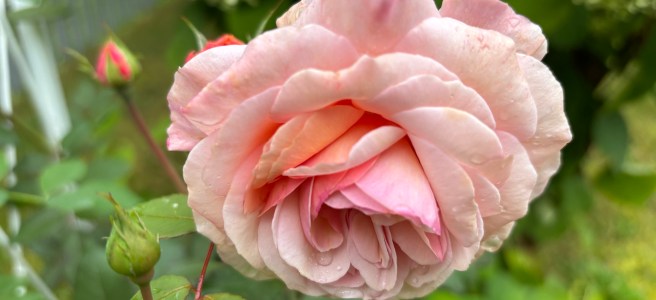
I delayed writing on the topic of gardening and growing roses so many times. It seemed to me that writing about these small everyday issues in a time of polycrisis was an unaffordable luxury (and a guilty pleasure). However, observing sociological and global trends in the countryside garden of the Moscow region, which lies in climate zone five, prompted me to sit down and write my thoughts out.

I am an apprentice gardener who started growing roses several years ago. My first involvement in this activity overlapped with my post-PhD life. By adopting this active hobby, I could not have imagined that growing, and especially growing roses, would captivate me so much. Apart from the emotional involvement, growing drew me into sensing changes in the seasons and experiencing the weather atmosphere in the garden.

Recently, I came across an English translation of a fairy tale, Roses: A Social Hypothesis, written by the German sociologist Georg Simmel. In this short piece, Simmel reflects on the emergence of inequalities in a fictional village, where some residents could cultivate beautiful roses thanks to their efforts and the good quality of soil on their plots, while non-rose owners cultivated envy and resentment towards their luckier neighbours. Robert van Krieken, the translator of this tale, comments on its moral, saying that in such a way Simmel shows the impossibility of getting rid of inequalities, and claims that ‘[t]he pursuit of equality is in many respects a Sisyphean endeavour’.

As a sociologist of inequality, I would debate this interpretation of Simmel’s work and disagree with van Krieken’s comparison of the pursuit of equality with a ‘Sisyphean endeavour’. Nevertheless, Simmel’s reflection on roses evoking feelings in people is of great interest to sociological analysis. I will leave it as an open question whether roses in a neighbour’s garden really evoke envy and resentment, or perhaps admiration and pleasure, while being observed publicly by the village residents. But what is undeniable is that growing and viewing roses is an affective experience.

I was convinced of this when I planted out the first thirteen shrubs of roses with my little relatives back in the spring of 2022. Among them were varieties of roses bred in different countries, including Russia, Germany, France and Britain, which we bought from a local rose nursery. At that time, I was curious about the connections between literature and growing, and little by little my attention was drawn to English roses bred by the gardener David Austin on his farm in Shropshire, in the Midlands, and named after fictional characters and writers.

Thus, a new literary and gardening world of roses opened up to me. That is how Lady of Shalott and A Shropshire Lad joined the community of roses in the garden.

To my surprise, David Austin’s roses proved to be popular among Russian growers, kindly calling them ‘ostinki’, or just English roses (‘angliiskie rosy’). The secret behind this popularity lies in the fact that English roses are unpretentious to cultivate and resilient in low temperatures. They survive the Russian winter well, being grafted onto rose hips to remain frost-resistant. In climate zone five and cooler, gardeners usually cover roses with protective materials or wooden boxes to save them during winter.

However, not all roses winter easily. From my observation, the tender Queen of Sweden, an English rose, wakes up best of all in the spring, while French varieties, such as the charming Emilien Guillot, freeze slightly and need some time to come back to life for a new growing season. I have quickly learnt that roses are sensory creatures, as they react to fluctuations in temperature and weather conditions. When it rains too much, they need additional care and treatment against dampness. When it is hot, they need to be watered well and fed with fertilisers. From time to time, they need to be protected from aphid invasions if ants create anthills nearby.

Returning to literature and roses, I was surprised to read the news about that A Shropshire Lad, the English rose named after the main character from the poem of the same name by Alfred Edward Housman, is no longer sold in the UK because of climate change which has resulted in evolving diseases and pests, and heatwaves on the island. However, it is still possible to find this rose in rose nurseries and garden centres in Russia. The same is true for the William Morris rose, also created by David Austin, which has stopped being sold in the UK but can be found in southern Russian regions, while still being too warm-loving and hard-growing in northern regions.

I have noticed that the experience of growing roses and other plants has widened my senses of perception and helped me think-feel locally and globally at once. Through growing roses, I found that this activity makes people more sensitive not only to atmospheric fluctuations and weather change in local areas but also to the global atmosphere and climate change.

XXXV

On the idle hill of summer,
Sleepy with the flow of streams,
Far I hear the steady drummer
Drumming like a noise in dreams.

Far and near and low and louder
On the roads of earth go by,
Dear to friends and food for powder,
Soldiers marching, all to die.

East and west on fields forgotten
Bleach the bones of comrades slain,
Lovely lads and dead and rotten;
None that go return again.

Far the calling bugles hollo,
High the screaming fife replies,
Gay the files of scarlet follow:
Woman bore me, I will rise.

From the poem A Shropshire Lad by A. E. Housman (1896)

Paperback release incoming: what critics think about my book and why it matters for the class debate – Part 2

This is the second part of the blogpost with my response to the reviewers who engaged with ‘The urban life of workers in post-Soviet Russia’ to be released in paperback in January 2026. In this part, I would like to discuss some comments on my book by Paupolina Gundarina and Mitja Stefancic.

In her essay ‘“Soviet in post-Soviet” in Alexandrina Vanke’s book The Urban Life of Workers in Post-Soviet Russia: Engaging in Everyday Struggle’, published in Russian on the Syg.ma platform, Paupolina Gundarina provides a very sensitive and careful reading of my book. She views my research as ‘an ambitious and creative ethnographic description of workers’ communities, which opens up new dimensions of (the working) class, creativity, imagination and phenomenology of home’. 

Gundarina finds my methodology, drawing on multi-sited ethnography, innovative and creative. She especially highlights the participatory nature of my study, when I invited research participants to draw their neighbourhood and society, which allowed me to grasp their ‘affective experience[s]’. As the reviewer stresses, this methodology opens up new opportunities for the debate about emotions regarding deindustrialisation and their relationships with the Soviet legacy and ‘the issues of morality, trauma, nostalgia, loss and adaptation’. 

‘[T]his is an ambitious and creative ethnographic description of workers’ communities, which opens up new dimensions of (the working) class, creativity, imagination and phenomenology of home.’ Paupolina Gundarina

Continuing this discussion, I would place my methodology within two developing strands. On the one hand, it is situated within the range of ethnographies paying particular attention to sensory-ness, affect and the imaginary. On the other hand, it develops creative, visual and arts-based methods. In my forthcoming article, I call this approach ‘avant-garde methodology’ which generates alternative interpretations of class experiences.

Gundarina finds my revision of class struggle, which I reconsider within the everyday realm, as an important contribution to the Marxist debate on class and resistance. As she writes, ‘Vanke’s book challenges economic determinism showing that the working class in post-Soviet Russia is defined through everyday practices, spatial belonging and grassroots resistance, not just through employment status’. She correctly reads my argument about the formation of classes in Russia’s major cities as ‘a constant, contradictory process, which is influenced by both the Soviet legacy and neoliberal change’. 

As Gundarina discusses further the ethnographic examples from my book, ordinary people continue to implement Soviet practices in deindustrialising urban spaces. But indeed, in the neoliberal context, these practices gain new meanings, allowing residents of industrial districts to cultivate class feelings and attachment to place, for example, through collective maintenance and decoration of the depleting infrastructure remaining from the Soviet era. According to my approach, these practical activities fall under the category of everyday struggle.  

I especially enjoy that the reviewer included her Russian translation of some research participants’ quotes from the book and provided her example of the controversial local debates around a DIY swan created by a local resident of Barnaul, a Western Siberian city of Russia, and put in a public place.

The book review by Mitja Stefancic, published in the 50th Anniversary Issue of Network, magazine by the British Sociological Association, continues to discuss my book in light of the class debate. As he writes, ‘One of the main achievements of the book lies in its successful attempt to re-discuss the concept of class’. Stefancic stresses the importance of my research as it ‘shows how class in Russia means something different when compared, for example, to Western societies’. This conversation about classes continued in an interview with me by Stefancic published in SerbianEnglish and Italian. I am very grateful for this opportunity to discuss my research outputs beyond academia. 

‘One of the main achievements of the book lies in its successful attempt to re-discuss the concept of class. In fact, on a theoretical level, Vanke effectively shows how class in Russia means something different when compared, for example, to Western societies.’ Mitja Stefancic

Indeed, unlike Western countries with stable social structures, Russia has experienced political upheavals and socio-economic reconfigurations of social groups during the 1990s, which influenced how people perceive classes and inequalities. Since the dissolution of the Soviet Union, a new social structure is being formed in contemporary Russia framed by the neoliberal neo-authoritarian order of power. 

My field research conducted before 2022 revealed polarisation in the social structure with a split between the poor and the rich, as I argue in the book and in my article on lay perceptions of inequality (read its summary on Everyday Society). However, sociologically it is interesting to understand how the Russia-Ukraine war will reconfigure the social structure and redistribute social wealth and capitals between particular segments of Russian society.

Stefancic concludes that my book helps to understand better Russian society itself and will be of interest to those who are focusing on how working classes around the globe overcome life difficulties while being excluded from big politics. In light of the global shift of the political mainstream to the right, as discussed in the August issue of Global Dialogue, my approach to everyday struggle in restrictive conditions has the potential to be transferred to other contexts. 

Paperback release incoming: what critics think about my book and why it matters for the class debate – Part 1

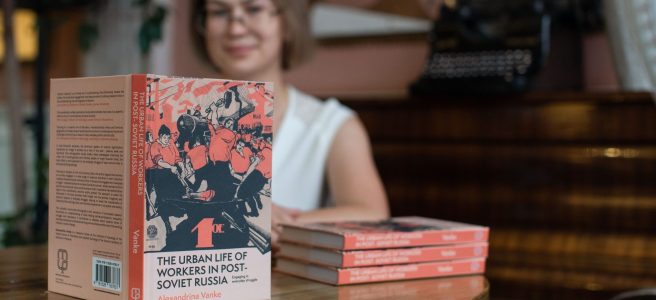
This is photo with the hardback copies of 'The urban life of workers in post-Soviet Russia' by Alexandrina Vanke

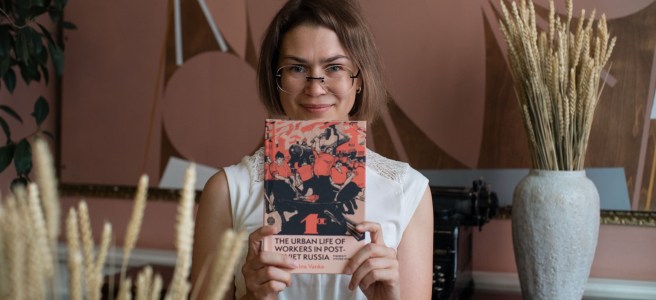
I got a wonderful news from Manchester University Press about The urban life of workers in post-Soviet RussiaIt will be out in paperback in January 2026. This means that the book will be available at a more affordable price soon. As recent reviews show, since its first edition in January 2024, the book remains highly relevant, widening discussion about the working classes, deindustrialisation, inequalities and everyday struggles.

In one of the previous blog posts, I replied to the first book reviews by sociologists Claudio Morrison and Christopher Altamura. In this blog post, I would like to continue this conversation about class with other commentators on the book, which appeared in the first half of 2025. I will engage with them in the chronological order in which their reviews were published.

In Challenging Stereotypes of Post-Soviet Russian Workers (CEU Review of Books), Victoria Kobzeva from the University of Birmingham provides critical comments on my theoretical framework, researcher positionality and interpretations of workers’ acts of everyday resistance. On the one hand, Kobzeva writes that the book introduces ‘a dozen concepts’ that are pivotal for my further ethnographic interpretations. On the other hand, she claims that my theoretical contribution to social theory, especially to Pierre Bourdieu’s approach of habitus, ‘feels limited’ despite rich empirical data.

‘Vanke’s book is an example of immersive, prolonged ethnography enriched by creative methodologies and a deep engagement with the lived experiences of Russia’s urban working class.’ Viktoria Kobzeva

When an author meets such criticism, it leads to reflection on what theoretical contribution means and how to increase it in future publications. Below, I would like to address this point of criticism.

The urban life of workers in post-Soviet Russia develops some theoretical concepts further. The book engages with ‘structure of feeling’, introduced by Raymond Williams, which I re-conceptualise as an affective principle regulating senses, imaginaries and practical activities within socio-material infrastructures, drawing on multi-sited ethnography in post-socialist deindustrialising contexts. The book also conceptualises everyday struggle, by which I mean a set of multiple counter-hegemonic acts, micro-practices and activities performed by workers and ordinary people in everyday life. I agree with Kobzeva that everyday struggle needs to be theorised further, as this concept differs from mundane resistance, introduced by James Scott, even though it encompasses resistance. However, I see working with everyday struggle as my contribution to theories of struggle and protest, which mainly focus on overt protests and social movements in Western liberal democracies.

Next, in the book, I map these and other concepts, visualising relationships between them in two theoretical sketches, and synthesise them into a theory of urban life and everyday struggle. I am still thinking about what this theory could be called: multi-sensory, affective or imaginative? The idea of everyday struggle embedded in life leaves room for reconsidering the concept of habitus, through re-viewing it as a set of dispositions of resistance and counter-actions.

The suggested framework adds affective, sensory and imaginative dimensions to the understanding of class and struggle that, as my ethnography shows, goes beyond coping and resistance. This framework opens up an opportunity to think about social change at the micro-level, enacted through enduring dispositions of co-creation and re-shaping. In the book, I also deal with the concept of spatialised gender habitus, or a gendered sense of place. I agree with the reviewer that it needs to be developed further, probably in future publications.

In the book, I do not introduce new concepts. What I do is theorise and synthesise existing concepts based on extensive multi-sited ethnography in Russia’s post-industrial cities. If such a framework contributes to the de-stigmatisation of low-resourced groups in post-socialist settings and can potentially be discussed and adopted (with adjustments) in other ‘local’ contexts, then my goal as an author will have been met.

However, there is still an open question about whether everyday struggle is exclusively working-class, and whether it allows class consciousness, as was asked in the review by Morrison. My continuing ethnography shows that not only working-class people engage in everyday struggle, but that it is still informed by how people sense inequality locally, imagine social justice in society and view the global future.

‘The Urban Life of Workers in Post-Soviet Russia: Engaging in Everyday Struggle (published by Manchester University Press in 2024) by Alexandrina Vanke is an innovative and textured engagement with the world of the working class in the post-industrial cities of Russia.’ Arpita Rachel Abraham

The book review by Arpita Rachel Abraham, an Urban Fellow at the Indian Institute for Human Settlements in Bengaluru, published on the Doing Sociology platform, continues the discussion about class consciousness, urban change, critical sociological theory and ethnography from the perspective of the impact of ‘global political developments’ and ‘Russia’s aggression on Ukraine’ on the working classes and ordinary people. Abraham stresses that my book advances the theory of the everyday, which is often lacking a political dimension. She points out that my research shows that the political is part of everyday life in neoliberal neo-authoritarian contexts. In this sense, my book bridges two separate areas: everyday life studies and social movement studies.

Praising ‘an impressive assemblage of textual, visual and performative elements’ in the book, Abraham raises a critical question about the one-dimensionality and repetitiveness of the argument regarding workers’ active engagement in everyday struggle. I would like to explain that the idea behind writing this book was to make this core argument part of academic storytelling, using it as the key element that would sew all chapters together like a needle. In the next book, I will probably experiment with integrating more authorial ideas and less polished arguments, which I will present not as analytically justified statements but as diverse interpretations, provoking new directions, debates and conversations on the subject matter.

I am grateful to both Victoria Kobzeva and Arpita Rachel Abraham for their interest in my book and for writing reviews that widen the discussion about the issues considered in The urban life of workers in post-Soviet Russia.

In the second part of this blog post, I will reflect on the comments from the reviews of my book by Paupolina Gundarin and Mitja Stefancic.

To be continued…

My response to the book reviews on The urban life of workers in post-Soviet Russia

It has been a year today since the publication of ‘The urban life of workers in post-Soviet Russia’. In this blogpost, I would like to reflect on the journey it has been for me, and the ripples it has created.

First of all, the alternative genre of writing that I crafted for the book aimed to engage readers in a dialogue about Russia’s workers and their place in the global international solidarity networks. This aim was complicated by the Russia-Ukraine war, which was for me like a thunderbolt at the beginning and  in the following years created cracks within and between societies. Nevertheless, as an author I managed to break away from the hegemonic discourses and create an alternative site for intellectual communication about the everyday struggles of Russia’s workers under the wars and crises that we as humanity are now experiencing globally.  

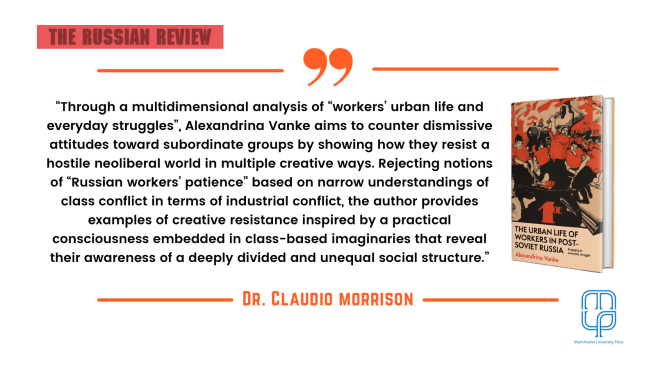
I am very pleased that two positive book reviews, one by sociologist Claudio Morrison (UK) and the other by sociologist Christopher Altamura (US), have appeared in The Russian Review and International Sociology journals, and with more to come this year. 

Both reviews raised important questions about my argument about worker’s engagement in everyday struggle under neoliberal neo-authoritarianism. 

Focusing on my criticism of the discursive construct of ‘Russian workers’ patience’, Morrison suggested that I had not sufficiently engaged with research work by sociologist Simon Clarke and colleagues who studied factory regimes, strikes and labour movements in Russia in the 1990s. I agree in part with this criticism, but I want to stress that I do not dismiss Clarke’s approach. In fact, although I mainly focus on working-class neighbourhoods rather than on social relations in production, I engage with Clarke’s scholarship through a critical dialogue. This is because I look at workers in Russian society from the perspective of the 2010s and the early 2020s, which is different from the 1990s version due to the evolution of the political regime and class structure. 

I would argue here that neoliberal neo-authoritarianism prompts social scholars to look at more tacit forms of struggle embedded in everyday life. Such a reorientation does not allow us to argue that workers in Russia (and elsewhere) are patient or do nothing to change their situation. It means that any form of political participation should be examined in relation to the regime and the social structure of society as a whole. I think that the relationships between class struggle, the regime and the social structure were not equally central to Clarke’s research in Russia. As a sociologist writing from the 2020s, I cannot overlook the relationships between these three elements, which together form the basis for ordinary people’s lives and struggles.

At the same time, the ethnographic approach by Clarke and colleagues has been an important foundation for my research on workers, also in terms of methodology, which I have had to develop further, as the changing social reality has forced us to push methodological boundaries. At the same time, we are currently at that stage of academic crisis in which we have to develop not only methods of data collection and analysis, but also methods of writing and dissemination, as we discursively represent ordinary people in texts in the era of catastrophes and war dramas.

Other questions raised by Morrison partly overlap with Altamura’s. 

While Morrison wonders whether the concept of habitus works well to explain the ethno-nationalism of workers found in my ethnography, Altamura doubts that the xenophobic attitude of Russian workers can be progressive in terms of class struggle. I would respond as follows. First, not all workers are xenophobic in my sampling. My research also look at workers who have positive and neutral attitudes towards labour migrants living in working-class neighbourhoods. Second, this everyday xenophobia or ethno-nationalism arises from inequality structures and can therefore be explained by habitus, which allows workers to navigate inequalities in everyday life. I would argue that this xenophobia or ethno-nationalism is generated by the political regime; it is caused by the poor quality of life and lack of working-class jobs in deindustrialising areas.

Finally, both sociologists raise questions about the concepts of everyday struggle and resistance that I theorise and develop further, drawing on ethnography of Russia’s workers and a wider group of ordinary people. Morrison asks whether the proposed notion of ‘struggle without class’ is a more sophisticated tool for challenging models of organisational stuggle similar to those in the West, or whether it is closer to the accounts of informality and survival strategies. Altamura claims that my critique of the ‘passive workers’ argument puts me in the position of overestimating workers’ struggle and resistance, which do not allow them to change the established order of power.

These are very good questions that move the debate about workers forward. First of all, I do not claim that the struggle of workers in today’s Russia is classless. Rather, I argue that this struggle is class-based and rooted in the changing social structure of Russian society, where classes are in the process of forming. According to my approach, everyday struggle, as a set of practical activities aimed at improving life from the bottom up, is activated by configurations of senses and imaginaries, both of which have class at their core. But this class is more affective and different from what can be seen, for example, in Western European societies with more stable social structures. In this sense, my notion of everyday struggle tends to challenge ‘Western’ understandings of institutional labour struggle and invites social scholars to broaden their understanding of struggle that takes place at both institutional and everyday levels.

As for the comment about the overestimation of workers’ struggle and the impossibility of resistance to change the status quo, I would say that this is a subject for further research. My book aimed to deconstruct the stereotypes of the ‘patient Russian workers’. The next step is to understand the short- and long-term effects of everyday struggles in Russia and beyond.

You can also read my answers to Mitja Stefancic’s questions about the book and class formation in Russian society (in Serbian or with Google translate) at Zofijini Ljubimci’s website.

The urban life of workers in post-Soviet Russia: dissemination and reception

Unbelievable, ‘The urban life of workers in post-Soviet Russia’ is now six month old! At its six-month mark, I would like to reflect on its dissemination and initial reception. 

This is an academic book. So it is not surprising that the first feedback and comments I received were from my colleagues in universities around the world. What surprised me, however, was that historians, including the historians of Russia and labour movements in other countries, appeared to be so grateful readers! 

Some of them wrote to me to say that they were interested in reading the book and found it valuable. At the same time, some of them pointed out that such title should cost less and that the high price prevents a wider audience from reading it. I absolutely agree! But the publisher sets the price. If enough copies are sold, Manchester University Press will reprint the book in softcover. So thinking about dissemination is important here.

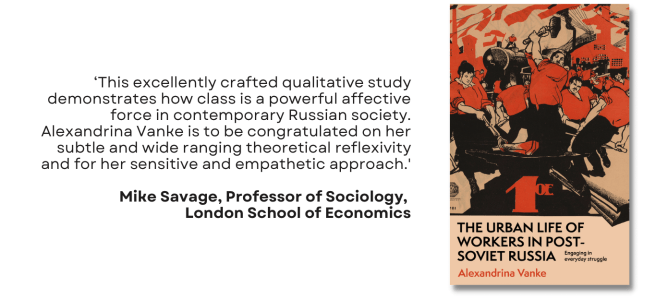
I have also received messages from friends and colleagues with congratulations saying that they liked the book cover. Needless to say, I like it too. I chose the image for the front cover deliberately. I was lucky that my publisher provided me with a designer who came up with a really great cover. I am glad that the readers find it cool and hot at once.

‘The urban life of workers in post-Soviet Russia’ tells the story of workers living in specific geographical locations, in post-industrial cities. So it seemed to be of interest to human geographers and urban scholars. Sociologist Anna Zhelnina invited me to talk about my book on one episode of the New Books Network. It was a very pleasant conversation, which helped me to talk about the book from different angles. We discussed the local atmosphere in Russia’s deindustrialising neighbourhoods, the involvement of residents in grassroots activities, social and labour movements, and, among other things, my research methodology, alternative approach to writing and theoretical contribution.

I really enjoy research blogging. So I have written a number of guest posts about the book. First, Manchester University Press republished my blog about subbotnik, proletarian art and the urban life of workers. Then, I wrote about how working-class communities experience deindustrialisation in Russia for the blog of the international project ‘Deindustrialization and the Politics of Our Time’ (DéPOT at Concordia University). Finally, I contributed to the blog of the Raymond Williams Society with a post on structure of feeling as a conceptual tool in the study of everyday life and struggle.

I am grateful to my colleagues for inviting me to present the book at the regular seminar of the Bourdieu, Work and Inequality research network and at the seminar for history students at Sorbonne Université. 

I also presented some chapters of the book at the British Sociological Association annual conference 2024 ‘Crisis, Continuity and Change’ and at the DéPOT project annual conference ‘Gender, Family and Deindustrialization’. 

These dissemination efforts has resulted in ‘The urban life of workers in post-Soviet Russia’ being included in the book review lists of the following journals, magazines and blogs (that I am aware of): 

·      The BSA Network Magazine

·      LSE Review of Books

·      Europe-Asia Studies

·      Eurasian Geography and Economics

·      Key Words: A Journal of Cultural Materialism 

·      Laboratorium: Russia Review of Social Research 

If you would like to get a free copy, please contact one of the issues listed above to write a review. 

Last but not least. I would like to thank all the people who ordered my book for their libraries! ‘The urban life of workers in post-Soviet Russia’ is now available in the library catalogues of the following universities:

·      University of Helsinki

·      University College London

·      University of Sussex

·      Aarhus University

·      Sorbonne University

·      Manchester Metropolitan University

·      University of Cambridge 

I guess this list is longer. 

What next? I see the interest in my book in French-speaking countries, especially in France and Canada. It would be great to have it translated into French and other languages. If anyone from a non-English publisher reads this post and is interested in translating my book into another language, please contact Manchester University Press. 

And for me, it’s time to think about how else I can tell the stories of workers’ urban lives. 

Stay tuned!

The release day of The urban life of workers in post-Soviet Russia

It’s release day! I am delighted to announce that The urban life of workers in post-Soviet Russia is out now!

Many thanks to all people whose support made this book possible. I am grateful to Manchester University Press for their professionalism and high quality book production. The process of crafting this book was inspiring for me, despite the dark times throughout which I was writing it.

The book is centered on the stories of urban workers in Russian society. But I hope that an international reader gets something useful about how ‘ordinary people’ overcome life difficulties with meagre resources they possess. This practical knowledge may be especially valuable in the era of crises and conflicts we live now as humankind.

In this final blog post in the series about The urban life of workers in post-Soviet Russia, I would like to discuss briefly its contents.

As I wrote earlier, the book consists of three parts. The first one Theoretical sketches presents my ethnographically grounded synthesis of the concepts allowing a critical reflection on the challenges that workers and other city dwellers face in deindustrialising urban areas. Chapter 1 develops a novel theory of urban life and everyday struggle building the network of revised concepts, including structure of feeling, senses, imaginaries, order of power, everyday struggle, consciousness and habitus.

The second part Ways of life tells the story about everyday life in Russia’s major post-industrial cities and Russian society as a whole.

Chapter 2 provides the setting of the story discussing the local atmospheres, sensual experiences and spatial imaginaries in the two industrial neighbourhoods located in the cities of Moscow and Yekaterinburg. Chapter 3 considers spatialised gendered senses of working-class people and intersectional inequalities in the industrial neighbourhoods studied.

Chapter 4 analyses the symbolic and moral meanings of social groups in Russia, including the working class and the middle class, mentioned by research participants from both cities. This chapter pays special attention to moral judgement and blaming working and poor people by wealthier classes intensified in the context of the Russia-Ukraine war. Chapter 5 examines research participants’ subjective perceptions of the whole Russian society by looking at their social imaginaries and everyday inequalities they experience daily.

The third part Ways of struggle explores different forms of struggle and particular consciousness emerging from engagement in them.

Chapter 6 focuses on open protests, including trade union strikes and social movements, leading to the formation of dispositions of protest and political consciousness. It shows how the objective restrictions for massive collective actions were steadily increasing in Russia throughout the 2010s and dropped to minimum in 2022.

Chapter 7 explains how workers and other residents of deindustrialising areas are actively engaged in the everyday forms of resistance to multiple challenges caused by neoliberalism and neo-authoritarianism. This long-standing engagement in everyday struggle leads to the formation of habituated resistance and practical consciousness of creative nature.

If you want to help The urban life of workers in post-Soviet Russia become visible, please consider taking the following action:

  • order the book for your library or recommend it to your librarian;
  • request a free copy from Manchester University Press to write a review;
  • include it in your syllabus or reading list.

By signing up to the MUP newsletter, you will get 30% discount on this title.

Enjoy the book!

On the poetics of The urban life of workers in post-Soviet Russia

The recent news about the outbreak of the Israel-Palestine war and the ongoing Russia-Ukraine war and the Armenia-Azerbaijan war makes me really sad. This news put me back to the reflection on how social scholars should write in the age of multiplication of conflicts, crises and catastrophes.

I finish The urban life of workers in post-Soviet Russia – to be out just in three months – with the suggestion to invent alternative genres of writing about social reality, society and ordinary people who suffer most from wars, crises and catastrophes. My book ends with a ready-made: ‘Toward the bright future of emergent genres!’ A ready-made is an avant-garde piece of text or art made of already existing objects, images or phrases, etc. which gain new meanings being placed into a new context (read more here).

The final sentence of my book starts with the phrase usually associated with Vladimir Lenin’s slogan ‘Toward the bright future’. On the one hand, it refers to the residualised form of expression, while the residual is always alternative to the dominant, according to Raymond Williams.On the other hand, it performatively calls for novatory action aimed to engage the creativity and imagination of a reader. Thus, it produces the possibility or hope for the emergence of genres different from the dominant ones.

When it is hard to express feelings and thoughts with prose, especially in the ages of wars and catastrophes, people often resort to poetry building on the symbolic, imaginative and rhythmic use of language. At this point, the reader may wonder what poetical can be about the book written in the genre of academic non-fiction.

While writing the book, I integrated some poetic forms in my discursive strategy aimed to represent workers alternatively to their negative, stigmatising representations reproduced in the mainstream academic and media discourses. The avant-garde poetry of the 1920s and the romantic poetry of the late 18th century inspired my academic non-fiction. Below, I shed light on the poetics of The urban life of workers in post-Soviet Russia.

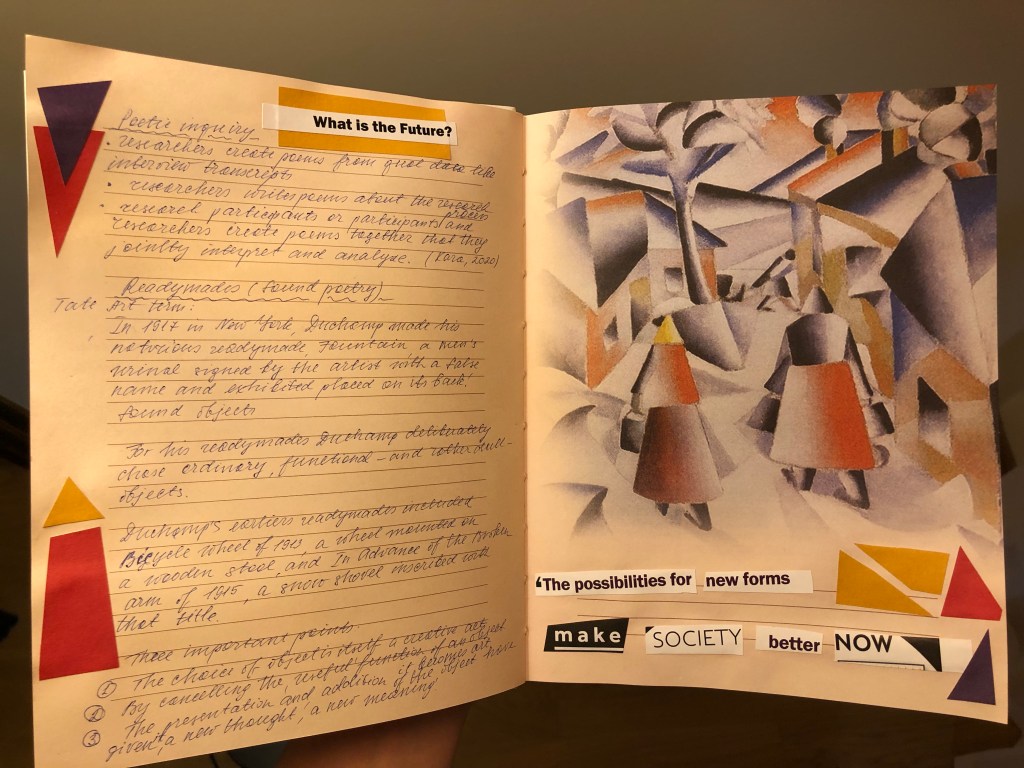
The book opens with my ready-made poem signed with ‘the author’:

What is the Future?

The possibilities for new forms.

Make SOCIETY better NOW!

– A ready-made poem by the author

This poem invites the reader to think about the meaning of the future and calls for action to make society better right now, at least at the level of everyday life. The poem also explains that the future can be viewed as the possibility for new forms of living, creating, writing, etc. The use of three different punctuation marks and upper and lower cases in the three-line poem helps me keep it rhythmic, performative and concise.

My ready-made poem about the future in the visual format © Alexandrina Vanke

I crafted this poem out of booklet and magazine clippings. I cut sentences out first and then glued them on the notepad page already filled with my handwritten notes about ready-made (found) poetry as arts-based research method.

Another example of how I used poetry in academic non-fiction is citing a poem by futurist poet Vladimir Mayakovsky. I included his All hail to subbotniki! in the book to illustrate the meanings of subbotnik, a collective clean of the neighbourhood or the workplace in a day off. (You can read more about this practice here). As far as I did not find an English translation of this poem written in Russian, I translated some of its parts for Chapter 7 covering the theme of the creative forms of everyday resistance.

All hail to subbotniki!

1. Hey, comrades, railway man

and water-transport worker!

2. Remember,

each honest worker

should go to subbotnik! […]

8. All move to subbotnik,

9. and the road will be fixed,

cleaned

and cleared.

Rosta No. 611. November 1920

The poem written in the avant-garde genre one hundred years ago performs several functions in my academic non-fiction about contemporaneity. It provides the reader with the example of the ideological meaning of early-Soviet subbotnik and helps me to show how the meaning of this practice evolved by the 2020s. Apart from this, Mayakovsky’s poem exemplifies performativity calling for action in the avant-garde poetic form which partly inspires (but not pre-determines) my discursive strategy. In this case, the poem by another author illustrates my ethnographic writting about a particular research theme.

The poem All hail to subbotniki! by Maykovsky (on the right-hand side) and his another visual poem (on the left-hand side) taken from the online database of the Russian State Library

The final example which I would like to give is about integration of poetic forms in the skeleton of academic non-fiction. One of the reasons why you may like or not like The urban life of workers in post-Soviet Russia is that the romantic poetry inspired its table of contents and framed its structural composition. The book consists of three parts, Part I: Theoretical sketches, Part Il: Ways of life and Part III: Ways of struggle, which reminiscent of the titles of poetry collections by William Blake, Poetical Sketches (1783) and two parts of his Songs of Innocence and Experience: Songs of Innocence and Songs of Experience (1789–1794).

You may ask: ‘What is William Blake doing in non-fiction about Russia’s workers?’ First of all, I integrated some elements of Blake’s poetry because the romantic poets made a discursive revolution in English literature breaking with the Shakespearian tradition without denying it. One can criticise Blake for being ‘mystic’, the Lake Poets for being ‘arrogant’ and the romantic poetesses for being too focused on their feelings, but their forms of expression helped me figure out my writing strategy about workers aimed not to romanticise them but represent them as they are through the alternative (to the dominant) stylistic means.

If you would like to know more about how these poetic genres allowed me to convey the dominant feelings of the age and creatively tell the story about working-class people, you can pre-order The urbanl life of workers in post-Soviet Russia via your University library or recommend it to your librarian.

On the front cover image of The urban life of workers in post-Soviet Russia

On the background of hot debates about Russia, I got the final version of the front cover of my forthcoming book to be released just in four months, on 16 January 2024. Drawing on multi-sited ethnography, The urban life of workers in post-Soviet Russia: Engaging in everyday struggle creatively explores the lived experiences of working-class and wider deindustrialising communities in the cities of Moscow and Yekaterinburg, and beyond.

In this blog post, I would like to discuss the visual aesthetics of the book mainly focusing on its front cover image. It contains some elements of the poster The 1st of May. The All-Russian subbotnik created by graphic artist Dmitrii Moor (Orlov) in 1920. A brief overview of his life will help to explain better his artistic approach. Moor was born in the family of an engineer in Novocherkassk in 1883. After moving to Moscow in 1989, he got a vocational education and participated in the Revolution of 1905. This experience made him realise that he should present the voice of working-class people through the artistic means (see Kozlov, 1949). Moor did not have a formal art education, but inside the country, he was considered to be a People’s Artist, while his art was called ‘proletarian art’. To the international audience, Moor may be known for his avant-garde posters and political caricatures.

The photo of the poster The 1st of May. The-All Russian subbotnik by Dmitrii Moor (Orlov) taken by Alexandrina Vanke in the Lenin Library

In The 1st of May, Moor depicted working-class people on May Day engaged in building and maintaining not only the industrial urban infrastructure but also the fabric of everyday life. This visual representation of workers as acting aligns with my main argument about workers’ engagement in the creative forms of mundane resistance which, as I explain in the book, falls under the category of everyday struggle.

For the greater effect, Moor used a combination of black, beige and red colours which characterise his graphic art style. The message of his image is clear and concise. The poster realistically shows the urban life of workers and emphasises their class consciousness: the themes my book explores in detail. In the background, one can see the industrial urban landscape with the train, some factories and power lines telling us about industrialisation and electrification in the early-Soviet era. There are two inscriptions on the top reading ‘Russian Socialist Federation of the Soviet Republic’ and ‘Workers Of All Countries Unite!’ (see also). There is the capitalised poster title at the bottom.

In his poster, Moor glorifies subbotnik – the word derived from subbota meaning Saturday – which is a voluntary collective activity of cleaning and maintaining the urban infrastructure or the workplace emerged right after the October Revolution. Subbotniks usually took place on days off around Vladimir Lenin’s birthday on 22 April. Very quickly from a volunteer activity they turned to be free labour of Soviet people. Emerged in the early-Soviet era, subbotnik as a practice survived the dissolution of the USSR and has gained new meanings in contemporary Russia. In Chapter 7, I analyse top-down and grassroots subbotniks organised in one industrial neighbourhood where I did ethnography.

I especially enjoy that Moor’s image shows not only the strength of working-class men but also working-class women. Chapter 3 of my book considers power relations in deindsutrialising communities mediated by the intersections of class, gender, age and ethnicity/race.

Before I started writing the book, I thought that Moor’s image may be good for the front cover. To obtain this image in high resolution, I went to the Lenin Library in Moscow, ordered it from the archive and photographed it. As far as another poster was glued on the backside of The 1st May from the library’s collection, some of the bleedthrough from it are visible in my photo.

The image by Dmitrii Moor (Orlov) used for Autumn/ Winter 2023 catalogue of Manchester University Press

At the stage of book production, I suggested the publisher to use my photo of Moor’s poster for the front cover. It was so exciting to see that Manchester University Press put this image on the front cover of their Autumn/ Winter 2023 catalogue.

The MUP designer created several front covers for my book differed by the title fonts and colour shades. I am very glad that in its final version, Moor’s avant-garde image from The 1st of May aesthetically resonates with the title font of The urban life of workers in post-Soviet Russia.

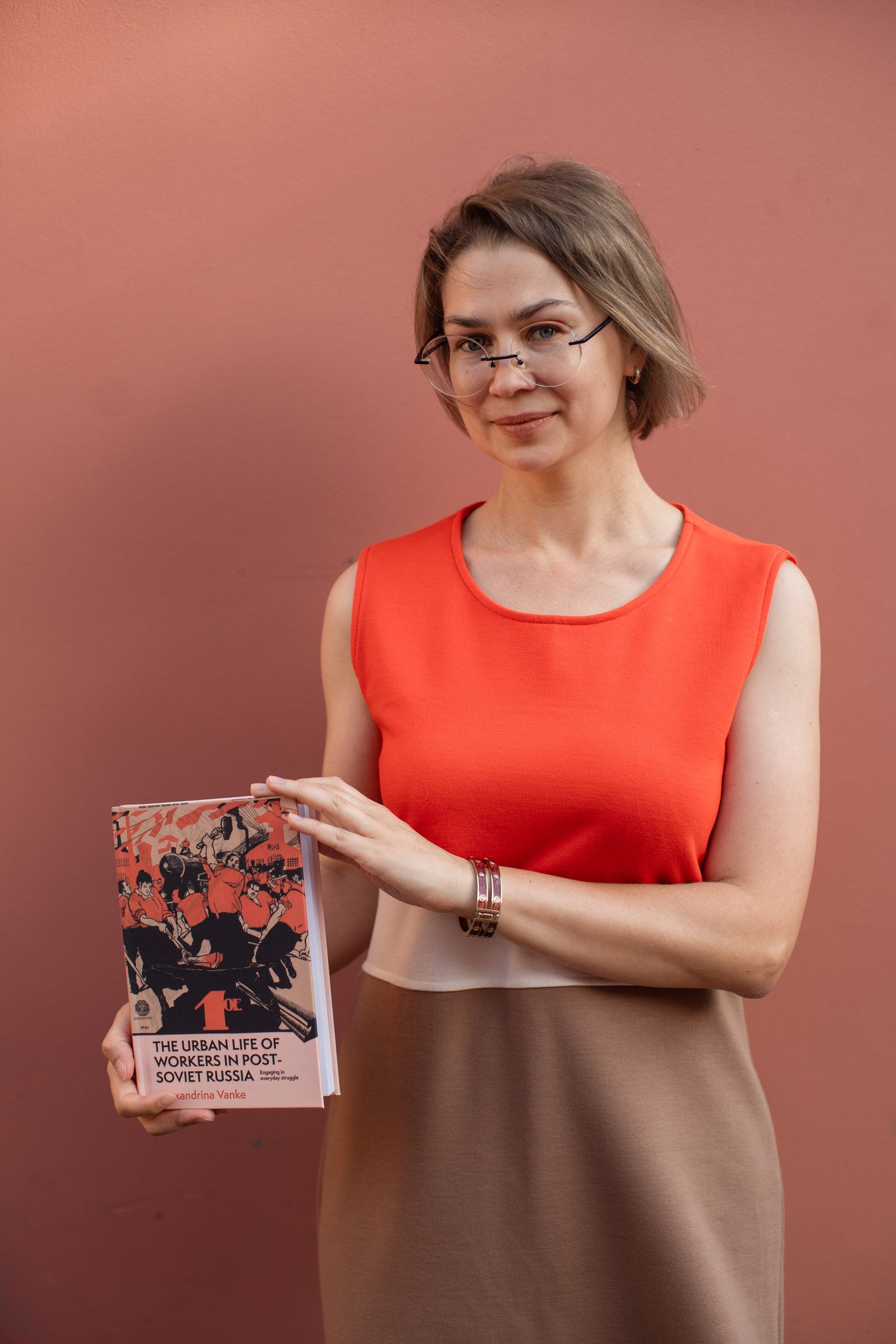
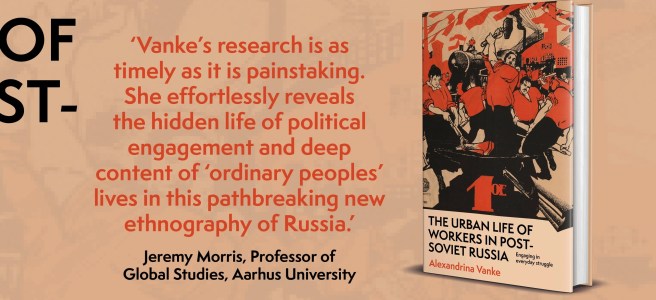
The final front cover of my book

You can find the book details and recommend it to your library on the website of Manchester University Press. The book is also available to pre-order via the following booksellers.

Research article on structure of feeling

My new article Co-existing structures of feeling: Senses and imaginaries of industrial neighbourhoods is out in The Sociological Review. This post summarises its key points. This is a first publication from my doctoral project exploring working-class life and struggle in post-Soviet Russia, which I completed at the University of Manchester in 2021.

tsr-7026773185022708375-71-1-january-2023

In the article, I provide an empirically grounded theorisation of the concept of structure of feeling introduced by sociologist Raymond Williams. Williams defined structure of feeling differently in his works. According to one of his definitions, structure of feeling can be viewed as ‘the spirit of the age’ reflecting the collective cultural feelings of a period or an era. Williams’s another understanding of structure of feeling is related to the lived experiences of working-class communities which have a particular way of life.

While Williams applied structures of feeling mainly in regard to English literature and film, I suggest bringing this concept in sociology of space and place and urban anthropology. In the article, I extend structure of feeling, drawing on my multi-sited ethnography in two industrial neighbourhoods located in the cities of Moscow and Yekaterinburg, Russia.

I conceptualise structure of feeling by focusing on its affective mechanisms regulating senses, imaginaries and practical activities of residents of the two neighbourhoods studied. This ethnographic conceptualisation of structure of feeling allows me to explain better everyday life and local atmospheres in the urban areas undergoing deindustrialisation. The article answers the question of how working-class and longstanding middle-class residents sense and imagine their neighbourhoods.

The article builds on rich multi-sensory data derived from my PhD project: 50 interview transcripts, more than 150 pages of field notes, more than 550 photographs and 43 drawings of the industrial neighbourhoods made by research participants. I show how to apply multi-sited ethnography in the study of the lived experiences of local communities in two locations. I also explain how to use a method of drawing, also known as a mental mapping technique, in research on structures of feeling and deindustrialisation.

© The image by artist Polina Nikitina based on my ethnographic data

My research has revealed that working-class and longstanding middle-class residents show an affective attachment to place informed by an industrial residual structure of feeling. An industrial structure of feeling comprises values of factory culture, communality and shared space, while an emergent structure of feeling is informed by values of neoliberal development, individual comfort and private space. Both neighbourhoods studied have its particular local atmosphere driven by complicated relationships between socialist/ Soviet / industrial and post-socialist/ post-Soviet/ post-industrial structures of feeling. That is why, I suggest understanding structure of feeling not as a spirit of the time but as a multiple spirit of the time and place.

I develop further this theorisation in my book The urban life of workers in post-Soviet Russia: Engaging in everyday struggle to be published by Manchester University Press. Focusing on the issue of inequality, the book provides a novel account of urban life in post-industrial cities. One of its empirical chapters is partly based on this article.

You can find the article OnlineFirst on the website of The Sociological Review.

If you find the information from this post helpful and decide to use it in your publications, please cite:

Vanke, A. (2023). Co-existing structures of feeling: Senses and imaginaries of industrial neighbourhoods. The Sociological Review, 0(0). https://doi.org/10.1177/00380261221149540

The publications digest

There were no posts in this blog for ten months for some objective reasons. I am currently writing the book The urban life of workers in post-Soviet Russia to be published by Manchester University Press.  

In 2022, I had some publications, which came out but were not covered in the blog. This post presents the digest of those and forthcoming publications.

1. Together with Andrea Lizama and Denisse Sepúlveda, I co-edited a special section on social mobility and inequality issued in Sociological Research Online.

Cite article: Lizama-Loyola, A., Sepúlveda, D., & Vanke, A. (2022). Making Sense of Social Mobility in Unequal Societies. Sociological Research Online, 27(1), 95–100. https://doi.org/10.1177/13607804211066120

The special section takes a global perspective on different aspects of subjective social mobility and inequality. It includes six contributions covering the themes of political debate about social mobility in the UK and collective social mobility of working-class communities in Wales, intersectional inequality experienced by British-born Bengali Muslim women of working-class origin and educational mobility of people from different social backgrounds in Chile, social mobility of rural students in China and Chilean people’s experiences of long-range upward mobility shaped by meritocratic narratives.

Continue reading “The publications digest”