While all social media are now overflooded with posts about (and by) Generative AI, I have been thinking about how to make high-quality social research visible in the era of Large Language Models and all kinds of AI-based chatbots. Another reason for writing this blogpost is to reflect on my own experience of making video abstracts for the journal articles I published after completing my PhD.
If you are doing social sciences, your goal may be not only to get published but also to share your research outputs with other scholars and broader publics beyond academia. There are many ways in which one can make research publications visible and engage with publics, ranging from writing op-eds and blogposts to making visuals and video abstracts.
Video abstract formats
When I published my first PhD-based article on structures of feeling, I wanted to creatively disseminate it to share the results of my research with wider audiences. I decided to make a video abstract. My quick research into the types of video abstracts for journal articles found three of the most engaging formats.
The most popular one is talking videos, where academics talk about their publications to the camera. This is a less time-consuming video to make, which can be easily recorded with a phone or a laptop camera. However, it requires writing a script or carefully thinking about what you will say. You will probably need to make several takes before you are happy with your video. This option may be uncomfortable for those who do not like talking to the camera.
Another format is recorded video slides with the key findings presented on slides, combining text, images and animation. This may be more familiar to academics, as many were presenting online during (and after) the COVID-19 pandemic. These slides can be made with PowerPoint and recorded with Zoom. This format allows choosing whether to show a face or not, and the focus will be on your slides, not your talking head.
Finally, I came across several animated video abstracts without an author’s face, employing visual storytelling about research outputs. I enjoyed whiteboard animations based on publications, which amazingly combined verbal, textual and visual forms in research presentation. It was not obvious how to make them, but it was obvious that their production is time-consuming, even though they stimulate the creativity and curiosity of both researcher and audience.
Further, I will share my experience of crafting animated and talking video abstracts and conclude with reflections on their role in research visibility.
Animated video abstract
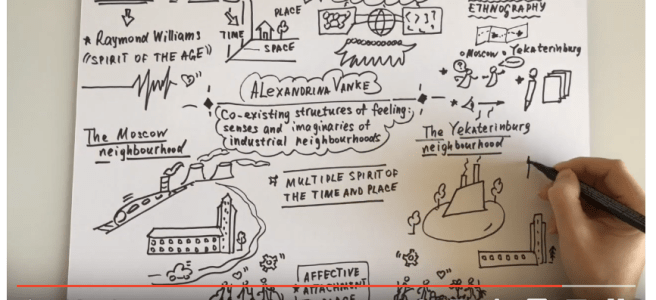
I decided to start with an animated video abstract, as I wanted to draw my article in the video. This prompted me to continue my search and learning. After watching animated videos about research, I found an educational course, From Verbal to Visual. From this online course, I learned how to use icons in sketchnoting, concisely visualise ideas with a black marker and use a video-editing software to combine a video of my graphic drawing, my audio explanation and background music.
It took me several days of creative thinking, learning and making until I crafted my first video abstract. I am sure some will view it as a luxury to spend so much time making an animated video abstract, especially under time pressure in academia. (I was crafting mine during the Christmas holidays). But for me, it was more about curiosity and learning how to make it and how to creatively disseminate research. Of course, when I crafted a second animated video abstract for my journal article on everyday inequalities, it was much easier and quicker. However, it still required time and energy for original thinking and crafting.
Despite all these efforts, I find the result amazing, even though it is far from perfect, but unique, like any handmade object. An animated video abstract reflects the idea of research as craft. This strongly resonates with my vision of doing creative ethnography, which my article on avant-garde methodology develops. This new article explains how to conduct multi-sited ethnography, use drawing and analytical assemblage in research, and creatively write with ethnographic data.
Talking video abstract
My experiences of making video abstracts broadened this year, when Sociology, the journal of the British Sociological Association, invited me to make a talking video about my article on everyday inequalities, which won the Sociology SAGE Prize for Innovation and Excellence 2025. In recent years, more and more academic journals have started suggesting their authors make video abstracts for published articles. In my opinion, Theory, Culture & Society provides really good examples of the talking video format, displayed on their journal website.
As for my experience, recording a talking video abstract for my article published in Sociology journal was split into four stages.
First, making a talking video requires writing and editing an accessible script for a three-minute video. I wrote this script, reread it and tried to tell it. Then I prepared a place and put the minimum equipment I had, a phone with a holder and a laptop camera, in two locations. Later, at the editing stage, I chose to work only with the video recorded with the phone, because it turned out to be better in terms of picture and sound. I decided to use a simple background which would not distract the viewer and put a table lamp on the floor to add cosy light, as it was rainy outside. I made a couple of shoots to check whether my face was in the frame and whether my voice was clearly heard.
At the second stage, ensure that there is no background noise from the window or anywhere else, which will disturb your video recording. Do not forget to put your phone on flight mode. Next, when you are recording a video abstract, it is better to talk about your research article, using a script as a reference and sometimes improvising, rather than reading a script. Natural talking makes a video abstract more engaging. (I know it is hard when you are talking to the camera). I did a couple of takes to choose the best one later.
The third stage includes editing a video abstract with a video-editing app or programme. I used iMovie, but you can use your preferred one, or skip this stage if you do not have time or the skills to use them. But then you need to record an almost perfect video, which does not need to be cut or improved. My talking video appeared to be twice as long as Sociology journal asked for. That is why I cut less important parts to make the video more concise and engaging. I should say that my video-editing skills are very basic. They still allowed me to add my title and name at the beginning and cut less important video frames.
At the final stage, I sent the video abstract and script to the editors of Sociology, who kindly helped me add subtitles. You can find this video abstract on my YouTube channel and it will be available on the Sociology journal website soon.
Is it worth making a video abstract?
Before making a video abstract, one may need to consider carefully whether all the effort and time spent is really worth it. On the one hand, academic journals follow the trend of encouraging authors to make video abstracts. The thing is that online users now consume more video content than textual and visual content. The probability that someone will become interested in your research article increases if they find your video abstract.
On the other hand, I have recently had a chance to discuss this issue with a senior academic who was sceptic about video abstracts and their dissemination on algorithm-based video streaming platforms. According to this position, it is not worth spending time making video abstracts, as they are not supported by algorithms and do not help increase the citation rate. If you are a recognised professor, your publications will be read without creative dissemination. However, early career researchers need to spend time for dissemination if they want their research outputs to rich academic and wider audiences.
It has been two and a half years since I posted a video abstract for my first PhD-based journal article on structures of feeling published behind a paywall. By now, it has reached 850+ views on YouTube, compared with 500+ reads of my blogpost with its summary, 1000+ reads on the journal website, and only eight citations in publications by other academics. This statistic tells us that video abstracts do not directly increase the citation rate, but they increase engagement with your article. For example, I regularly receive emails from people who want to read the article but cannot access it and ask me to share it with them. Some people (most of them students) contact me to say that my article helped them in their research.
As for the article on everyday inequality, also published behind a paywall, its animated video abstract got only 150+ views over the last two years. But the article and my research findings were mentioned in a conversation between three characters in one British film, and it has been cited five times by other academics so far. Again, there is no direct link between a video abstract and scholarly recognition. But what I see from this experience is that my research has become more visible thanks to the video abstracts, which I also posted on my social media accounts.
Are you curious about learning how to craft a video abstract? Are you interested in creative research dissemination? Are you looking for innovative ways of public engagement? If yes, then why not experiment with a video abstract and see what it may bring in terms of making your research visible? At the end of the day, why not give a video abstract a chance among research dissemination channels and public engagement tools?

 Alexandrina Vanke