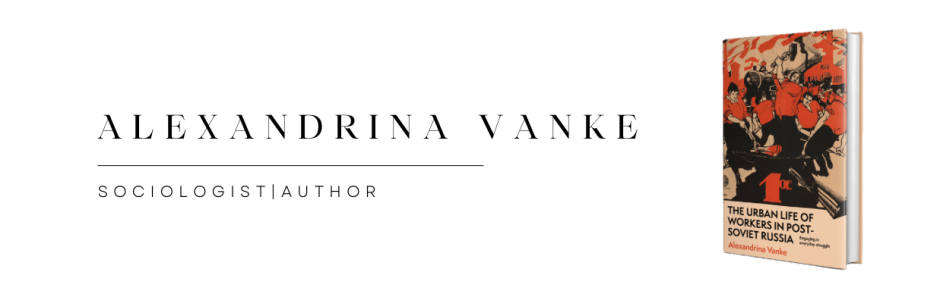

It has been a year today since the publication of ‘The urban life of workers in post-Soviet Russia’. In this blogpost, I would like to reflect on the journey it has been for me, and the ripples it has created.
First of all, the alternative genre of writing that I crafted for the book aimed to engage readers in a dialogue about Russia’s workers and their place in the global international solidarity networks. This aim was complicated by the Russia-Ukraine war, which was for me like a thunderbolt at the beginning and in the following years created cracks within and between societies. Nevertheless, as an author I managed to break away from the hegemonic discourses and create an alternative site for intellectual communication about the everyday struggles of Russia’s workers under the wars and crises that we as humanity are now experiencing globally.
I am very pleased that two positive book reviews, one by sociologist Claudio Morrison (UK) and the other by sociologist Christopher Altamura (US), have appeared in The Russian Review and International Sociology journals, and with more to come this year.
Both reviews raised important questions about my argument about worker’s engagement in everyday struggle under neoliberal neo-authoritarianism.
Focusing on my criticism of the discursive construct of ‘Russian workers’ patience’, Morrison suggested that I had not sufficiently engaged with research work by sociologist Simon Clarke and colleagues who studied factory regimes, strikes and labour movements in Russia in the 1990s. I agree in part with this criticism, but I want to stress that I do not dismiss Clarke’s approach. In fact, although I mainly focus on working-class neighbourhoods rather than on social relations in production, I engage with Clarke’s scholarship through a critical dialogue. This is because I look at workers in Russian society from the perspective of the 2010s and the early 2020s, which is different from the 1990s version due to the evolution of the political regime and class structure.
I would argue here that neoliberal neo-authoritarianism prompts social scholars to look at more tacit forms of struggle embedded in everyday life. Such a reorientation does not allow us to argue that workers in Russia (and elsewhere) are patient or do nothing to change their situation. It means that any form of political participation should be examined in relation to the regime and the social structure of society as a whole. I think that the relationships between class struggle, the regime and the social structure were not equally central to Clarke’s research in Russia. As a sociologist writing from the 2020s, I cannot overlook the relationships between these three elements, which together form the basis for ordinary people’s lives and struggles.
At the same time, the ethnographic approach by Clarke and colleagues has been an important foundation for my research on workers, also in terms of methodology, which I have had to develop further, as the changing social reality has forced us to push methodological boundaries. At the same time, we are currently at that stage of academic crisis in which we have to develop not only methods of data collection and analysis, but also methods of writing and dissemination, as we discursively represent ordinary people in texts in the era of catastrophes and war dramas.
Other questions raised by Morrison partly overlap with Altamura’s.

While Morrison wonders whether the concept of habitus works well to explain the ethno-nationalism of workers found in my ethnography, Altamura doubts that the xenophobic attitude of Russian workers can be progressive in terms of class struggle. I would respond as follows. First, not all workers are xenophobic in my sampling. My research also look at workers who have positive and neutral attitudes towards labour migrants living in working-class neighbourhoods. Second, this everyday xenophobia or ethno-nationalism arises from inequality structures and can therefore be explained by habitus, which allows workers to navigate inequalities in everyday life. I would argue that this xenophobia or ethno-nationalism is generated by the political regime; it is caused by the poor quality of life and lack of working-class jobs in deindustrialising areas.
Finally, both sociologists raise questions about the concepts of everyday struggle and resistance that I theorise and develop further, drawing on ethnography of Russia’s workers and a wider group of ordinary people. Morrison asks whether the proposed notion of ‘struggle without class’ is a more sophisticated tool for challenging models of organisational stuggle similar to those in the West, or whether it is closer to the accounts of informality and survival strategies. Altamura claims that my critique of the ‘passive workers’ argument puts me in the position of overestimating workers’ struggle and resistance, which do not allow them to change the established order of power.
These are very good questions that move the debate about workers forward. First of all, I do not claim that the struggle of workers in today’s Russia is classless. Rather, I argue that this struggle is class-based and rooted in the changing social structure of Russian society, where classes are in the process of forming. According to my approach, everyday struggle, as a set of practical activities aimed at improving life from the bottom up, is activated by configurations of senses and imaginaries, both of which have class at their core. But this class is more affective and different from what can be seen, for example, in Western European societies with more stable social structures. In this sense, my notion of everyday struggle tends to challenge ‘Western’ understandings of institutional labour struggle and invites social scholars to broaden their understanding of struggle that takes place at both institutional and everyday levels.
As for the comment about the overestimation of workers’ struggle and the impossibility of resistance to change the status quo, I would say that this is a subject for further research. My book aimed to deconstruct the stereotypes of the ‘patient Russian workers’. The next step is to understand the short- and long-term effects of everyday struggles in Russia and beyond.
You can also read my answers to Mitja Stefancic’s questions about the book and class formation in Russian society (in Serbian or with Google translate) at Zofijini Ljubimci’s website.















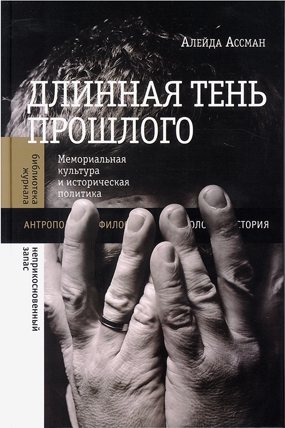 Моя рецензия “Диалоги памяти” на книгу немецкой исследовательницы Алейды Ассман опубликована во втором номере за 2016 год журнала “Социологическое обозрение”.
 Alexandrina Vanke