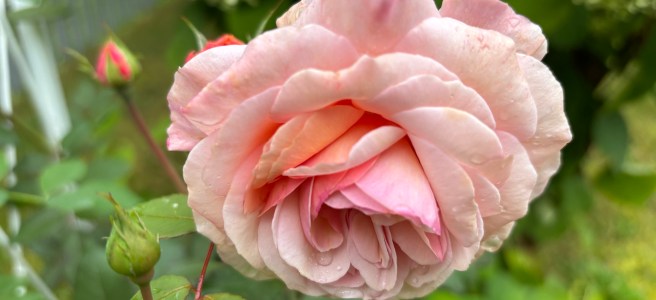
Through growing roses, and what I found there (spoiler: climate change)

I delayed writing on the topic of gardening and growing roses so many times. It seemed to me that writing about these small everyday issues in a time of polycrisis was an unaffordable luxury (and a guilty pleasure). However, observing sociological and global trends in the countryside garden of the Moscow region, which lies in climate zone five, prompted me to sit down and write my thoughts out.

I am an apprentice gardener who started growing roses several years ago. My first involvement in this activity overlapped with my post-PhD life. By adopting this active hobby, I could not have imagined that growing, and especially growing roses, would captivate me so much. Apart from the emotional involvement, growing drew me into sensing changes in the seasons and experiencing the weather atmosphere in the garden.

Recently, I came across an English translation of a fairy tale, Roses: A Social Hypothesis, written by the German sociologist Georg Simmel. In this short piece, Simmel reflects on the emergence of inequalities in a fictional village, where some residents could cultivate beautiful roses thanks to their efforts and the good quality of soil on their plots, while non-rose owners cultivated envy and resentment towards their luckier neighbours. Robert van Krieken, the translator of this tale, comments on its moral, saying that in such a way Simmel shows the impossibility of getting rid of inequalities, and claims that ‘[t]he pursuit of equality is in many respects a Sisyphean endeavour’.

As a sociologist of inequality, I would debate this interpretation of Simmel’s work and disagree with van Krieken’s comparison of the pursuit of equality with a ‘Sisyphean endeavour’. Nevertheless, Simmel’s reflection on roses evoking feelings in people is of great interest to sociological analysis. I will leave it as an open question whether roses in a neighbour’s garden really evoke envy and resentment, or perhaps admiration and pleasure, while being observed publicly by the village residents. But what is undeniable is that growing and viewing roses is an affective experience.

I was convinced of this when I planted out the first thirteen shrubs of roses with my little relatives back in the spring of 2022. Among them were varieties of roses bred in different countries, including Russia, Germany, France and Britain, which we bought from a local rose nursery. At that time, I was curious about the connections between literature and growing, and little by little my attention was drawn to English roses bred by the gardener David Austin on his farm in Shropshire, in the Midlands, and named after fictional characters and writers.

Thus, a new literary and gardening world of roses opened up to me. That is how Lady of Shalott and A Shropshire Lad joined the community of roses in the garden.

To my surprise, David Austin’s roses proved to be popular among Russian growers, kindly calling them ‘ostinki’, or just English roses (‘angliiskie rosy’). The secret behind this popularity lies in the fact that English roses are unpretentious to cultivate and resilient in low temperatures. They survive the Russian winter well, being grafted onto rose hips to remain frost-resistant. In climate zone five and cooler, gardeners usually cover roses with protective materials or wooden boxes to save them during winter.

However, not all roses winter easily. From my observation, the tender Queen of Sweden, an English rose, wakes up best of all in the spring, while French varieties, such as the charming Emilien Guillot, freeze slightly and need some time to come back to life for a new growing season. I have quickly learnt that roses are sensory creatures, as they react to fluctuations in temperature and weather conditions. When it rains too much, they need additional care and treatment against dampness. When it is hot, they need to be watered well and fed with fertilisers. From time to time, they need to be protected from aphid invasions if ants create anthills nearby.

Returning to literature and roses, I was surprised to read the news about that A Shropshire Lad, the English rose named after the main character from the poem of the same name by Alfred Edward Housman, is no longer sold in the UK because of climate change which has resulted in evolving diseases and pests, and heatwaves on the island. However, it is still possible to find this rose in rose nurseries and garden centres in Russia. The same is true for the William Morris rose, also created by David Austin, which has stopped being sold in the UK but can be found in southern Russian regions, while still being too warm-loving and hard-growing in northern regions.

I have noticed that the experience of growing roses and other plants has widened my senses of perception and helped me think-feel locally and globally at once. Through growing roses, I found that this activity makes people more sensitive not only to atmospheric fluctuations and weather change in local areas but also to the global atmosphere and climate change.

XXXV

On the idle hill of summer,
Sleepy with the flow of streams,
Far I hear the steady drummer
Drumming like a noise in dreams.

Far and near and low and louder
On the roads of earth go by,
Dear to friends and food for powder,
Soldiers marching, all to die.

East and west on fields forgotten
Bleach the bones of comrades slain,
Lovely lads and dead and rotten;
None that go return again.

Far the calling bugles hollo,
High the screaming fife replies,
Gay the files of scarlet follow:
Woman bore me, I will rise.

From the poem A Shropshire Lad by A. E. Housman (1896)

On the poetics of The urban life of workers in post-Soviet Russia

The recent news about the outbreak of the Israel-Palestine war and the ongoing Russia-Ukraine war and the Armenia-Azerbaijan war makes me really sad. This news put me back to the reflection on how social scholars should write in the age of multiplication of conflicts, crises and catastrophes.

I finish The urban life of workers in post-Soviet Russia – to be out just in three months – with the suggestion to invent alternative genres of writing about social reality, society and ordinary people who suffer most from wars, crises and catastrophes. My book ends with a ready-made: ‘Toward the bright future of emergent genres!’ A ready-made is an avant-garde piece of text or art made of already existing objects, images or phrases, etc. which gain new meanings being placed into a new context (read more here).

The final sentence of my book starts with the phrase usually associated with Vladimir Lenin’s slogan ‘Toward the bright future’. On the one hand, it refers to the residualised form of expression, while the residual is always alternative to the dominant, according to Raymond Williams.On the other hand, it performatively calls for novatory action aimed to engage the creativity and imagination of a reader. Thus, it produces the possibility or hope for the emergence of genres different from the dominant ones.

When it is hard to express feelings and thoughts with prose, especially in the ages of wars and catastrophes, people often resort to poetry building on the symbolic, imaginative and rhythmic use of language. At this point, the reader may wonder what poetical can be about the book written in the genre of academic non-fiction.

While writing the book, I integrated some poetic forms in my discursive strategy aimed to represent workers alternatively to their negative, stigmatising representations reproduced in the mainstream academic and media discourses. The avant-garde poetry of the 1920s and the romantic poetry of the late 18th century inspired my academic non-fiction. Below, I shed light on the poetics of The urban life of workers in post-Soviet Russia.

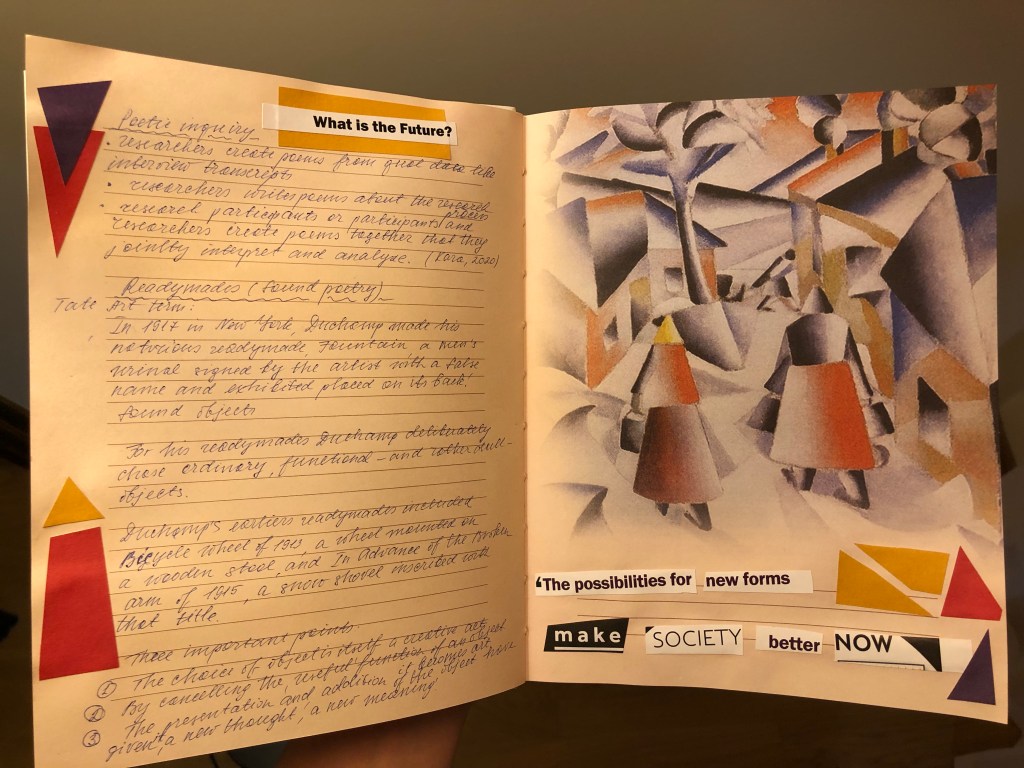
The book opens with my ready-made poem signed with ‘the author’:

What is the Future?

The possibilities for new forms.

Make SOCIETY better NOW!

– A ready-made poem by the author

This poem invites the reader to think about the meaning of the future and calls for action to make society better right now, at least at the level of everyday life. The poem also explains that the future can be viewed as the possibility for new forms of living, creating, writing, etc. The use of three different punctuation marks and upper and lower cases in the three-line poem helps me keep it rhythmic, performative and concise.

My ready-made poem about the future in the visual format © Alexandrina Vanke

I crafted this poem out of booklet and magazine clippings. I cut sentences out first and then glued them on the notepad page already filled with my handwritten notes about ready-made (found) poetry as arts-based research method.

Another example of how I used poetry in academic non-fiction is citing a poem by futurist poet Vladimir Mayakovsky. I included his All hail to subbotniki! in the book to illustrate the meanings of subbotnik, a collective clean of the neighbourhood or the workplace in a day off. (You can read more about this practice here). As far as I did not find an English translation of this poem written in Russian, I translated some of its parts for Chapter 7 covering the theme of the creative forms of everyday resistance.

All hail to subbotniki!

1. Hey, comrades, railway man

and water-transport worker!

2. Remember,

each honest worker

should go to subbotnik! […]

8. All move to subbotnik,

9. and the road will be fixed,

cleaned

and cleared.

Rosta No. 611. November 1920

The poem written in the avant-garde genre one hundred years ago performs several functions in my academic non-fiction about contemporaneity. It provides the reader with the example of the ideological meaning of early-Soviet subbotnik and helps me to show how the meaning of this practice evolved by the 2020s. Apart from this, Mayakovsky’s poem exemplifies performativity calling for action in the avant-garde poetic form which partly inspires (but not pre-determines) my discursive strategy. In this case, the poem by another author illustrates my ethnographic writting about a particular research theme.

The poem All hail to subbotniki! by Maykovsky (on the right-hand side) and his another visual poem (on the left-hand side) taken from the online database of the Russian State Library

The final example which I would like to give is about integration of poetic forms in the skeleton of academic non-fiction. One of the reasons why you may like or not like The urban life of workers in post-Soviet Russia is that the romantic poetry inspired its table of contents and framed its structural composition. The book consists of three parts, Part I: Theoretical sketches, Part Il: Ways of life and Part III: Ways of struggle, which reminiscent of the titles of poetry collections by William Blake, Poetical Sketches (1783) and two parts of his Songs of Innocence and Experience: Songs of Innocence and Songs of Experience (1789–1794).

You may ask: ‘What is William Blake doing in non-fiction about Russia’s workers?’ First of all, I integrated some elements of Blake’s poetry because the romantic poets made a discursive revolution in English literature breaking with the Shakespearian tradition without denying it. One can criticise Blake for being ‘mystic’, the Lake Poets for being ‘arrogant’ and the romantic poetesses for being too focused on their feelings, but their forms of expression helped me figure out my writing strategy about workers aimed not to romanticise them but represent them as they are through the alternative (to the dominant) stylistic means.

If you would like to know more about how these poetic genres allowed me to convey the dominant feelings of the age and creatively tell the story about working-class people, you can pre-order The urbanl life of workers in post-Soviet Russia via your University library or recommend it to your librarian.

Lakeland and its Poets. Visiting Lodore Falls and the town of Keswick

‘How does the water
Come down at Lodore?’
My little boy asked me
Thus, once on a time;
And moreover he tasked me
To tell him in rhyme.

Robert Southey, The Cataract of Lodore, 1820

Having a genuine interest in English Romantic poetry, one December weekend, I decided to go to the town of Keswick (pronounced as [‘kesik] or [‘kezik]) located in the Lake District, Cumbria. My choice of destination was motivated by the fact that the poets Samuel Coleridge and Robert Southey lived there at the beginning of the 19th century and where their friend William Wordsworth, a famous poet, visited them.

Below, I will reflect on the visual landscape of the area and nature as a public good. Finally, I will consider critically the issue of taste as defined by the Lake Poets[1]. Altogether, this reflection should explain the social, cultural and economic divisions that I found in Keswick and its surroundings.

The visual landscape of Lakeland

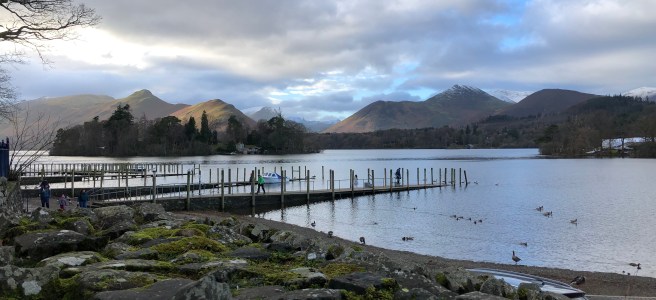
The Lake District, also known as the Lakes and Lakeland, is a national park of North West England. I had a chance to see its northern part with the town of Keswick situated along the northeast shore of Derwentwater lake and surrounded by picturesque hills and mountains, scary caves and magnificent waterfalls.

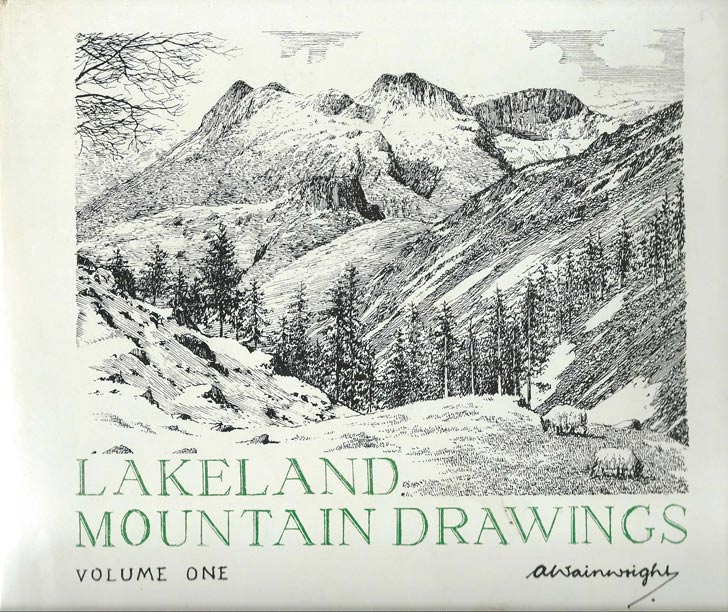
Alfred Wainwright, a British cartographer and illustrator, dedicated 13 years of his life to exploring the landscape of the area and created seven volumes of A Pictorial Guide to the Lakeland Fells published between 1955 and 1966. Through fine detailing, Wainwright’s illustrations and maps depict not only the fells and paths of Lakeland but also the enigma of nature and its magnetism.

The cover of Volume One of Lakeland Mountain Drawings by Alfred Wainwright

My perception of Lakeland was conditioned by the fact that it was my first visit to that area. I was impressed by the beauty of unusual colours of nature which I have not seen anywhere in the UK.  The mountains of orange, green and brown with white snowcaps; the azure sky with lenticular clouds of white and grey shades reflecting in the surface of Derwentwater; black-and-white sheep feeding in the green meadows; trees and shrubs of marsh, sand and black; and pearl-white waterfalls altogether made up the palette of Lakeland in winter.

Continue reading “Lakeland and its Poets. Visiting Lodore Falls and the town of Keswick”

Stick out your tongue at your mother tongue. Or how I visited Shakespeare’s town Stratford-upon-Avon

One December weekend before Christmas, I decided to visit Stratford-upon-Avon, the hometown of English poet and writer William Shakespeare. I went there with the Manchester International Society organising cultural events and bus trips across the UK for students and members of the university community.

Whilst the bus was carrying us from Northern England to Midlands, I had a very nice chat with a female master student from China who came to Manchester to study intercultural communication. We shared a common interest in Lake poetry and experienced similar problems of using English English, as far as we were native speakers of Russian and Chinese languages.

For the first time, I leant that British English should be called English English from my main supervisor who explained to me how to use it in my thesis properly. Not ‘practice’ but ‘practise’, not ‘garbage’ but ‘rubbish’, not ‘while’ but ‘whilst’, etc.

My acquaintance, a master student, told me that there was a hierarchy of English languages. For example, British English and American English take higher positions within the hierarchy of languages compared to Australian and Canadian variants, whilst Asian and Chinese English-es take the lowest positions because of the sounds and pronunciations that are typical for those groups of languages. 

Meanwhile, our bus reached the green fields of Warwickshire and I saw a couple of road signs reading ‘Shakespeare’s town’ and ‘London’. Once the bus dropped us off in Stratford-upon-Avon, we noticed that the car parking was very busy. Crowds of people, including us, were going towards the Victorian Christmas Fayre taking place in the town centre.

The Fayre stalls located along the main streets near the river Avon were full of Christmas gifts, decorations, hand-crafted goods, candles and illuminations. The smell of fried potatoes, mulled wine and other tasty food mixed with the Christmas spirit was in the air. People were waiting in queues to grab something to eat or drink.

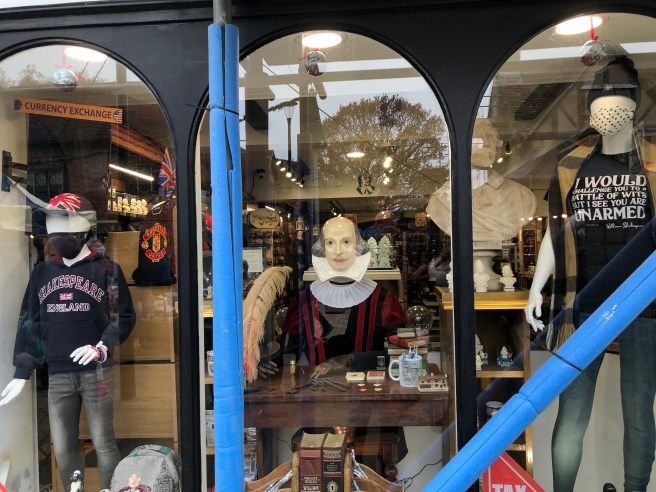
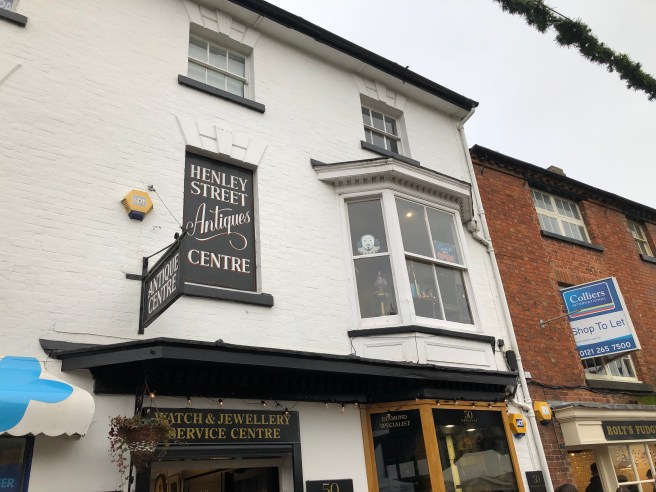
And Shakespeare as a linguistic sign looked at the crowded street from different corners and through the windows of pubs, shops and half-timbered houses. One could see his images on hotel signs, hoodies, mugs, copybooks and souvenirs. We followed Henley Street and came across William Shakespeare’s statue that was surrounded by people visiting the Christmas Fayre.

Continue reading “Stick out your tongue at your mother tongue. Or how I visited Shakespeare’s town Stratford-upon-Avon”

An imaginative journey in the pandemic world

I wrote this poem during the third lockdown in the UK. It reflects my experience of staying in one place and not crossing borders between countries for more than a year. The poem has no rhymes but who cares about rhymes nowadays. 
 
An imaginative journey in the pandemic world

I am on my way to St. Michael’s Mount
The train is moving from the North to the South of England
I see green fields and fast-flowing hill streams
But then I cross the English Channel 
(or la Manche as they call it in France)
And I am thinking about people who cross it 
Day by day risking their lives
And where am I going?
To St. Michael’s Mount 
(or le Mont-Saint-Michel as they call it in France)
That welcomes pilgrims with the rise and fall of tides.

Alexandrina Vanke
18th March 2021