The recent requests from academic journals to peer-review submissions on drawing as a method and an invitation to give a guest talk on drawing in social research have made me reflect on my experience of using drawing in sensory ethnography and, more broadly, in the social sciences. Looking back at my published research and evaluating my unpublished work in progress have provided me with several insights on applying drawing as a research tool of data collection, which I share below.
I should say that I am not an artist. I am a professional sociologist who is mainly doing ethnography and qualitative research. For these methodological traditions, interviewing and observation in all their variations are the main methods of data collection. But how can we make these classical methods more vivid, imaginative and (multi-)sensory? I suggest that integrating drawing in interviewing and observation in different ways, genres and formats can help with this.
Preparing my slides for the guest talk within the course ‘Research in Pictures’ led by the contemporary artist Victoria Lomasko at Humboldt University, I realised that I tend to use line and graphic drawing in research in two ways.
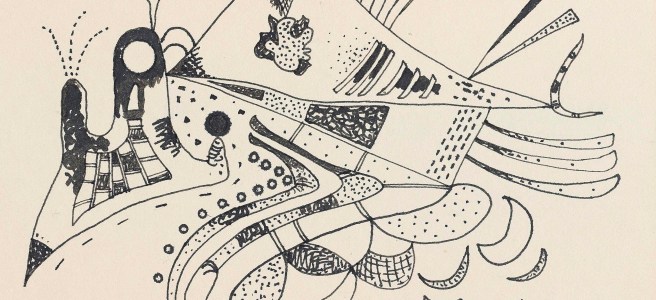
First, I apply drawing as a creative task for research participants while interviewing them. In this case, a researcher invites interviewees to draw something with a pen, a black liner or felt pens. And then participants are asked to explain their drawings, as this verbal information will be important for further interpretations at the stage of data analysis. As a sociologist, I believe that it does not make sense to ask participants to draw anything without their additional explanations. Otherwise, a researcher would not interpret the drawings correctly. But this is also an issue for the methodological discussion.

Sometimes this leads to the situation when participants draw and talk simultaneously, sharing their emotions, senses, feelings and thoughts about the topic of drawing. Sometimes they draw in silence and then provide a reflection on the drawing made or the topic discussed. Thus, drawing becomes a helpful means for talking in a deeper, emotional way and from another angle about the research topic compared to directly answering questions from the interview guide.
My recent articles on felt-sensed imaginaries of industrial neighbourhoods and on everyday perceptions of inequalities explain how to ask people to draw their neighbourhoods and society in one interview. Throughout my research practice, I learnt that requests for participants to draw something should be short and clear, and relevant to the research questions or themes. Then drawing will enrich an inquiry with visual information, which is different from verbal narratives but extends and supports them.
Second, I experiment with sketching and graphic drawing in ethnographic observation. In social research, observation typically requires writing field notes. There is a rule saying that without field notes it does not make sense to do observation. I am sure some social scholars will disagree with that. They will probably be right because one can make graphic field notes, although they still require inscriptions. But what if we apply sketching as one more way of documenting events, life situations or slow changes in space? Why not combine observational drawings with written field notes or keep them as either additional or substantive visual data, similar to photos but not equal to photos?
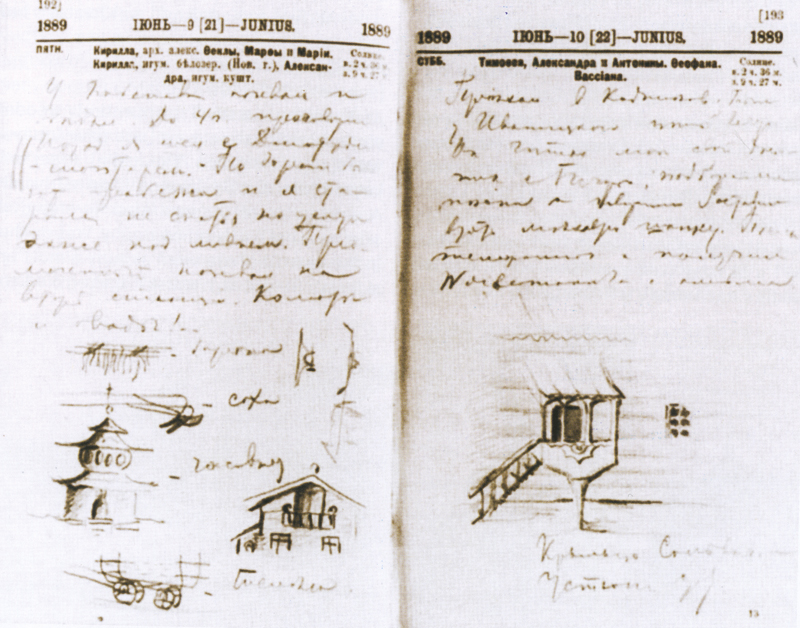
My favourite example is the black-and-white drawings from the expedition diary by the artist Wassily Kandinsky, who studied the culture of the people living in the Russian North. Kandinsky’s field notes combine written words and quick sketches of folk architecture, costumes and rituals.
To be sincere, I am still struggling with sketching people, and especially moving ones. But sometimes I manage to grasp their motion and movements with curvy lines and fuzzy shapes. Indeed, it is much easier to draw people resting or sitting, for example, in a café or on a bench.
However, the easiest way to start sketching for research purposes is to depict the landscape or an architectural building through simple and familiar shapes, like triangles, squares and rectangles. After that, one can add some eye-catching details to these geometrical objects and connect them with lines. Making a straight horizontal line dividing the field and the sky on a paper sheet does not require specific artistic skills. But this exercise will help to feel a drawing tool and a drawing surface and to connect yourself with the drawn subject.
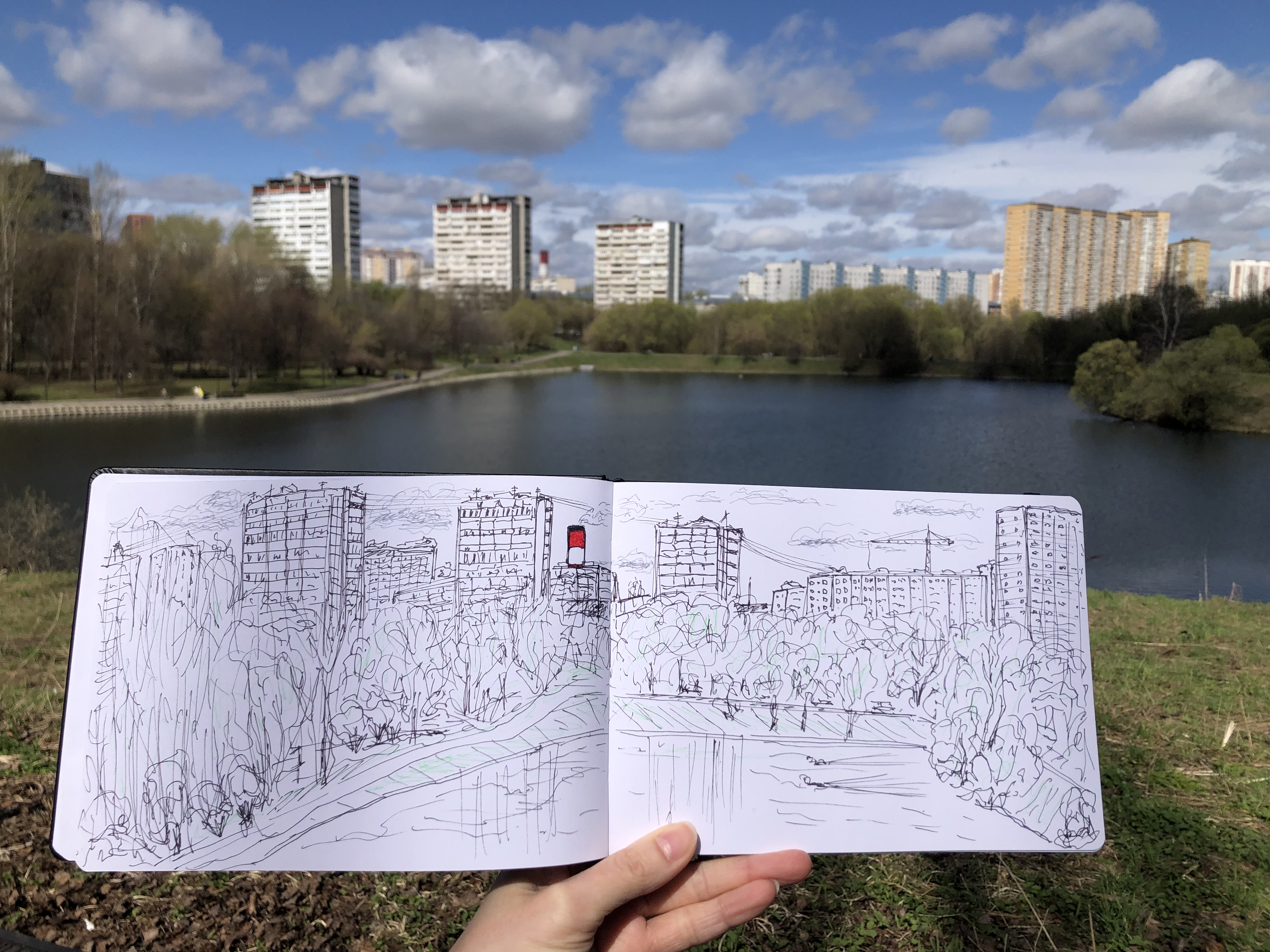
I write more about these and other issues, such as how to analyse drawings by participants and make observational drawings and theoretical sketches in my article ‘Multi-sited ethnography: developing avant-garde methodology for creative research into everyday lives’ forthcoming in Sociological Research Online. Stay tuned for more updates!
For learning more examples of using line and graphic drawing in social research, check out the following publications:
- Ingold, Tim. (2007). Lines: A Brief History. London: Routledge.
- Bonnano, Letizia. (2022). The Graphic in the Ethnographic: A Serious Methodological Turn or Just Some Visual Fun? Society for Cultural Anthropology. July 28.
- Gunko, Maria. (2025). ‘No Money and No Life’: the Soviet Something and Post-Soviet Nothing. Infocom.am. April 25.
 Alexandrina Vanke