Seeing between the lines: how drawing opens up new horizons in social research 

The recent requests from academic journals to peer-review submissions on drawing as a method and an invitation to give a guest talk on drawing in social research have made me reflect on my experience of using drawing in sensory ethnography and, more broadly, in the social sciences. Looking back at my published research and evaluating my unpublished work in progress have provided me with several insights on applying drawing as a research tool of data collection, which I share below.

I should say that I am not an artist. I am a professional sociologist who is mainly doing ethnography and qualitative research. For these methodological traditions, interviewing and observation in all their variations are the main methods of data collection. But how can we make these classical methods more vivid, imaginative and (multi-)sensory? I suggest that integrating drawing in interviewing and observation in different ways, genres and formats can help with this.

Preparing my slides for the guest talk within the course ‘Research in Pictures’ led by the contemporary artist Victoria Lomasko at Humboldt University, I realised that I tend to use line and graphic drawing in research in two ways.

First, I apply drawing as a creative task for research participants while interviewing them. In this case, a researcher invites interviewees to draw something with a pen, a black liner or felt pens. And then participants are asked to explain their drawings, as this verbal information will be important for further interpretations at the stage of data analysis. As a sociologist, I believe that it does not make sense to ask participants to draw anything without their additional explanations. Otherwise, a researcher would not interpret the drawings correctly. But this is also an issue for the methodological discussion.

A research participant drawing her volunteer experience of cleaning the Black Sea from the fuel oil split. Photo by Alexandrina Vanke ©

Sometimes this leads to the situation when participants draw and talk simultaneously, sharing their emotions, senses, feelings and thoughts about the topic of drawing. Sometimes they draw in silence and then provide a reflection on the drawing made or the topic discussed. Thus, drawing becomes a helpful means for talking in a deeper, emotional way and from another angle about the research topic compared to directly answering questions from the interview guide.

My recent articles on felt-sensed imaginaries of industrial neighbourhoods and on everyday perceptions of inequalities explain how to ask people to draw their neighbourhoods and society in one interview. Throughout my research practice, I learnt that requests for participants to draw something should be short and clear, and relevant to the research questions or themes. Then drawing will enrich an inquiry with visual information, which is different from verbal narratives but extends and supports them.

Second, I experiment with sketching and graphic drawing in ethnographic observation. In social research, observation typically requires writing field notes. There is a rule saying that without field notes it does not make sense to do observation. I am sure some social scholars will disagree with that. They will probably be right because one can make graphic field notes, although they still require inscriptions. But what if we apply sketching as one more way of documenting events, life situations or slow changes in space? Why not combine observational drawings with written field notes or keep them as either additional or substantive visual data, similar to photos but not equal to photos?

My favourite example is the black-and-white drawings from the expedition diary by the artist Wassily Kandinsky, who studied the culture of the people living in the Russian North. Kandinsky’s field notes combine written words and quick sketches of folk architecture, costumes and rituals.
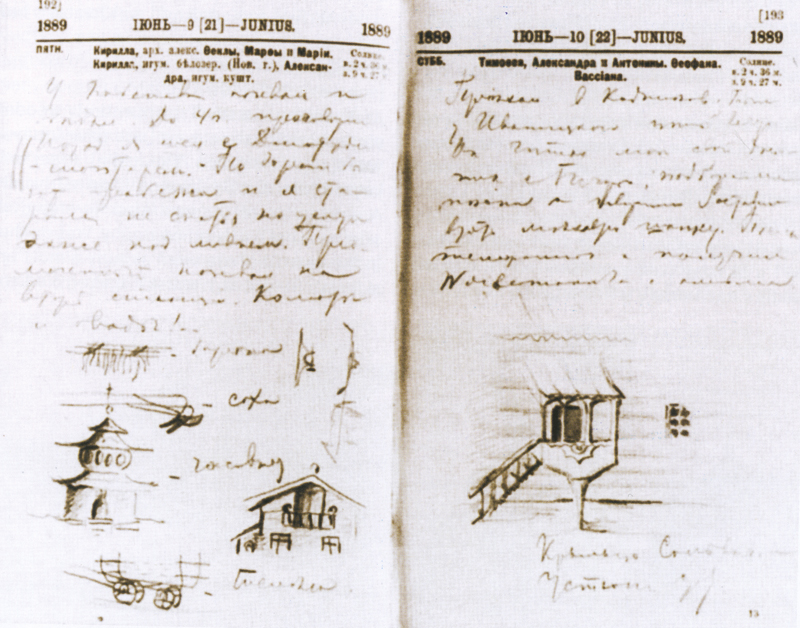
Sketches in the expedition diary by Wassily Kandinsky. Source: https://ourreg.ru/2018/01/29/ja-polozhitelno-vljublen-zyrjan/

To be sincere, I am still struggling with sketching people, and especially moving ones. But sometimes I manage to grasp their motion and movements with curvy lines and fuzzy shapes. Indeed, it is much easier to draw people resting or sitting, for example, in a café or on a bench.

However, the easiest way to start sketching for research purposes is to depict the landscape or an architectural building through simple and familiar shapes, like triangles, squares and rectangles. After that, one can add some eye-catching details to these geometrical objects and connect them with lines. Making a straight horizontal line dividing the field and the sky on a paper sheet does not require specific artistic skills. But this exercise will help to feel a drawing tool and a drawing surface and to connect yourself with the drawn subject.
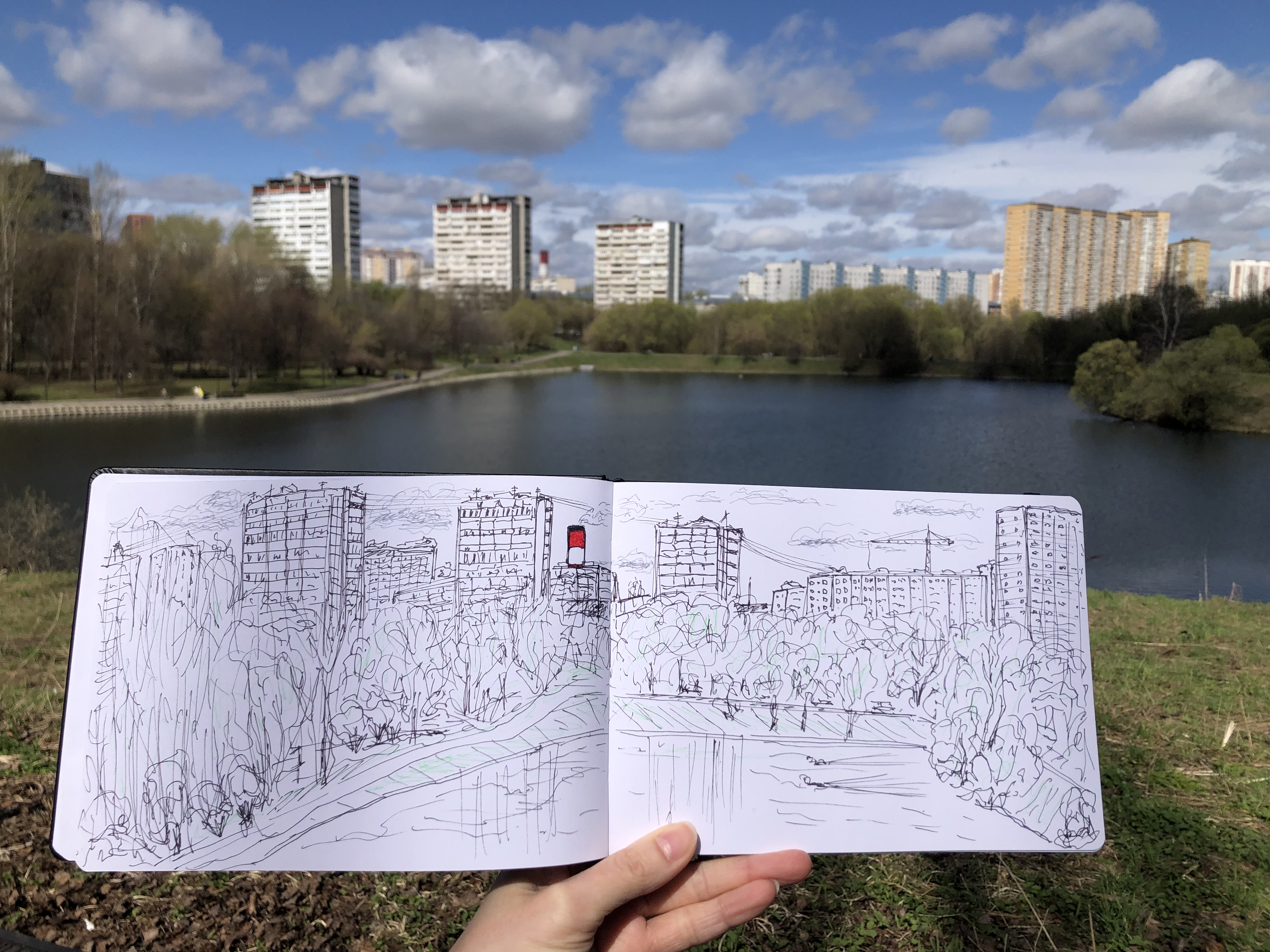
Graphic drawing of the deindustrialising landscape of Moscow by Alexandrina Vanke ©

I write more about these and other issues, such as how to analyse drawings by participants and make observational drawings and theoretical sketches in my article ‘Multi-sited ethnography: developing avant-garde methodology for creative research into everyday lives’ forthcoming in Sociological Research Online. Stay tuned for more updates!

For learning more examples of using line and graphic drawing in social research, check out the following publications:

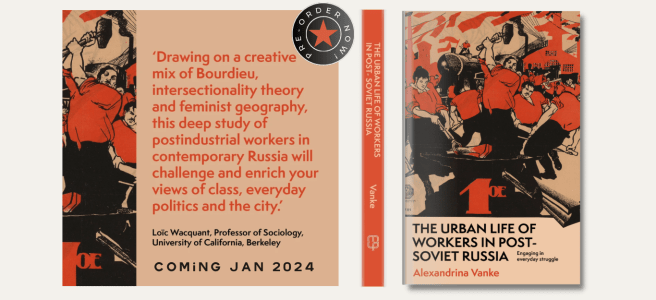
On crafting illustrations for The urban life of workers in post-Soviet Russia

This is the third blogpost in the series about The urban life of workers in post-Soviet Russia. The book will be out in two months in January 2024. I am very excited about this and looking forward to receiving comments from the readers and reviewers.

From its short description, you may learn that the book draws on the ethnographic study with elements of arts-based research. Earlier I wrote about how I integrated poetry in academic writing (read here). In this post, I would like to explain how I used illustrations to support the textual narrative and my overarching argument.

The urban life of workers in post-Soviet Russia includes about 30 black and white illustrations of three types.

First, I illustrate one of my arguments about the complexity of socio-spatial imaginaries with drawings of the industrial neighbourhoods and Russian society made by research participants with a black pen. I obtained these drawings with verbal explanations during interviews with workers and professionals. Drawings with explanations are multi-sensory data created by participants. That is why I view my participants as co-creators of unique data for this ethnographic study. These drawings are as important as interview narratives and other data. They visualise the feelings of residents of the industrial neighbourhoods to their places of residence and their subjective perceptions of inequality and whole Russian society.   

Second, I use some ethnographic photographs taken during fieldwork in Moscow and Yekaterinburg cities. The photographs help to provide the reader with a sense of atmosphere in two locations studied. Some of them show the urban settings and infrastructure of the industrial neighbourhoods. Some others focus on practical activities of ordinary people, such as collective maintenance of deindustrialising areas and cultivating mini-gardens near social housing blocks. For illustrations, I selected those photographs that did not show particiapants’ faces to align with the ethical principles of anonymity. I also use a photograph of a massive May Day Demo in St. Petersburg by Pyotr Prinyov from the mid-2010s to explain better the restrictions for open protests in today’s Russia.

Finally, I crafted several graphic illustrations with the help of drawing skills that I learnt from artist Victoria Lomasko within our course ‘Avant-garde and arts-based methods in qualitative research’. With a black marker, I drew the portraits of some research participants, as well as workers of different ages, genders and ethnicities who I met in a post-industrial city. Moreover, I entitled the first part of the book ‘Theoretical sketches’ not only because ‘Poetical Sketches’ by William Blake inspired my writing. Synthesising a novel theory of urban life, this first part includes my graphic sketches visually explaining the conceptualisation of structure of feeling and everyday struggle.

In the book, I combine the textual register with the visual one to tell the story about the urban life of workers vividly and vibrantly. The idea of such a creative approach to academic writing is not (only) to entertain the reader but not to leave them indifferent.

If you are interested in writing a book review, you can request a free copy of The urban life of workers in post-Soviet Russia on the website of Manchester University Press (click here). If you can, please purchase the book via your University or local library to make it available to a wider community of readers (click here).

Lakeland and its Poets. Visiting Lodore Falls and the town of Keswick

‘How does the water
Come down at Lodore?’
My little boy asked me
Thus, once on a time;
And moreover he tasked me
To tell him in rhyme.

Robert Southey, The Cataract of Lodore, 1820

Having a genuine interest in English Romantic poetry, one December weekend, I decided to go to the town of Keswick (pronounced as [‘kesik] or [‘kezik]) located in the Lake District, Cumbria. My choice of destination was motivated by the fact that the poets Samuel Coleridge and Robert Southey lived there at the beginning of the 19th century and where their friend William Wordsworth, a famous poet, visited them.

Below, I will reflect on the visual landscape of the area and nature as a public good. Finally, I will consider critically the issue of taste as defined by the Lake Poets[1]. Altogether, this reflection should explain the social, cultural and economic divisions that I found in Keswick and its surroundings.

The visual landscape of Lakeland

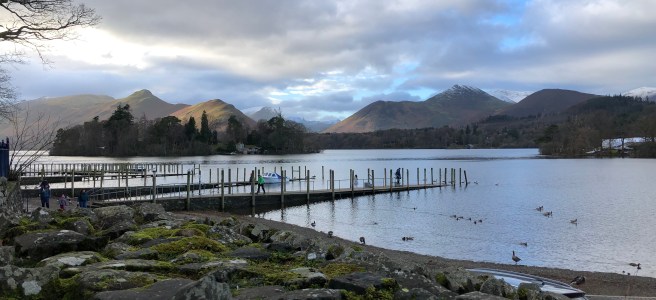
The Lake District, also known as the Lakes and Lakeland, is a national park of North West England. I had a chance to see its northern part with the town of Keswick situated along the northeast shore of Derwentwater lake and surrounded by picturesque hills and mountains, scary caves and magnificent waterfalls.

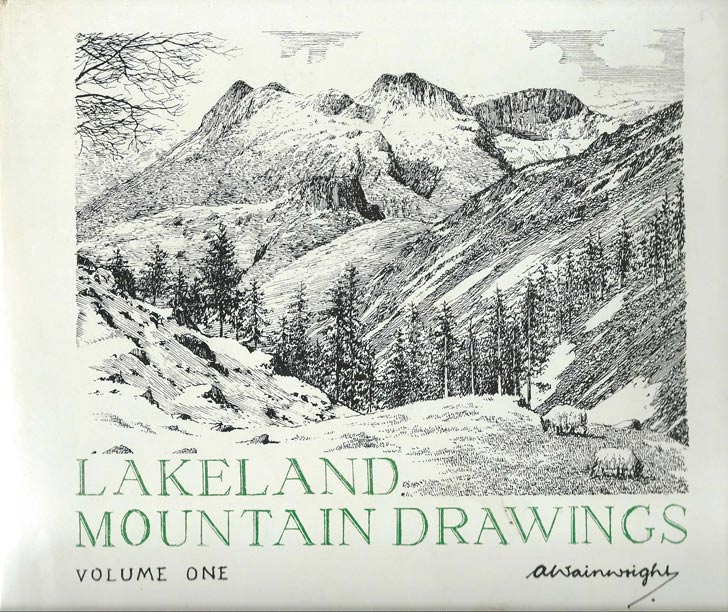
Alfred Wainwright, a British cartographer and illustrator, dedicated 13 years of his life to exploring the landscape of the area and created seven volumes of A Pictorial Guide to the Lakeland Fells published between 1955 and 1966. Through fine detailing, Wainwright’s illustrations and maps depict not only the fells and paths of Lakeland but also the enigma of nature and its magnetism.

The cover of Volume One of Lakeland Mountain Drawings by Alfred Wainwright

My perception of Lakeland was conditioned by the fact that it was my first visit to that area. I was impressed by the beauty of unusual colours of nature which I have not seen anywhere in the UK.  The mountains of orange, green and brown with white snowcaps; the azure sky with lenticular clouds of white and grey shades reflecting in the surface of Derwentwater; black-and-white sheep feeding in the green meadows; trees and shrubs of marsh, sand and black; and pearl-white waterfalls altogether made up the palette of Lakeland in winter.

Continue reading “Lakeland and its Poets. Visiting Lodore Falls and the town of Keswick”