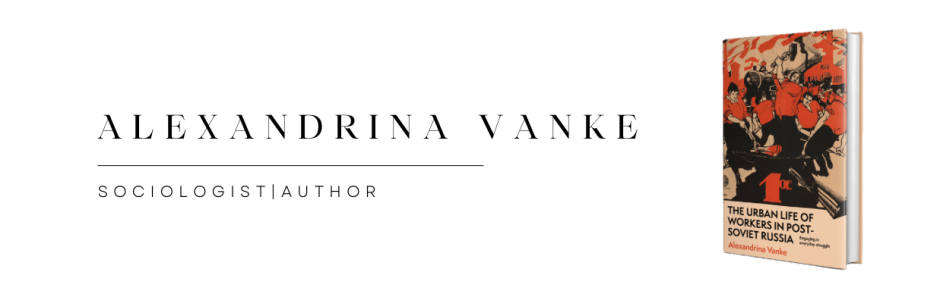
It’s release day! I am delighted to announce that The urban life of workers in post-Soviet Russia is out now!
Many thanks to all people whose support made this book possible. I am grateful to Manchester University Press for their professionalism and high quality book production. The process of crafting this book was inspiring for me, despite the dark times throughout which I was writing it.
The book is centered on the stories of urban workers in Russian society. But I hope that an international reader gets something useful about how ‘ordinary people’ overcome life difficulties with meagre resources they possess. This practical knowledge may be especially valuable in the era of crises and conflicts we live now as humankind.
In this final blog post in the series about The urban life of workers in post-Soviet Russia, I would like to discuss briefly its contents.
As I wrote earlier, the book consists of three parts. The first one Theoretical sketches presents my ethnographically grounded synthesis of the concepts allowing a critical reflection on the challenges that workers and other city dwellers face in deindustrialising urban areas. Chapter 1 develops a novel theory of urban life and everyday struggle building the network of revised concepts, including structure of feeling, senses, imaginaries, order of power, everyday struggle, consciousness and habitus.
The second part Ways of life tells the story about everyday life in Russia’s major post-industrial cities and Russian society as a whole.
Chapter 2 provides the setting of the story discussing the local atmospheres, sensual experiences and spatial imaginaries in the two industrial neighbourhoods located in the cities of Moscow and Yekaterinburg. Chapter 3 considers spatialised gendered senses of working-class people and intersectional inequalities in the industrial neighbourhoods studied.
Chapter 4 analyses the symbolic and moral meanings of social groups in Russia, including the working class and the middle class, mentioned by research participants from both cities. This chapter pays special attention to moral judgement and blaming working and poor people by wealthier classes intensified in the context of the Russia-Ukraine war. Chapter 5 examines research participants’ subjective perceptions of the whole Russian society by looking at their social imaginaries and everyday inequalities they experience daily.
The third part Ways of struggle explores different forms of struggle and particular consciousness emerging from engagement in them.
Chapter 6 focuses on open protests, including trade union strikes and social movements, leading to the formation of dispositions of protest and political consciousness. It shows how the objective restrictions for massive collective actions were steadily increasing in Russia throughout the 2010s and dropped to minimum in 2022.
Chapter 7 explains how workers and other residents of deindustrialising areas are actively engaged in the everyday forms of resistance to multiple challenges caused by neoliberalism and neo-authoritarianism. This long-standing engagement in everyday struggle leads to the formation of habituated resistance and practical consciousness of creative nature.
If you want to help The urban life of workers in post-Soviet Russia become visible, please consider taking the following action:
- order the book for your library or recommend it to your librarian;
- request a free copy from Manchester University Press to write a review;
- include it in your syllabus or reading list.
By signing up to the MUP newsletter, you will get 30% discount on this title.
Enjoy the book!

 Alexandrina Vanke