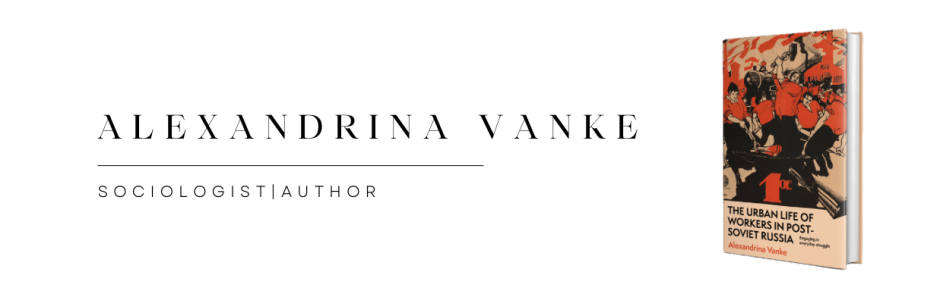

Unbelievable, ‘The urban life of workers in post-Soviet Russia’ is now six month old! At its six-month mark, I would like to reflect on its dissemination and initial reception.
This is an academic book. So it is not surprising that the first feedback and comments I received were from my colleagues in universities around the world. What surprised me, however, was that historians, including the historians of Russia and labour movements in other countries, appeared to be so grateful readers!
Some of them wrote to me to say that they were interested in reading the book and found it valuable. At the same time, some of them pointed out that such title should cost less and that the high price prevents a wider audience from reading it. I absolutely agree! But the publisher sets the price. If enough copies are sold, Manchester University Press will reprint the book in softcover. So thinking about dissemination is important here.
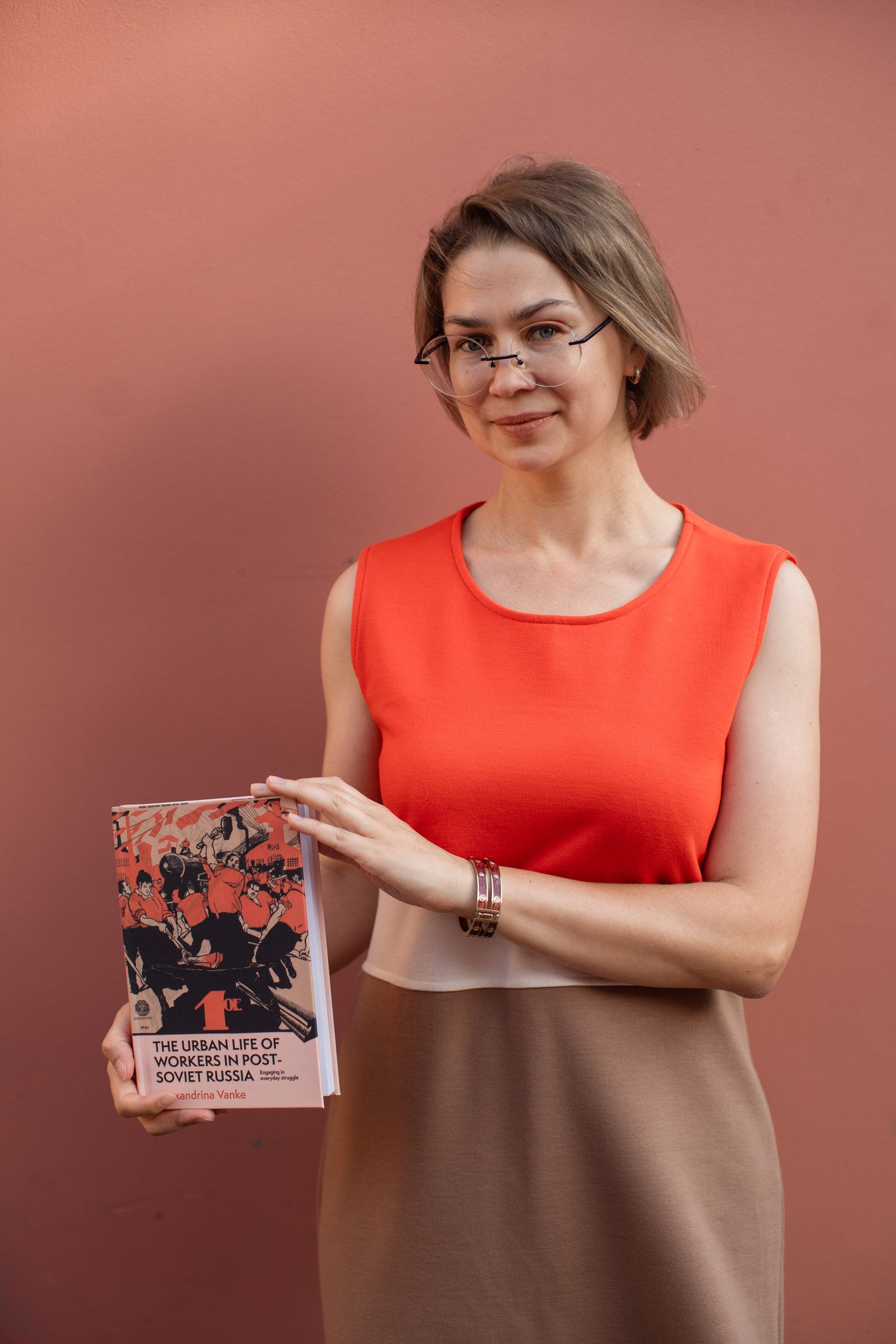
I have also received messages from friends and colleagues with congratulations saying that they liked the book cover. Needless to say, I like it too. I chose the image for the front cover deliberately. I was lucky that my publisher provided me with a designer who came up with a really great cover. I am glad that the readers find it cool and hot at once.

‘The urban life of workers in post-Soviet Russia’ tells the story of workers living in specific geographical locations, in post-industrial cities. So it seemed to be of interest to human geographers and urban scholars. Sociologist Anna Zhelnina invited me to talk about my book on one episode of the New Books Network. It was a very pleasant conversation, which helped me to talk about the book from different angles. We discussed the local atmosphere in Russia’s deindustrialising neighbourhoods, the involvement of residents in grassroots activities, social and labour movements, and, among other things, my research methodology, alternative approach to writing and theoretical contribution.
I really enjoy research blogging. So I have written a number of guest posts about the book. First, Manchester University Press republished my blog about subbotnik, proletarian art and the urban life of workers. Then, I wrote about how working-class communities experience deindustrialisation in Russia for the blog of the international project ‘Deindustrialization and the Politics of Our Time’ (DéPOT at Concordia University). Finally, I contributed to the blog of the Raymond Williams Society with a post on structure of feeling as a conceptual tool in the study of everyday life and struggle.
I am grateful to my colleagues for inviting me to present the book at the regular seminar of the Bourdieu, Work and Inequality research network and at the seminar for history students at Sorbonne Université.
I also presented some chapters of the book at the British Sociological Association annual conference 2024 ‘Crisis, Continuity and Change’ and at the DéPOT project annual conference ‘Gender, Family and Deindustrialization’.
These dissemination efforts has resulted in ‘The urban life of workers in post-Soviet Russia’ being included in the book review lists of the following journals, magazines and blogs (that I am aware of):
· Eurasian Geography and Economics
· Key Words: A Journal of Cultural Materialism
· Laboratorium: Russia Review of Social Research
If you would like to get a free copy, please contact one of the issues listed above to write a review.
Last but not least. I would like to thank all the people who ordered my book for their libraries! ‘The urban life of workers in post-Soviet Russia’ is now available in the library catalogues of the following universities:
· University of Helsinki
· University College London
· University of Sussex
· Aarhus University
· Sorbonne University
· Manchester Metropolitan University
· University of Cambridge
I guess this list is longer.
What next? I see the interest in my book in French-speaking countries, especially in France and Canada. It would be great to have it translated into French and other languages. If anyone from a non-English publisher reads this post and is interested in translating my book into another language, please contact Manchester University Press.
And for me, it’s time to think about how else I can tell the stories of workers’ urban lives.
Stay tuned!

 Alexandrina Vanke