2nd year of the PhD: facing new challenges

Some people say that the 2nd year is the most exciting and easiest stage of the full PhD process. On the one hand, I agree with this, because at this point you know what you should do exactly and it is still far to write the whole thesis. On the other hand, each PGR student has its own path depending on her/his research project, so you never know what challenges may arise at this stage. During my 2nd year of the PhD in Sociology at the University of Manchester, I completed fieldwork, analyzed most of the empirical data, and gained teaching experience. I decided not to make these things all together and spent several months for each of these activities separately.

Teaching

In September 2018, I came back to Manchester from the 2nd field trip to Russia and as a teaching assistant joined two courses, Media, Culture & Society and Researching Culture & Society, given at the University of Manchester. Before the PhD I had already taught in Moscow Universities. However, as far as British and Russian systems of higher education differ, there was something new for me to learn. New teaching assistants have to take introductory courses explaining, for example, how to protect confidential information about students, how to solve a problem of cultural diversity in the classroom, how to assess students’ records and give feedback, etc. Only after the completion of these introductory courses you are allowed to start teaching.
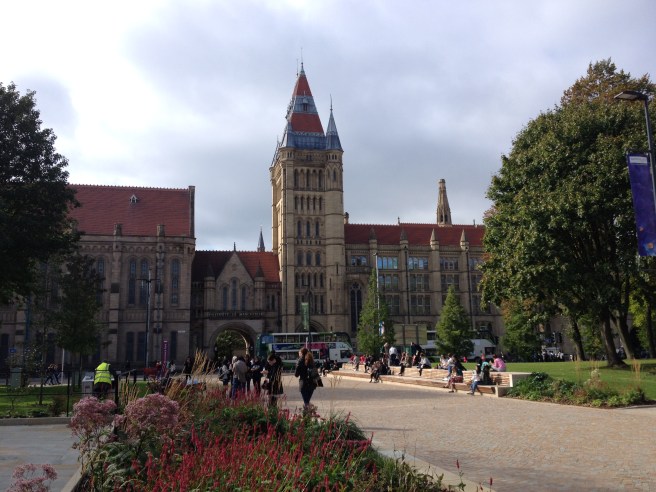
IMG_2772The Whitworth Building of the University of Manchester. Photo by Alexandrina Vanke

From October to December 2018, I gave seminars (called tutorials at the University of Manchester) in four groups, in two for each of the course. There were approx. 10 students in each group. It took me two-three days of preparation, and one day of teaching. Normally teaching assistants should read the required and additional literature for tutorials (up to 10 positions for one tutorial) and facilitate a discussion in the classroom. Lecturers prepare questions for the discussion beforehand. You may be creative and add something else but a seminar has already a structure though. The things you are required to do is to help students to get answers to the questions based on the reading and support them in critical debating the issues formulated by the lecturer.

By the mid-autumn, each student had to submit a written work on one of the topics proposed by the lecturer and based on the recommended reading. For me, the assessment of students’ essays was the most time-consuming part of teaching. It was absolutely different from the assessment process I used to do in Russian Unis. At the University of Manchester, you should estimate an essay on a 100-point scale and explain in detail (i.e. to write feedback), why you gave a particular mark to a student. In addition, you should assess different elements of each essay on a 10-point scale, e.g. creativity, methodology, originality, critical reflection, arguments, etc.
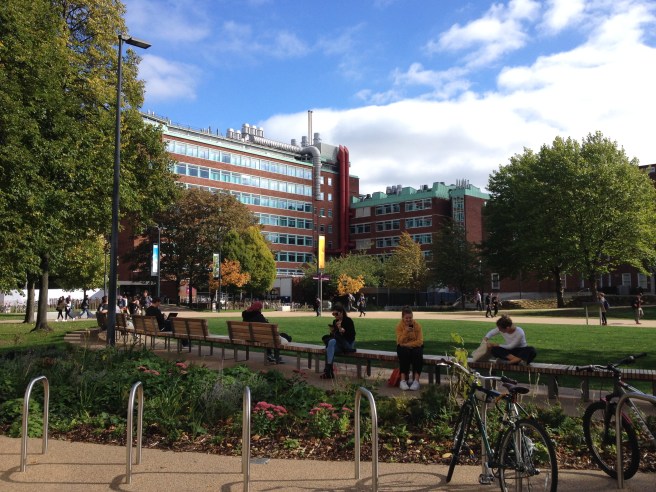
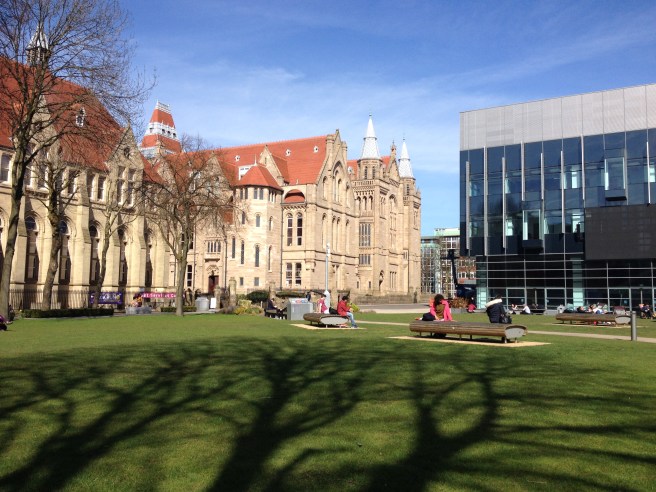
IMG_2780.JPGThe campus of the University of Manchester. Photo by Alexandrina Vanke

At the time of teaching, I spent one-two days in the working week for my PhD research and sometimes weekends. In spite of new challenges, it was really great for me to change the activity: to switch from fieldwork to teaching. In addition, I got to know some new approaches from the course Media, Culture & Society, which I may use in PhD, and broadened knowledge in qualitative research methods thanks to the course Researching Culture & Society. At the beginning of December 2018, I went to Boston to present PhD research at the Annual Conference of the Association for Slavic, East European, and Eurasian Studies. After coming back to Manchester I gave the final class and in the next couple of days headed to Moscow to undertake the final phase of fieldwork.

Fieldwork

The research design of my PhD project ‘Working-class life and struggle in post-Soviet Russia’ is based on the approach of multi-sited ethnography and involved collecting ethnographic data in two localities. Fieldwork took place in two field sites and was split into three phases. By the end of the 1st year of the PhD (read more: here), I had two field trips to Yekaterinburg and Moscow and collected most of the empirical data in two industrial neighbourhoods located in these two cities. After the 2nd field trip, I formulated some new suggestions, which needed to be supported by additional empirical data.

To check the provisional arguments, I decided to undertake the 3rd phase of fieldwork in Moscow between December 2018 and January 2019. During this final field trip, I came back to the examined Moscow neighbourhood and conducted some more interviews with its residents. However, this phase aimed at researching the experiences of workers who took part in trade union activity. As far as this winter field trip coincided with long New Year celebrations in Russia, it was quite problematic to arrange meetings with potential participants. If people agreed for the interviews, our talks were long and occurred in a warm and relaxing atmosphere, sometimes over tea at the participant’s place.

Sociology PGR Colloquium

An announcement of my presentation at the colloquium. Made by Francisca Ortiz Ruiz

In February 2019, I finished collecting data and came back to Manchester being ready to move onto the next stage of data analysis. Finally, my database consisted of 53 ethnographic interviews, 155 pages of field notes, more than 550 photographs and other visual data. I was invited to present the PhD project at the PGR colloquium organized by my peers from Sociology. The process of preparation for the colloquium allowed me to build a more or less coherent visual narrative with sociological ethnography and to see that I had enough empirics for putting a puzzle together.

Data analysis

The spring semester of the 2nd year was fully dedicated to work with empirical data. First of all, interview transcripts needed anonymization and creation of an anonymization log with records about places data, which was removed or replaced by pseudonyms. I changed the names of research participants, and the names of their relatives and friends mentioned in interviews, the names of neighbourhoods, streets, and other recognizable spots, numbers of schools and house buildings, etc.

IMG_5238.JPGMy desk in the office of the Department of Sociology. Photo by Alexandrina Vanke

At the next stage, from March to July 2019, I coded all anonymized interview transcripts in NVivo 12 software. Before coding my supervisors advised me to choose three absolutely different interviews from the data set – I chose one interview from each of three fieldwork phases – and to create the initial codes, which changed slightly in the following process of coding. At the beginning, the codes looked a bit unstructured, but later I restructured them and generated child codes related to the key categories. On the one hand, the process of coding was routine and monotonous. On the other hand, coding in NVivo helped me to structure ethnographic data and create a detailed hierarchy of codes, which consists of more than 670 items now.

I generated some codes ‘bottom-up’ from empirical data and some codes ‘top-down’ by keeping in mind theory. Now it is clear that coding in NVivo was the first step toward bridging empirical data with theory, theory with empirical data in my PhD research. Emotions were also there. While rereading interviews, I was sometimes weeping, sometimes laughing. Well, the everyday life of workers in Russia is really hard, but there is also a place for humour and resilience.
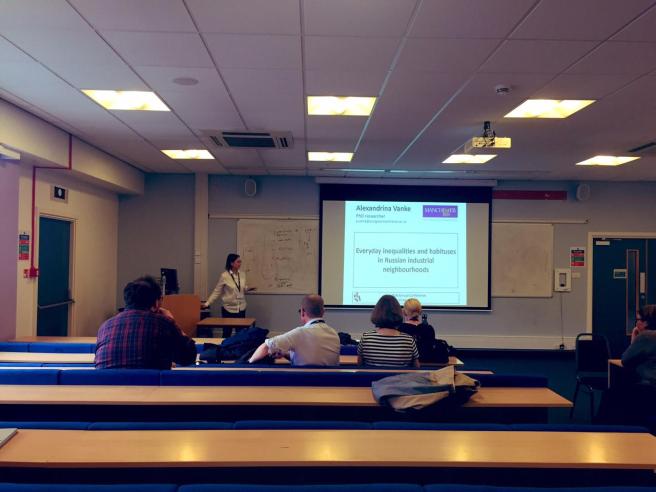
IMG_5698Presenting PhD research at the BSA conference. Photo by Francisca Ortiz Ruiz

In April I presented the intermediated results of data analysis at the Annual Conference of the British Sociological Association which took place in Glasgow. May and June were fully spent on preparing a field report and other research documents for the annual review. In the field report, I tried to write a sociological ethnography – which was not easy for me – and figured out how the empirical chapters of the thesis may look like. At the end of the 2nd year of the PhD I presented the field report at the annual review. The reviewer gave me insightful feedback on empirical research and helpful advice on the theoretical framework. Inspired by the stimulating discussion at the annual review, I am looking forward to moving onto the next stage and starting writing the thesis.

Публикации 2018

В 2018 году вышли следующие мои статьи, посвященные исследованиям маскулинной телесности и территориальной идентичности в индустриальных районах.

Ваньке, Александрина (2018). Мужские тела, сексуальности и субъективности, Философско-литературный журнал Логос 28(4), сс. 85-108.

fresh-topleft.jpgАннотация. Углубление социального неравенства, которое автор связывает с глобальным распространением неолиберализма, усложняет систему властных отношений между мужскими телами и сексуальностями и ведет к дифференциации типов маскулинности. На материале 43 биографических интервью переосмысляются властные отношения внутри двух социально-профессиональных сред — так называемых синих и белых воротничков. Автор приходит к выводу, что через регулирование телесности сфера труда управляет эмоциональными отношениями и, как следствие, сексуальной жизнью мужчин из обеих групп. Наряду с этим режимы производственного и офисного труда генерируют разные логики управления мужской телесностью, которые воспроизводятся в приватной сфере и используются для создания мужской субъективности.
Основным ресурсом конституирования мужественности для рабочих служат физическая сила и умения, тогда как для офисных клерков — телесная репрезентация и перформанс. Следствием дифференциации в структуре труда становится неравенство возможностей создать «успешный» маскулинный субъект. Мужчины-рабочие называют себя «неудачниками», в то время как служащие считают себя «состоятельными», хотя и те и другие в равной степени выступают объектами эксплуатации. Телесный труд рабочего отчуждается в процессе управления телами на производстве, тогда как тело офисного клерка коммодифицируется и превращается в знак в системе символического обмена. Вместе с тем результаты исследования свидетельствуют о размывании средовых границ и ослаблении классового сознания, что позволяет мужчинам — рабочим и офисным служащим — применять сходные сексуальные стратегии, различающиеся лишь по форме и стилю. Маскулинная субъективность синих и белых воротничков включает одни и те же компоненты традиционной, либеральной и новой мужественности, которые отличаются по способам и формам выражения.

Ключевые слова:  мужчины; тело; сексуальность; синие воротнички; белые воротнички; труд; власть; эмоции; неравенство.


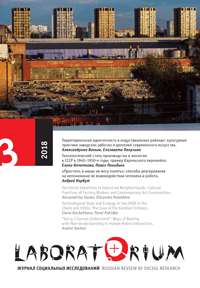
Ваньке, Александрина и Елизавета, Полухина (2018). Территориальная идентичность в индустриальных районах: культурные практики заводских рабочих и деятелей современного искусства, Laboratorium Журнал социальных исследований 10(3), сс. 4-34.

cover_issue_31_en_USАннотация. В статье рассматриваются территориальные идентичности, сформировавшиеся вокруг советских предприятий: завода имени И. А. Лихачева (ЗИЛ) в Москве и Уральского завода тяжелого машиностроения (Уралмаш) в Екатеринбурге. На примере двух кейсов авторы отвечают на вопрос о том, как создается территориальная идентичность индустриальных районов в постсоветской России. Авторы анализируют культурные практики в двух индустриальных районах и показывают, какой вклад в изменение их территориальных идентичностей вносят культурные акторы: представители творческих профессий и культурной среды, то есть научные работники, художники, архитекторы, фотографы, преподаватели высших учебных заведений, работники музеев, культурные и городские активисты. Исследование обнаруживает увеличение социального неравенства между резидентами индустриальных районов: рабочими и представителями других социальных групп. На фоне неолиберальной политики новые социальные акторы приходят в индустриальные районы, изменяя конфигурацию их социального состава. Оба кейса – территории вокруг завода имени И. А. Лихачёва и Уралмашзавода – демонстрируют наслоение разных типов идентичности и ассоциирующихся с ними культур рабочего и среднего классов. Так, в случае индустриальных районов мы можем говорить о множественной территориальной идентичности, которая выражается в том, что коренные жители и новые культурные акторы применяют классово дифференцированные «советские» и «постсоветские» культурные практики, воспроизводят «старые» и «новые» стили жизни.

Роль культурных акторов в формировании множественной территориальной идентичности индустриальных районов амбивалентна. С одной стороны, они вносят вклад в создание новой культурной среды и ведут работу по снятию маргинальных маркеров с промышленных территорий, делая эти районы более привлекательными для общегородских публик. С другой стороны, в процессе культурной экспансии резиденты индустриальных районов становятся «невидимой» социальной группой, лишенной возможности говорить публично. Культура рабочих, выражающаяся в практиках культурного потребления, сформировавшихся в советский период (например, посещение театров, музеев, домов культуры) и ремесленных навыках (например, вышивание, вязание, пошив одежды для женщин, а для мужчин создание предметов быта своими руками), обесценивается и не воспринимается как достойная внимания. Таким образом, деятельность культурных акторов вписана в общий тренд джентрификации и вытеснения рабочих за пределы промышленных территорий и публичного пространства. Вышеперечисленные процессы указывают на воспроизводство культурного, классового и территориального неравенств внутри индустриальных районов.

Ключевые слова: территориальная идентичность, индустриальный район, культурные практики, заводские рабочие, культурологический анализ классов

Первый год PhD. Как это было?

Первый год моего обучения на программе PhD по социологии в Манчестерском университете подошел к концу. Каким он был для меня? И как проходит обучение в английской аспирантуре? Постараюсь рассказать об этом.

Первое, с чем сталкивается PhD студент, приезжающий на учебу из другой страны, – это поиск жилья, улаживание бытовых проблем и знакомство с локальной инфраструктурой. На решение этих вопросов может потребоваться немало времени. Одним словом, первые месяцы уходят на адаптацию к жизни в новой среде. Лично у меня этот процесс занял два месяца. Параллельно с этим начинается посещение обязательных занятий в университете и взаимодействие с научными руководителями.

В первые два месяца мои научные руководители давали мне задания на написание коротких текстов, которые мы вместе разбирали на консультациях. Они заключались в том, чтобы прописать возможные стратегии исследования, сформулировать проблему, наметить теоретическую рамку. Однажды я получила задание нарисовать план-карту моего проекта с темой, ключевыми понятиями, исследовательскими вопросами, возможными вариантами мест сбора данных.

IMG_8591

Whitworth Hall Манчестерского университета

Наряду с выполнением заданий моих научных руководителей, я посещала занятия по академическому письму, развивая навыки написания научных текстов на английском. На первый взгляд может показаться, что писать по-английски просто, но когда сталкиваешься с созданием научного текста, то понимаешь, что это определенный жанр, требующий специфических навыков. Эти навыки заключаются в умении четко обосновывать свою позицию, распознавать аргументы других авторов и полемизировать с ними. Английское академическое письмо строится на силе аргумента.

Приобретению навыков строить аргументы способствует и обязательное для PhD студентов чтение научной литературы, которую условно можно разделить на три вида: классическая, новейшая, методологическая. При работе с научной литературой мне помогло составление конспекта и выписывание основных тезисов разных авторов, работающих в моей области.

IMG_9712

Кампус Манчестерского университета

После того, как мне удалось изучить необходимую литературу, я приступила к написанию литературного обзора, разработке исследовательского инструментария и составлению заявки на этическую комиссию. Этический комитет факультета или университета дает разрешение на проведение полевых работ. Последующие месяцы были посвящены более плотной работе над обзором литературы, обсуждению исследовательского дизайна с научными руководителями, созданию плана полевых работ, доработке текста обзора и укреплению аргументов.

В последних числах апреля у меня состоялась защита проекта, после чего начался этап полевых работ. 1-я фаза сбора данных проходила в Екатеринбурге, а 2-я фаза – в Москве. За год мне удалось развить навыки академического письма, расширить знания по современной литературе, познакомиться с рядом исследовательских методик, узнать, как устроен университет в Англии, и составить представление о ландшафте британской социологии. В целом, мой опыт прохождения первого года аспирантуры убедил меня в том, что PhD – это сложно, но в то же время интересно. Второй год обещает быть не менее насыщенным.


Russian Workers an ‘Invisible Class’ Since Collapse of Soviet Union, New Study Concludes

Text by: Paul Goble

Staunton, January 11 – Russians employed in factories have become “an invisible group” in society since 1991; and as a result, the identity even now is based largely on memories of the Soviet past as exacerbated by their sense of growing social inequality, according to a new study by the Higher School of Economics of workers at the Uralmash plant.

The study, prepared by Elizaveta Polukhina and Anna Strelnikova of the HSE and Alexandrina Vanke of the University of Manchester, notes that since the end of the Soviet Union, workers have received very little attention, including from sociologists and other scholars (iq.hse.ru/news/213569213.html).

This has left members of this group “lost” because they had been respected in Soviet times; but “in the 1990s everything changed completely.” They lost their former status in society and watched as their relative position in the income pyramid fell precipitously, the three researchers say.

Uralmash, set up in the northern section of Yekaterinburg in 1927 was a workers’ settlement based on a number of factories. It was one of dozens of such settlements in Soviet times. At present, more than 190,000 people live there, a number far lower than in the past. The HSE researchers conducted deep interviews with a number of the remaining workers.

These settlements, the sociologists say, were intended to provide everything the workers needed and to root them to one place. As such, they served as an important component of the Soviet system of control. But despite what many might think, many there now recall that arrangement as a positive thing.

Most of the workers now say they felt like “part of a large family,” one in which their days and even their lives were predictable and in which they could expect to be taken care of cradle to grave. They say they were proud to be “simple Soviet people,” a category that they defined more in ethical terms than in class ones.

For these workers, the collapse of the Soviet system as completely negative and remains so. And if they were quite happy to talk about the Soviet period, they were much more restrained in discussing the 1990s, the three sociologists say. For them, that period meant wage arrears, the loss of many fellow workers, and search for a new place in life.

The sociologists say that even now, workers at Uralmash view themselves as “innocent ‘victims of circumstances.’” As a result, “the contemporary identity of workers is a kind of mix which includes Soviet and post-Soviet practices, meanings and values,” but it still focuses on values rather than income alone.

“This doesn’t mean that class distinctions have disappeared entirely. To a large extent,” the three write, “identity is defined as a result of a sense of social stratification.” Workers don’t feel comfortable dealing with managers or owners and don’t have the same social cohesion they once had particularly as younger workers gain education and move away.

Read the orginal text here.

Transformation of Working-Class Identity in Post-Soviet Russia

We present the results of our group project The Everyday Life of Industrial Workers: Ethnographic Case-Study of Industrial Neighborhood in Yekaterinburg, conducted by me, Elizaveta Polukhina and Anna Strelnikova, in the working paper The Transformation of Working-Class Identity in Post-Soviet Russia: A Case-Study of an Ural Industrial Neighborhood.

Abstract

This paper presents an analytical description of working-class identity in three key periods of the socioeconomic transformations which changed the structure of a plant’s industry and working-class life: the Soviet era (1930s-1980s), the time of economical change (1990s), and the post-Soviet years (2000s-2010s). The analytical framework of the study is based on the concept of ‘cultural class analysis’ (Savage 2015). It includes the concepts of habitus and cultural capital, and culture as embedded in economic and social relations (Bourdieu 1980).

In the course of the research we conducted an ethnographic case-study in 2017 and lived in the neighborhood of Uralmash, which was designed for workers of a heavy machinery plant dating back to the 1920s in the city of Yekaterinburg. Based on 15 in-depth interviews with Uralmash workers living in the neighborhood and 8 experts, and our field observations, we discovered 3 restructuring shapes of the Uralmash worker identity. These working class identities shapes referred to 3 determined periods. The Soviet period showed a ‘consistent’ working-class identity of the Uralmash workers, whereby the plant and working spirits were the centers of their lives. The 1990s was marked by severe deterioration of workers’ social conditions and the loss of their familiar bearings in life. As a consequence, the Uralmash workers perceived themselves as ‘victims of circumstances’ with ‘collapsing’ worker identity in 1990s. Currently, ‘Soviet’ and ‘post-Soviet’ practices and values are combined in today’s ‘mixing’ and an inconsistent worker identity. The notions of ‘simple’ and ‘working-class’ as sense-making images are encapsulated in nostalgic memories and retain their role as criteria for the delineation between inequalities and social discrimination along the ‘them’ and ‘us’: ‘we are those who live belonging to the past’. The Soviet past still continues to be an important sense-making resource; in fact, it is the only ‘universal’ prop for them that support their subjective perception of themselves.

Keywords: Industrial Neighborhood, Worker, Working-Class Identity, Ethnographic Case-Study

Elizaveta, Polukhina and Strelnikova, Anna and Vanke, Alexandrina, The Transformation of Working-Class Identity in Post-Soviet Russia: A Case-Study of an Ural Industrial Neighborhood (November 22, 2017). Higher School of Economics Research Paper No. WP BRP 77/SOC/2017. Available at SSRN: https://ssrn.com/abstract=3075749

Masculinities, Bodies and Subjectivities

A book Masculinity, Labour, and Neoliberalism. Working-Class Men in International Perspective edited by Charlie Walker and Steven Roberts with my contribution Masculinities, Bodies and Subjectivities: Working-Class Men Negotiating Russia’s Post-Soviet Gender Order has been finally published by Palgrave Mcmillan.

Abstract

This chapter considers the interrelation between masculinities, bodies and subjectivities of Russian working-class men generated by Russia’s post-Soviet gender order. The collapse of the Soviet Union led to large transformations in Russian society that changed its social structure significantly. During the period of transition, some social classes and groups, which had been sustained by the state and respected in Soviet times, were devalued and downshifted. Working-class people, especially men, experienced this downgrade in the greatest measure. Building on the approaches by Michel Foucault and Raewyn Connell, the chapter examines masculine subjectivities constituted through body and sexual practices of working-class men, and it explains the peculiarities of post-Soviet gender order reflecting Russia’s new forms of socioeconomic politics. The author defines several types of working-class masculinity, which are classic masculine subjectivity reproducing patterns of the Soviet gender order and trying to sustain a normative gender model; and new masculine subjectivity combining neoliberal and counter-neoliberal patterns which can be divided into consuming and protest masculinities.

Cite this chapter as: Vanke A. (2018) Masculinities, Bodies and Subjectivities: Working-Class Men Negotiating Russia’s Post-Soviet Gender Order. In: Walker C., Roberts S. (eds) Masculinity, Labour, and Neoliberalism. Global Masculinities. Palgrave Macmillan, Cham

How do social factors determine which music, fashions, trends, films etc become pop culture phenomena and which don’t?

My answer to the question “How do social factors determine which music, fashions, trends, films etc become pop culture phenomena and which don’t?” on the website TheQuestion UK


According to one sociological approach, music, films, books, clothes, and other cultural goods become popular among mass audiences through the mechanism of competitive struggle between various social groups.

The social groups that are important in the fields of fashion and culture production are those that possess a large amount of capital (in terms of Pierre Bourdieu),e.g.: economic capital, cultural capital, symbolic capital, etc.

These resource groups are made up of:
a) dominating classes (the elite, bourgeoisie),
b) producers of cultural products (designers, couturiers),
c) staff of fashion-papers (editors, journalists), and
d) other collective agents who set the fashionable styles.

Thus, popular culture is the result of the interplay between many agents and conventional consumers who are mostly represented by middle-class buyers, who in turn try to perform upward social mobility with the help of improving the appearance, consuming fashionable goods, reading popular literature, watching new films, etc.

However, through the exercise of these imitative practices, conventional consumers are only engaged in symbolic mobility, while their actual social positions remain the same. This means that in societies with a well-defined class structure, dominating classes, as well as agents with specific competencies from fashion and mass media industries, set the trends that are accepted by the ordinary public.

The SAGE Encyclopedia of War: Social Science Perspectives

51yc7abn0pl-_sx258_bo1204203200_The SAGE Encyclopedia of War: Social Science Perspectives with my entry Fear of War has finally been released.

Fear of War

The humanitarian scientific literature contains various approaches to fear. In social sciences, especially in psychology, fear is considered as an emotional feeling or an affective reaction associated with a real or imaginary threat. It may be caused by past traumatic experience sensed in the present, or projected onto future situations. In sociology, anthropology, and history of emotions, fear is perceived as a social construct that is embedded into a particular context and produced with the help of interpersonal interactions in daily life. Frequently, fear relates to risks and is cultivated through connections with potential threats. To this extent, it ispossible to talk about different human phobias such as fear of death, fear of pain, fear of violence, and fear of war.

Continue reading…

Трансформации маскулинности российских рабочих

В четвертом номере журнала “Мир России” за 2016 год вышла моя статья “Трансформации маскулинности российских рабочих в контексте социальной мобильности”, написанная в соавторстве с Ириной Тартаковской. 

В статье реконструируются маскулинности рабочих в постсоветской России, прослеживается их динамика в соотношении с субъективной социальной мобильностью в 1991–2015 гг. Авторы приходят к выводу, что сегодня в российском обществе сочетаются классические и новые типы мужественности рабочих. Классическая маскулинность рабочих воспроизводит образцы советского гендерного порядка и стремится достигнуть нормативного образца, что оказывается не всегда возможным. Новая маскулинность отличается независимостью, активностью и инициативностью рабочих. В то же время она воспроизводит стратегии нового гендерного порядка, в основе которого лежат ценности индивидуализма, интенсивного потребления и значительных инвестиций в свою внешность. С помощью этих стратегий рабочие стремятся создать свою мужественность и осуществить восходящую субъективную социальную мобильность при ограниченности их объективных условий.

Прочитать статью можно на сайте журнала или по ссылке.

Карьера рабочего как биографический выбор

В третьем номере за 2016 год журнала “Социологическое обозрение” вышла наша с Ириной Тартаковской статья “Карьера рабочего как биографический выбор”.

В ней мы рассматриваем карьерные стратегии российских рабочих, которые изучаем в контексте ситуаций биографического выбора. Опираясь на классовый и интерсекциональный анализ, мы описываем мотивы выбора рабочей профессии и дальнейшую социальную мобильность рабочих. В статье мы показываем, что восходящая мобильность молодых рабочих возможна при условии, что заводская иерархия позволит им конвертировать образовательный капитал (в виде повышения уровня образования и квалификации) в символический и экономический. Нисходящая же мобильность наиболее характерна для рабочих старших возрастов, которые не смогли адаптироваться к новым социально-экономическим условиям, потерпели неудачи и понизили свой социальный статус, например, из инженеров перешли в рабочие. Мы отмечаем, что для выходцев из рабочей среды характерна стратегия воспроизводства классовой позиции. В статье мы утверждаем, что карьерные стратегии рабочих в значительной степени обусловлены гендерным габитусом, имеющим для них определенную классовую специфику. Она выражается в том, что женщины-рабочие, имея карьерные амбиции, все же ориентированы на жизненный успех в приватной сфере (в браке и семье), в то время как для мужчин-рабочих успех может быть связан не только с построением профессиональной карьеры, но и просто с повышением качества жизни. В заключении мы приходим к выводу о том, что сегодня российские рабочие не склонны проблематизировать свой социальный статус и, скорее, воспроизводят свою классовую позицию, чем вкладывают силы в ее изменение.

Читайте статью на сайте журнала или по ссылке.